
Packaging Machine Types: What Each Machine Does
A process-ordered guide to packaging machine types: what each machine does, which products and packs it suits, and the first question to ask a supplier.
Packaging equipment is easiest to sort by the job each machine does, from product infeed through dosing, forming and sealing, coding, secondary packing and end-of-line handling. Most products can follow more than one route, so the right machine type depends on the product, the pack format and how the machines will be combined.
Applies to: Covers the main machine types in primary, secondary and end-of-line packaging for consumer and industrial products. Does not cover process equipment upstream of packaging, such as mixing or cooking, or machine-specific settings.
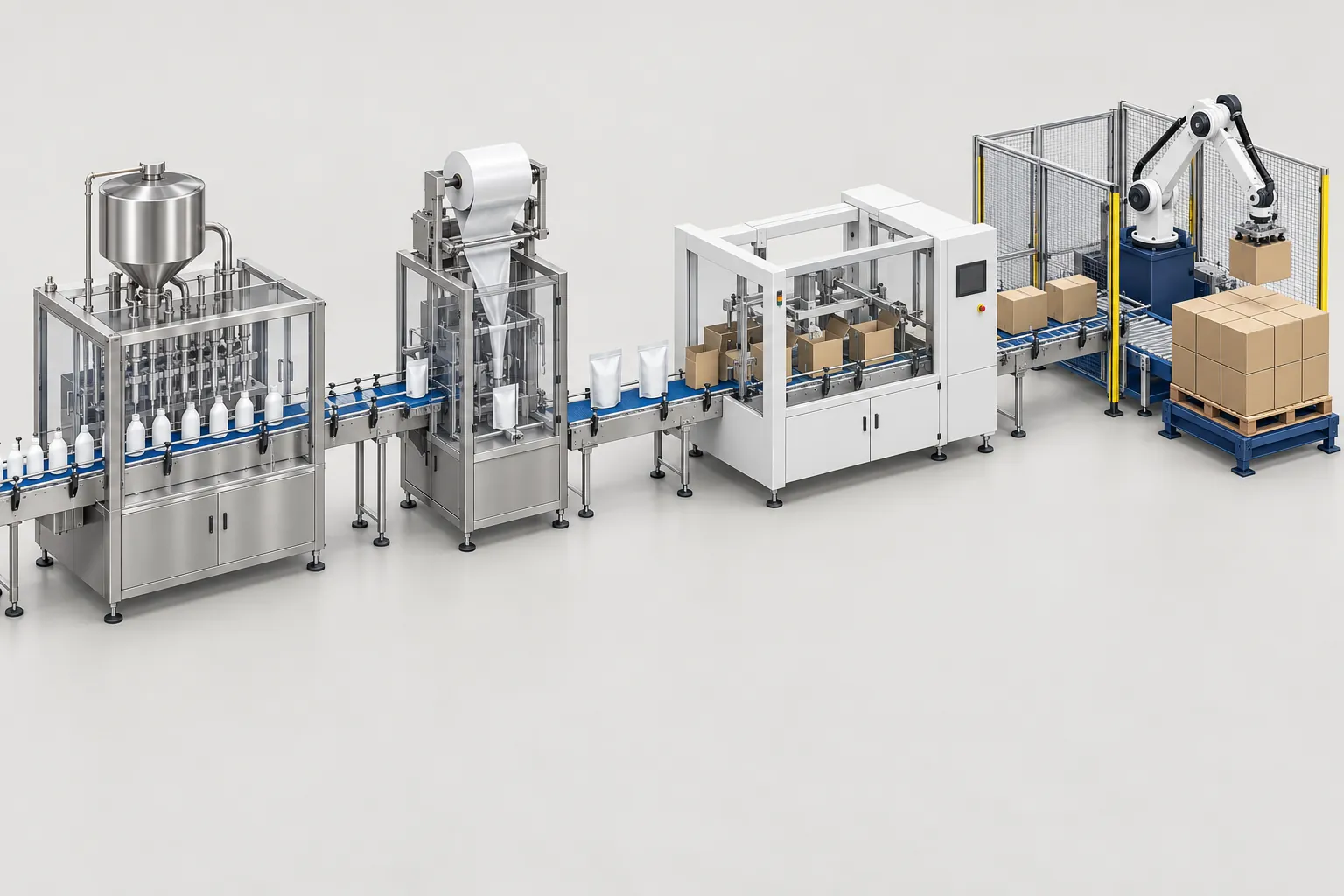
Buying a machine by name without listing its tasks can leave filling, sealing or an interface outside the quoted scope. Sort candidate equipment by the process step it performs, then use the matching guide to check product and pack requirements.
Swipe sideways to see the other columns. The first column stays visible.
| Task | Candidate equipment | Next guide |
|---|---|---|
| Present product | Feeder, orienter or buffer | Line interfaces |
| Dose / fill | Auger, weigher, piston or pump | Dry dosing / liquid filling |
| Form / close pack | VFFS, premade pouch, flow wrapper or related route | Pouch routes |
| Code / inspect | Coder, checkweigher, detector or camera | Inspection jobs |
| Group retail packs | Cartoner, multipacker or overwrapper | Wrap formats |
| Build shipping unit | Case packer, sealer, palletizer or wrapper | Cartoning and case packing |
For products presented in individual pockets, the blister packaging machine guide compares forming routes, manual and automatic work, and the scope to specify in a supplier quotation.
How a packaging line is organized
Packaging lines are usually described in three levels. Primary packaging is the pack that touches the product, such as a pouch, bottle, tray or wrapper. Secondary packaging groups primary packs, for example a carton holding several pouches or a multipack film around cans. Tertiary packaging, also called end of line, protects goods in storage and transport: shipping cases, pallets and stretch wrap.
Figure 1 shows these three bands and the machine types that usually sit in each. Read it as a map, not a layout. A real line may skip a band, repeat one, or place a step in a different order.
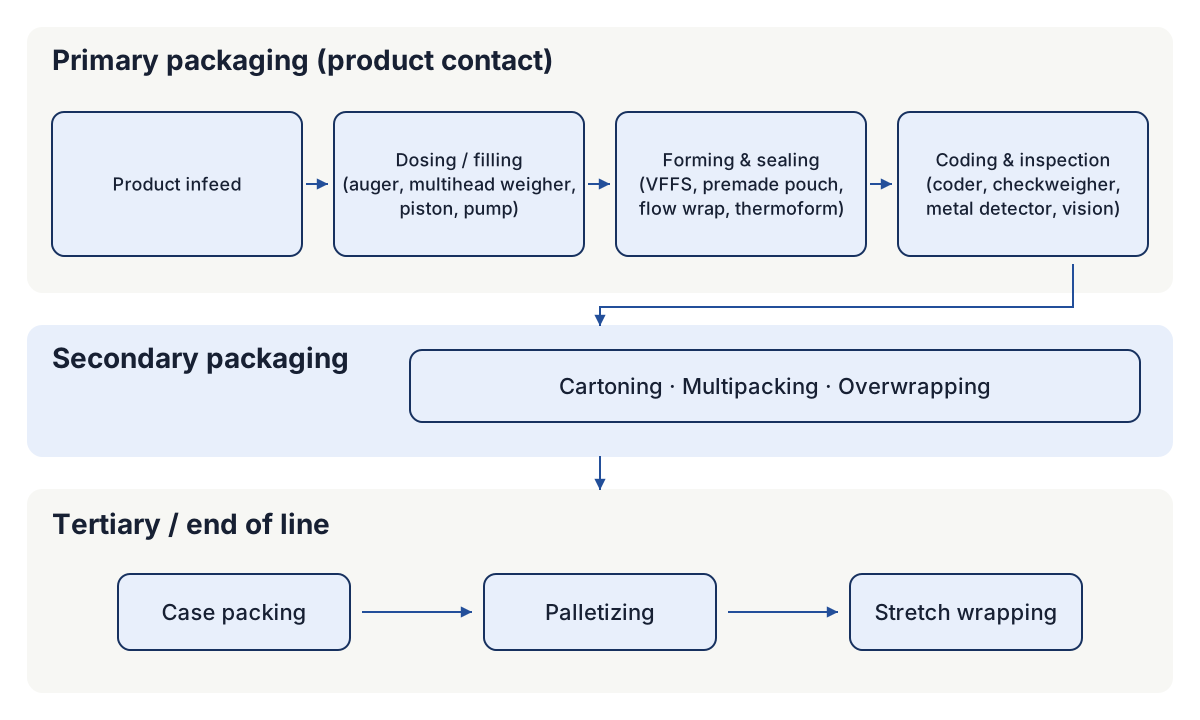
Each machine on the map has one main task, and most buying mistakes come from mixing up tasks. A filler puts product into a container but does not make the container. A form-fill-seal machine makes the pack and fills it, so it covers two or three tasks at once. A checkweigher confirms weight but does not correct the filling. Keeping the task separate from the machine name shows what a quote actually includes.
What each machine does
The sections below follow the order of the line. The comparison guides linked in each section go further into the choices within one step.
Product infeed and preparation
Product has to reach the packaging machine in a form it can accept. For loose products that means feeders, elevators, vibratory conveyors or buffer hoppers. For discrete items such as bars, bottles or cartons it means orienting, spacing and sometimes grouping them. This step gets little attention and causes many stoppages, because the packaging machine can only run at the rate and consistency of what reaches it.
Next step: Define the incoming form, rate and stop response.
Dosing and filling
Dosing machines control how much product goes into each pack. Four families cover most requests.
- Auger fillers meter powders and some granular products by volume, using screw revolutions.
- Multihead weighers weigh several portions in separate hoppers and pick the combination of hopper contents closest to the target weight. They are common for snacks, confectionery, frozen items and other free-flowing or irregular pieces.
- Piston fillers draw in and discharge a set volume per stroke and suit many liquids, creams and pastes.
- Pump fillers use gear, lobe, peristaltic or other pumps, with fill volume set by revolutions, a flow meter or time.
Two of these choices have their own guides: auger fillers compared with multihead weighers and piston fillers compared with pump fillers.
Next step: List dosing and sealing as separate scope items.
Forming and sealing
This step creates or closes the pack. The main types are:
- Vertical form-fill-seal (VFFS) machines pull film from a roll, shape it into a tube around a forming shoulder, seal it and fill it from above. The result is typically a pillow or gusseted bag.
- Premade pouch machines take empty, finished pouches from a magazine, open them, fill them and seal the top. Stand-up and zipper pouches are typical.
- Flow wrappers form a tube of film around a product moving horizontally, then seal a fin along the back and crimp the ends. Flow wrapping and overwrapping differ in structure and materials.
- Thermoform machines heat a film web, form a cavity, fill it and seal a lidding film over it.
- Other options include sachet and stick pack machines, bottle capping and sealing lines, and tube fillers. An induction foil liner under a cap is set from the head gap and the torque row, in induction cap sealing. VFFS compared with premade pouch machines covers the choice between pouch routes, and stick packs compared with sachets covers single-serve formats.
Next step: Choose the pack route before asking for format parts.
Coding and inspection
Coders print or mark dates, lot codes and sometimes barcodes. Inspection equipment checks the result. Checkweighers verify package weight, metal detectors look for metal contaminants, and vision systems check labels, codes, closures or fill level. Each check needs a reject mechanism and a way to confirm that rejected packs really leave the line. Checkweighers compared with metal detectors explains the difference between two common inspection tasks.
Next step: Write down each required check and its reject response.
Secondary packaging
Cartoners erect or take cartons, load primary packs into them and close them. Multipackers group packs under film or in trays. Overwrappers apply a folded outer film. Which of these appears depends on the retail format, the shelf or e-commerce requirement and what regulations or customers expect in the target market.
Next step: Confirm the retail grouping and the primary-pack presentation.
Tertiary and end of line
Case packers load packs or cartons into shipping cases by top-load, side-load, wrap-around or robotic pick-and-place methods. Case sealers close the case with tape or adhesive. Palletizers stack cases into a load pattern, and stretch wrappers secure the pallet. Pallet stacking patterns compared explains how column and interlocked patterns differ in strength, stability and forming effort. Cartoners compared with case packers covers the difference between cartoning and case packing.
Next step: Carry the case and pallet requirements into the interface specification.
Process steps, machine types and first questions
The table collects the sections above in one place. The final column is the question that most often changes the scope of a quote, not a complete specification.
Swipe sideways to see the other columns. The first column stays visible.
| Process step | Machine types | Typical product/pack formats | First question for the buyer |
|---|---|---|---|
| Product infeed and preparation | Feeders, elevators, vibratory or belt conveyors, buffer hoppers, orienting and spacing devices | Loose bulk product, discrete items, bottles, cartons | In what form and at what rate does product arrive, and what happens when upstream stops? |
| Dosing and filling | Auger filler, multihead weigher, piston filler, pump filler, linear or combination weigher | Powders, granules, snacks, liquids, creams, pastes | Is the product dosed by volume or by weight, and how consistent is its bulk density or viscosity? |
| Forming and sealing | VFFS, premade pouch machine, flow wrapper, thermoform fill-seal, sachet and stick pack machine | Pillow bags, gusseted bags, stand-up pouches, trays, stick packs, sachets | Which pack styles must run today, and which might be added later? |
| Coding and inspection | Inkjet, thermal transfer or laser coder; checkweigher; metal detector; vision system | Printed dates and lot codes, weight checks, contaminant checks, label and seal checks | Which checks are required by customers, regulations or internal risk analysis, and what happens to a rejected pack? |
| Secondary packaging | Cartoner, multipacker, overwrapper, tray packer | Cartons, multipacks, trays, overwrapped boxes | What retail or club format is needed, and how does the primary pack arrive at the cartoner? |
| Tertiary and end of line | Case packer, case sealer, palletizer, stretch wrapper | Shipping cases, trays, full pallets | What case sizes, pallet patterns and customer pallet rules apply? |
What counts as a flexible packaging machine?
“Flexible packaging machine” is used in two senses, and quotes sometimes mix them.
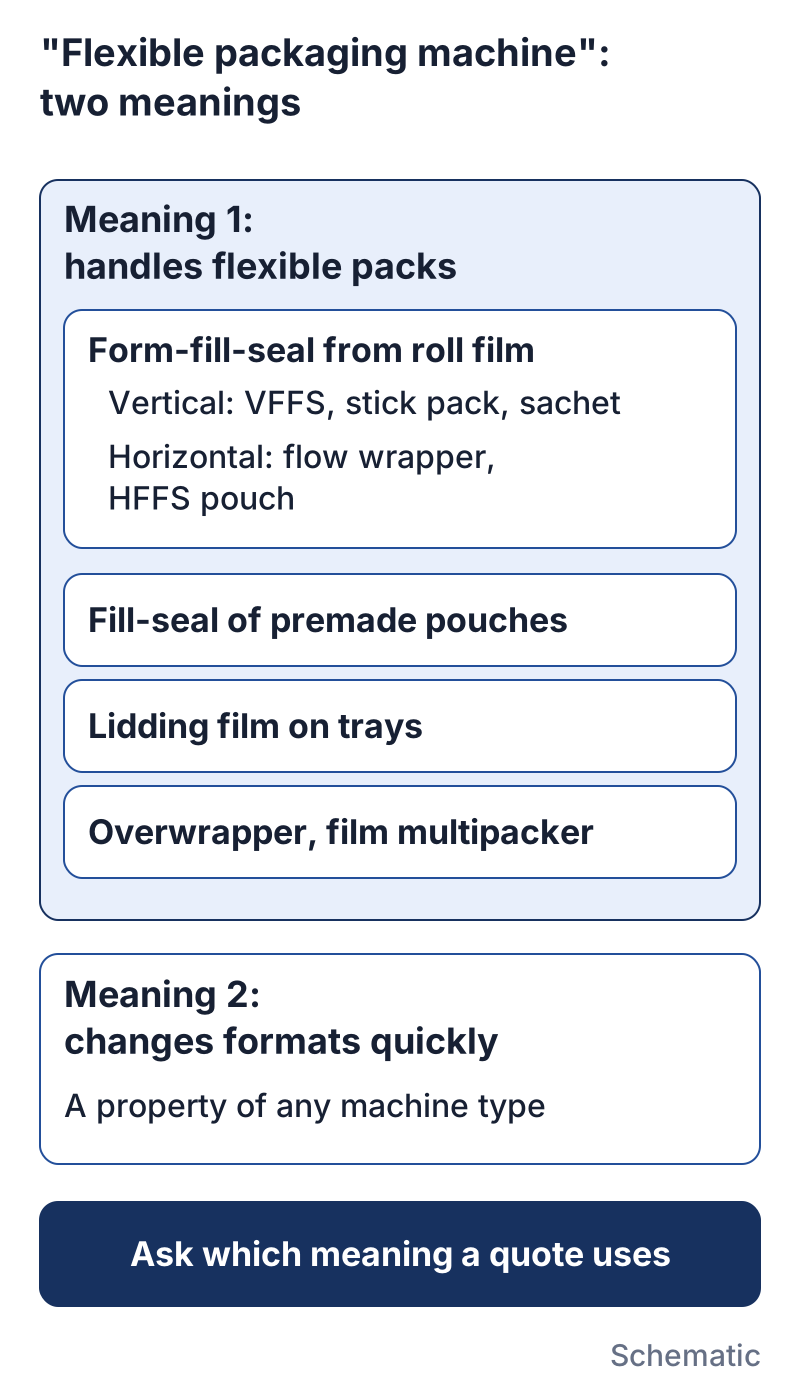
The first and more precise sense is a machine that makes, fills or closes flexible packages. The Flexible Packaging Association, the US trade association for the flexible packaging industry, defines a flexible package as one made of flexible or easily yielding materials that, when filled or closed, can be readily changed in shape. It lists paper, plastic film and foil, in any combination, as the materials, and bags, film, lidding, liners, overwraps, pouches, rollstock, sleeves and wraps as the typical shapes. On the line map above, the machines that handle such packs sit mainly in the forming and sealing step, with some in secondary packaging:
- Machines that form the pack from roll film, then fill and seal it: VFFS machines, flow wrappers, and sachet and stick pack machines.
- Machines that fill and seal premade flexible pouches.
- Machines that seal lidding film onto thermoformed or preformed trays.
- Secondary machines that apply film, such as overwrappers and film multipackers.
For the forming and filling subset, the scope of EN 415-3:2021 groups flow wrapping, vertical and horizontal sachet form-fill-seal, and thermoform-fill-seal machines separately from machines that erect, fill and seal premade bags. It also covers cup/tub and sack fill-and-seal machines, so its scope is wider than flexible pouches alone. That split is useful when reading quotes. A form-fill-seal machine depends on how roll film runs through it; a fill-seal machine depends on how consistently the premade pouches or containers are supplied. The film and machine compatibility guide explains the film side.
The second sense is format flexibility: a machine that can change quickly between products, sizes or pack styles. That is a property any machine type can have, not a machine family. The packaging automation section explains the difference between programmable and flexible automation. When a quote calls a machine “flexible”, ask which sense is meant: the pack material, or the range of formats and the time and parts needed to change between them.
Horizontal and vertical packaging machines
Orientation describes how the product and the pack travel through forming and sealing. It changes which products a machine suits, so it is worth settling before comparing quotes.
Swipe sideways to see the other columns. The first column stays visible.
| Orientation | How the product enters the pack | Typical products | Typical packs | First check |
|---|---|---|---|---|
| Vertical | Product is dosed from above and falls by gravity into a film tube formed around a forming shoulder (VFFS) | Free-flowing powders, granules, snacks and pieces | Pillow and gusseted bags, stick packs, sachets | Does the product flow and dose consistently from above? |
| Horizontal | Product travels on a conveyor and film is wrapped around it (flow wrapper); some horizontal form-fill-seal machines make pouches from film running horizontally and fill them from above | Discrete items such as bars, baked goods and trays, or pouch formats | Flow-wrapped packs, horizontal-form pouches and sachets | Does the product arrive in a stable, evenly spaced line? |
Premade pouch machines are a third route: they open, fill and seal pouches that were made elsewhere, so the pouch supply rather than film forming sets their limits. The VFFS and premade pouch comparison covers that choice, and the flow wrapping and overwrapping guide covers the main horizontal formats.
Automated, semi-automatic and industrial machines
Two other labels describe a machine’s degree of automation or duty rather than its job. An automated packaging machine performs its cycle without an operator handling each pack; a semi-automatic machine needs an operator for a step such as placing a container or starting each cycle. “Industrial packaging machine” is used loosely, sometimes for any production machine and sometimes for bulk and transport packaging such as large bags, drums or pallet loads. Neither label names a step on the line, so map the machine back to the process table above before comparing quotes.
Combined machines or separate machines
Filling does not imply sealing is included. Ask for the operation list: a standalone filler may deliver to a separate closure machine, while an integrated fill-and-seal system includes a defined closure step. For a semi-automatic proposal, record every manual task, such as presenting containers, loading product, starting cycles, replenishing materials and collecting packs; the exact list comes from its operating sequence.
Some machines cover several steps. A VFFS machine forms, fills and seals. A thermoform fill-seal machine does the same for trays. Some systems also include the dosing unit, a coder and a reject station. Separate machines connected by conveyors give the same sequence with more flexibility.
Combined machines usually suit situations where:
- the pack format is stable and the product is well matched to the machine’s fill method;
- floor space is limited;
- one supplier can take responsibility for the combined result, including how the dosing and forming steps interact.
Separate machines usually suit situations where:
- several products or pack formats must share part of the line;
- one step is likely to be replaced or upgraded before the others;
- the plant wants to buffer between steps so a stop at one machine does not stop everything.
A combined machine has fewer interfaces to engineer, but a fault in one section may stop the whole unit. A line of separate machines has more interfaces but allows buffering, bypassing and staged investment. The line integration checklist covers those interfaces in detail.
One product, several routes
A buyer who asks for “a machine for granola” will usually hear more than one proposal. Dry snack products can go into a pillow bag from a VFFS machine, a stand-up pouch from a premade pouch machine, a carton from a cartoner, or a tub or tray on a different line. Each route differs in cost structure, pack appearance, speed, material supply and changeover effort.
So the first step in specifying equipment is to describe the product and the sales requirement, not the machine. Useful starting points are:
- the product’s physical form, flow behavior, fragility and any dust or stickiness;
- the target pack style and the retail or customer requirement behind it;
- the pack size range and how many formats must run;
- the output required per shift, and the unit it is expressed in (packs per minute, kilograms per hour, cases per day);
- the shelf life and barrier requirements that affect film or container choice.
With that information, two or three candidate routes can be compared on the same basis. The RFQ checklist lists what to put in the request so that suppliers quote against the same description.
Note. Machine names are not standardized. “Pouch packer”, “bagger” and “form-fill-seal” can overlap, and a “filler” may or may not include a sealing step. When comparing quotes, check the list of steps each quote covers instead of relying on the machine name.
Questions to ask suppliers
Whatever the machine type, a supplier should be able to answer or provide the following, and the answers are worth comparing across quotes.
- Which steps the machine performs and which it expects from upstream or downstream equipment.
- The rated speed in the same unit you will use to plan production, and the product, pack size and conditions to which that rating applies.
- The pack formats the machine can run, and which parts or settings change between them.
- What product, film or container samples the supplier needs to confirm the machine suits your product, and whether they offer trials.
- The utilities and interfaces required: power, compressed air, water, vacuum, signals and communication.
- How the machine behaves when upstream product stops or downstream is blocked, and how it reports that to the line control. Industry guidance such as PackML is often used for machine states and tags, so ask whether and how the machine supports it.
- The safeguarding approach, applicable safety standards for the target market, and the documentation that comes with the machine.
- Cleaning access and, where relevant, hygienic design and washdown rating.
- Recommended spares and expected consumables, such as sealing elements, knives and filters.
Pre-quote checklist
Use this list to check that the information going to suppliers is complete enough to be comparable.
- The product is described by physical form, flow behavior and any hazards, with samples available.
- The target pack styles and sizes are listed, with drawings or sample packs.
- The required output is stated with its unit, shift pattern and expected efficiency.
- The steps expected from each supplier are listed, including inspection and coding.
- Upstream and downstream equipment is identified, with interface details and heights.
- Available floor space, utilities and ceiling height are noted.
- Packaging materials are identified, with specification sheets or sample reels or pouches.
- Regulatory and customer requirements for the target market are known.
- Future formats or products that the machine should handle are listed separately from today’s needs.
Limits and on-site verification
This guide describes machine families in general terms. It cannot say which type suits a specific product, because that depends on product behavior, packaging material, required output and plant conditions. Machines within one type also differ widely in design, so the machine manual and the supplier’s specification are the reference for what a given model can do.
Check claims about speed, accuracy and format range with your real product and packaging material on the actual machine, either in a trial at the supplier’s site or during acceptance on your own. Relevant safety references include the general requirements for packaging machines in the EU and in the United States; which ones apply depends on the market and the product. Where a purchase has safety or regulatory implications, the safeguarding design needs a risk assessment following the method in ISO 12100 and review by qualified personnel. Cleaning, adjustment and maintenance belong to trained staff working under the plant’s own procedures, including energy isolation, which are outside the scope of this guide.
Related decisions
If your product could go into either a roll-stock bag or a premade pouch, continue with the VFFS and premade pouch comparison. If the packs are already formed and the question is how to carton and case them, go to cartoners and case packers. To turn a machine choice into a request that suppliers can answer, use the RFQ checklist.
Method and source review
Reviewed October 8, 2026: process-task links, flexible-packaging terminology and the public scope of EN 415-3:2021. DIN Media’s standards-body listing confirms that scope includes fill-and-seal machines and multihead weighers and excludes cartoners. The FPA definition remains attributed to the trade association’s archived source in References.
The previous historical plant-route paragraph was intended only to illustrate upstream/downstream order, not modern capacity. It has been removed because the cited trade-media report could not be rechecked against a primary record; the process map is an editorial schematic. No speed, output or accuracy is inferred from it.
References
- EN 415-10:2014 — Safety of packaging machines — Part 10: General requirements — CEN
- EN 415-3:2021 — Safety of packaging machines — Part 3: Form, fill and seal machines; fill and seal machines — CEN
- An Overview of the Flexible Packaging Industry (Flexible Packaging Association, archived June 2026) — Flexible Packaging Association
- ANSI/PMMI B155.1-2023 — Safety Requirements for Packaging and Processing Machinery — PMMI
- ISO 12100:2010 — Safety of machinery — General principles for design — Risk assessment and risk reduction — ISO
- PackML (Packaging Machine Language) - OMAC — OMAC (Organization for Machine Automation and Control)
Update history
- : First published.
- : Added a six-task reading route, a vertical process map and scope answers, reconciled the prior update history, and removed an unverified historical example.
- : Added contextual links to the blister-machine selection guide and pallet-stacking comparison. This records the October 7 revisions present in the page; their links and source context were rechecked on October 8.
- : Added sections on what counts as a flexible packaging machine, horizontal and vertical machines, and automated, semi-automatic and industrial labels.
Next steps
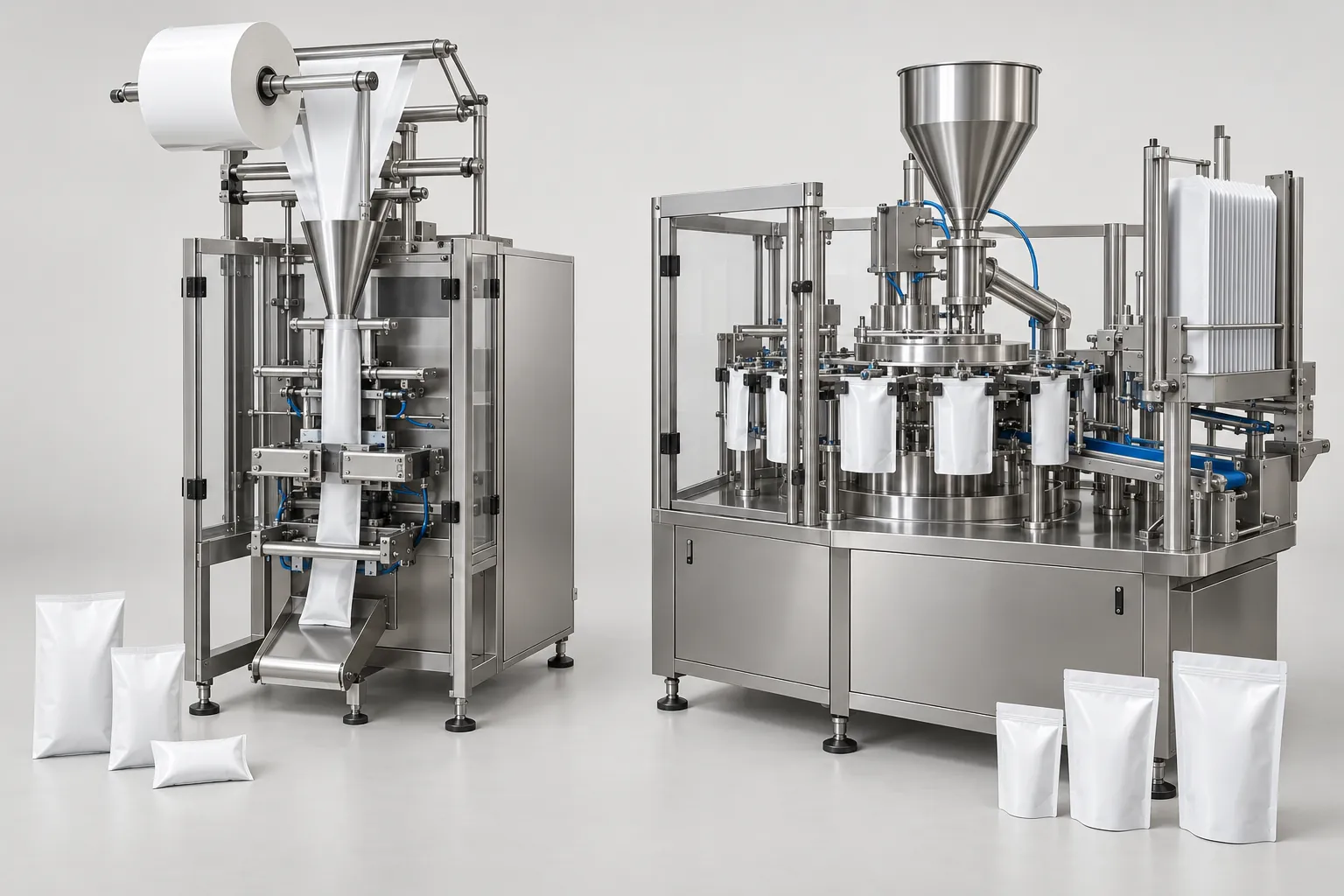
VFFS vs. Premade Pouch Machines: How to Choose
Compare VFFS and premade pouch machines by bag style, product, changeover, film or pouch supply, appearance, footprint and staffing, with questions for suppliers.
Read guide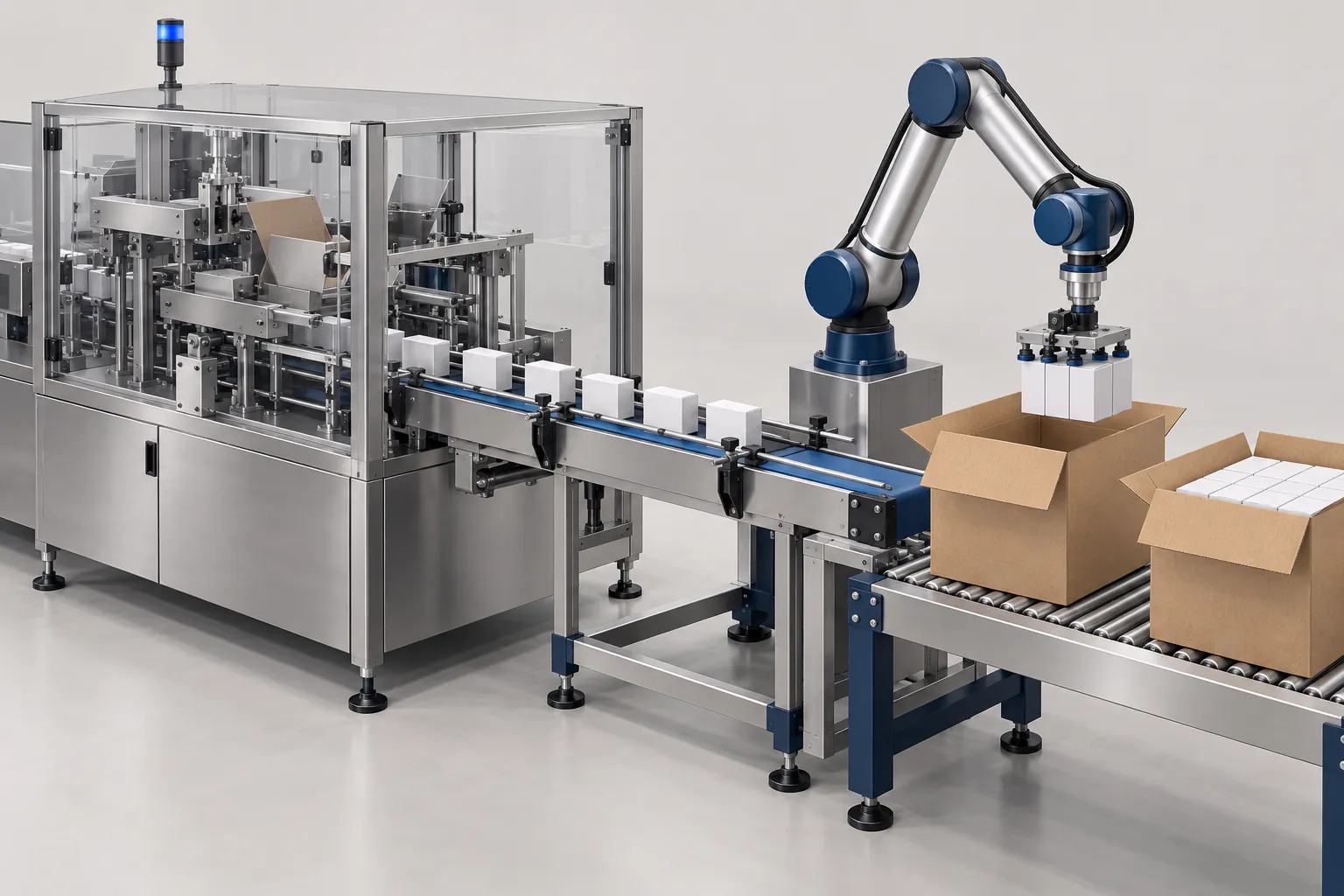
Cartoners vs. Case Packers: Where Each Fits in a Packaging Line
Compare cartoners and case packers by packaging level, loading style, product orientation, counting and end-of-line interfaces, with questions for suppliers.
Read guide
Packaging Machine RFQ Checklist: Information Suppliers Need
A reusable blank RFQ template for packaging machines in nine sections, with the reason suppliers need each item and a list of commonly missed details.
Read guide