
Cartoners vs. Case Packers: Where Each Fits in a Packaging Line
Compare cartoners and case packers by packaging level, loading style, product orientation, counting and end-of-line interfaces, with questions for suppliers.
A cartoner puts one or more primary packs into a folded carton, which is secondary packaging for retail or handling. A case packer puts cartons or packs into a shipping case, which is tertiary packaging. Many lines need both, in that order. Which loading style suits you depends on how product arrives, how it is grouped and what the next machine expects.
Applies to: Covers cartoners (end load and top load, continuous and intermittent) and case packers (top load, side load, wrap-around and robotic pick-and-place) in the secondary and tertiary stages of a line. Does not cover palletizing detail, stretch wrapping or machine-specific settings.
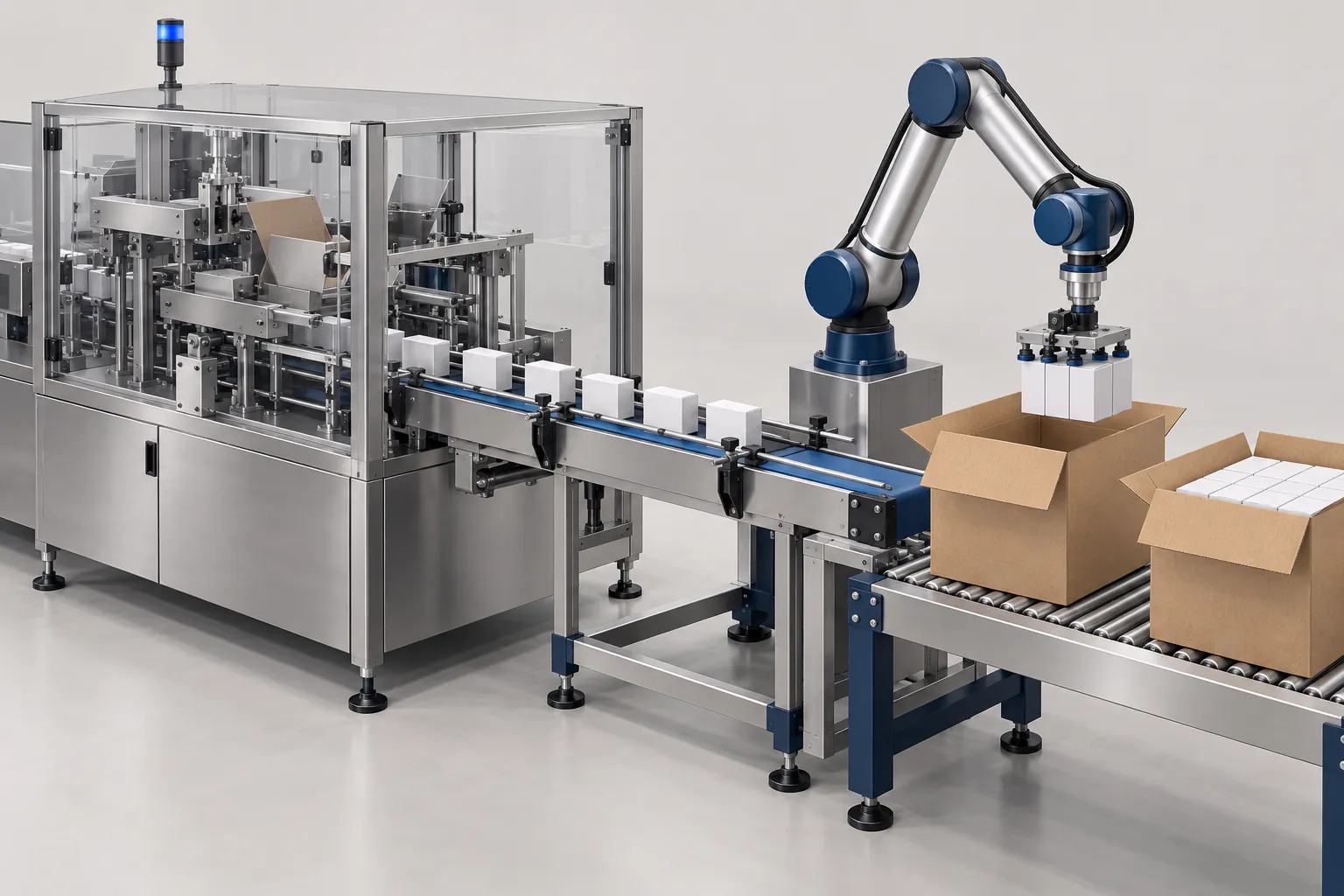
Confusing cartoning with case packing can specify the wrong container, count or downstream interface. A cartoner loads primary packs into cartons; a case packer loads packs or cartons into shipping cases.
Swipe sideways to see the other columns. The first column stays visible.
| Item | Cartoner | Case packer |
|---|---|---|
| Input | Primary packs and carton blanks | Packs/cartons and shipping-case material |
| Output | Loaded, closed carton | Loaded shipping case; closure scope to confirm |
| Purpose | Retail or intermediate grouping | Shipping and handling |
| Counting unit | Packs per carton; cartons/min | Packs/cartons per case; cases/min |
| Downstream interface | Case packing or another retail-pack step | Case closing, labeling and palletizing |
Compare the loading styles once the container and count are defined. This comparison explains public equipment principles rather than our own machine tests.
Packaging levels and where each machine sits
Packaging is commonly described in three levels. Primary packaging is the pack in direct contact with the product, such as a pouch, bottle, tray or sachet. Secondary packaging groups or protects primary packs, as a carton does around a pouch or bottle, or a multipack film wrap does. Tertiary packaging is the shipping and handling level: shipping cases, trays on pallets and the pallet unit itself.
A cartoner works at the secondary level and a case packer at the tertiary level. In a typical line, primary packs flow from the filling and sealing machines, a cartoner builds cartons around them, a case packer places the cartons into shipping cases, a case sealer closes the cases and a palletizer builds the pallet. A route may skip the carton when the primary pack and shipping-case design meet the product protection, handling and customer presentation requirements; verify that route with real packs. Other routes use shrink or tray packs instead of a case. The same product can follow several routes.
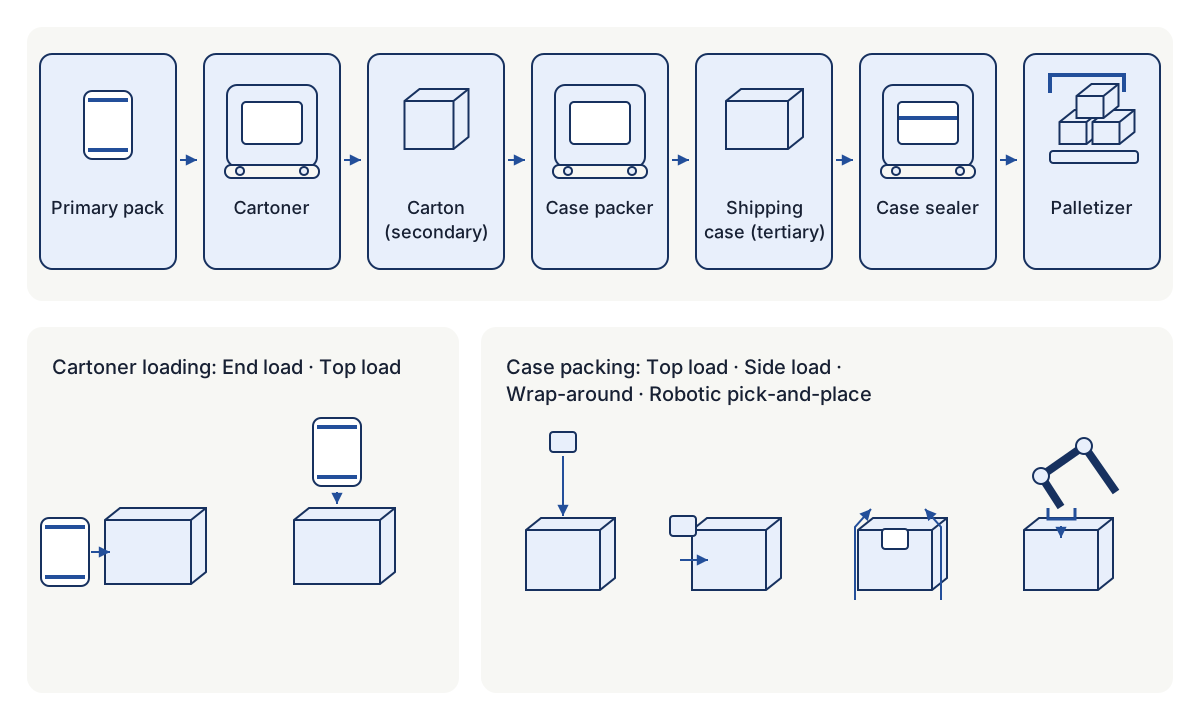
The overall line map, including the stages before the cartoner, is in our overview of packaging machine types.
What “carton packing machine” can mean
“Carton packing machine” is used for both machines on this page, so settle which one is meant before comparing quotes. In some usage a carton is a folding paperboard box that holds one retail unit or a small group, and the machine that fills it is a cartoner. In other usage, “carton” means the corrugated shipping box, and the machine that fills it is a case packer. Supplier listings under the same phrase can show either, and sometimes a case erector or a case sealer on its own.
Two questions sort it out. What is the container made of and who opens it: a printed folding carton that the consumer opens, or a corrugated case that goes to a warehouse or store? And what goes into it: individual primary packs, or cartons and packs that are already finished? The first answer points to a cartoner, the second to a case packer.
The safety references have changed scope between editions. EN 415-7:2006+A1:2008 covered group/secondary packaging machinery and excluded cartoners, referring them to the then-applicable Part 3. EN 415-3:2021 also excludes cartoners. The separately identified prEN 415-7:2022 draft is titled “Cartoning and case packing machines.” A draft is not a published requirement: confirm the final edition, its status and applicability with the standards body and qualified reviewer. The source review below identifies each document; none establishes compliance for a particular machine.
How a cartoner works
A cartoner takes flat, folded carton blanks from a magazine, erects them into open cartons, loads the product and closes the carton. Closing can be done by tucking flaps, gluing, or both, depending on the carton design. Leaflets or inserts can be added before closing, and coding or inspection can follow.
Two features define the machine: how product enters the carton and how the carton moves.
Loading styles for cartons
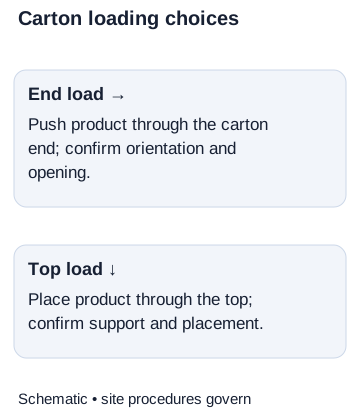
In an end-load cartoner, the carton is open at its short end and the product is pushed in horizontally, along the length of the carton. End loading is widely used for products that travel in a line, such as bottles, tubes, blister cards and pouches stacked or grouped for the carton.
In a top-load cartoner, the carton opens at the top and the product is lowered or dropped in from above, often with a pick-and-place or a vertical pusher. Top loading suits products or groups that are placed from above, or cartons that are wide and shallow.
Continuous and intermittent motion
An intermittent cartoner moves the carton in steps, with a stop at each station. A continuous cartoner moves the cartons steadily, and the loading mechanism travels with them. The motion type affects how the machine handles speed, product feed and mechanical load, and it changes how product must be presented. Ask the supplier how each design handles your product instead of assuming one type is faster.
How a case packer works
A case packer takes a case, usually corrugated board, either as a flat blank erected by a case erector or as a pre-formed case. It loads the cartons or packs into the case in the required pattern and passes the case to a case sealer, which closes it with tape or hot melt adhesive.
Loading styles for cases
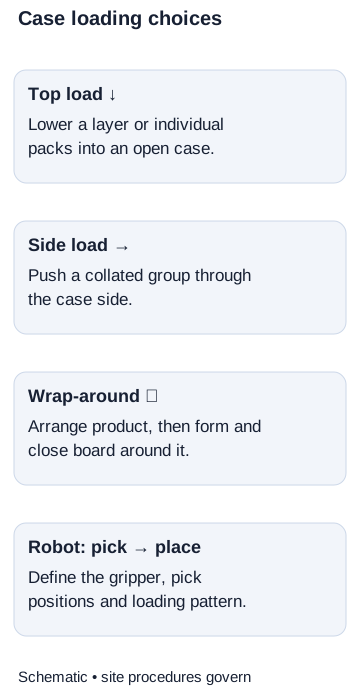
A top-load case packer lowers product into an open-top case, either as a whole layer or as individual items placed by a gripper.
A side-load case packer pushes product into the case from the side, with the case open at the side. It is used where product groups are pushed horizontally from a collating area.
A wrap-around packer folds a flat sheet of corrugated board around a group of products that has already been arranged, then glues or tapes it. There is no pre-erected case, because the case is formed around the product.
A robotic pick-and-place packer uses a robot to pick packs or cartons and place them in the case. It suits mixed formats, varied patterns or frequent format changes, because pattern and gripper settings are programmed. The gripper design and the pick positions still have to be defined for your products.
The units of an automated case packing system
A case packer rarely works alone. What suppliers sell as an automated box or case packing system is usually a chain of separate units, and each hand-off between them is an interface to specify:
- Case erector. Takes flat corrugated blanks from a magazine, opens them and closes the bottom flaps, with tape or hot melt adhesive depending on the design. Erectors exist as semi-automatic machines, where an operator presents the blank, and as fully automatic machines.
- Case packer. Loads cartons or packs into the open case in the required pattern, by top loading, side loading or robotic pick-and-place.
- Case sealer. Closes the top flaps with tape or hot melt adhesive. Taping machines range from manually adjusted to self-adjusting and fully automatic designs.
- Weighing, coding and labeling (where required). Some lines check the case weight, print a code or apply a shipping label after sealing. Whether you need these steps depends on your customers and your traceability requirements.
- Palletizer. Stacks sealed cases into a pallet pattern. Palletizing detail is outside this guide.
The separation is explicit in equipment manuals. The Eastey ERX-15 user guide, introduction, describes taking flat blanks from a magazine and delivering erected cases with the bottom taped and the top open for downstream filling and top sealing. The Eastey SB-2/3EX-Auto case-taper user guide, overview and operation sections, documents a separate machine with flap-closing guides, drive belts and tape heads. These manuals illustrate the erect–load–seal interfaces; they do not establish the loading pattern, throughput or optional equipment for your line. Packing between those machines may be manual or automated, depending on the specified system.
A wrap-around case packer combines several of these steps. It forms the case from a flat blank around a product group that has already been arranged, then glues or tapes it closed, so there is no separate case erector in front of it. EN 415-7 describes case erecting mechanisms and case closing devices as parts of a wraparound case packing machine, which matches this arrangement.
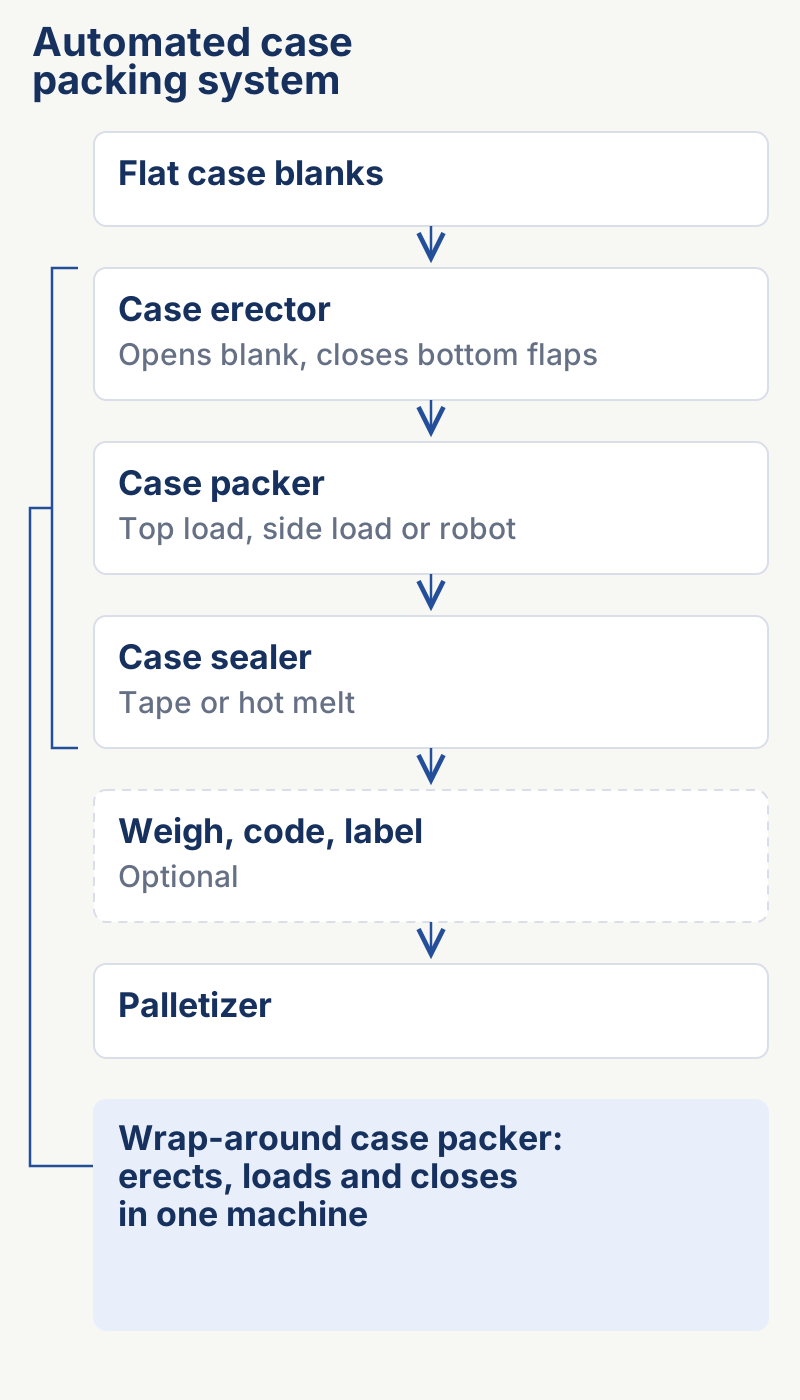
When you compare system quotes, list which of these units each quote includes, which are assumed to come from another supplier or the plant, and who owns the conveyors and signals between them. The packaging line integration checklist has a responsibility matrix you can use for that.
Small-volume and semi-automatic options
For a staged project, choose a defined step to automate while assigning the remaining manual loading, replenishment and recovery work. Future automated loading needs compatible pack presentation, transfer, controls and safeguarding; do not assume it can be added without redesign.
Searches for a small carton packing machine usually come from plants where full automation of every step is not justified yet. In those plants the useful question is which step to automate first, not which machine is smallest. Semi-automatic units are a recognized category: EN 415-7 lists semi-automatic case erectors and manually adjusted case taping machines alongside their fully automatic counterparts.
Conditions that point toward semi-automatic or partly manual options:
- Several formats with frequent changes. If case or carton sizes change often, a manual or semi-automatic step can be simpler to change over than a fully automatic machine. Ask each supplier for the changeover steps for your format list.
- One step ties up most of the labor. Case erecting and case taping are separate steps that can be mechanized while product is still placed by hand. Observe your own line before deciding; the step that limits output is not always the one that looks busiest.
- Output is set by the machines upstream. When the filler or bagger limits the line, a fully automatic case packer may wait for product most of the shift. The bottlenecks guide shows how to check which machine sets the pace.
- Space or staffing is limited. A semi-automatic unit needs an operator at the machine, so check that the station is ergonomic and that the staffing plan allows for it.
Conditions that point toward full automation are the reverse: few formats, long runs, a stable product group and a line where packing by hand cannot keep up with upstream output. For cartoning, ask the supplier whether a cartoner can be supplied with manual product loading and automatic erecting and closing, and what changes if you automate loading later. Price factors and what drives the cost of each option are covered in the total cost of ownership guide.
Conditional comparison of loading styles
Swipe sideways to see the other columns. The first column stays visible.
| Style | Machine | Suits when… | Points to check |
|---|---|---|---|
| End load | Cartoner | Product arrives in a line and can be pushed endwise into the carton; the carton has a suitable end opening | Product orientation on arrival, carton design, leaflet handling |
| Top load | Cartoner | Product or group is placed from above; the carton is wide or shallow; gentle placement is needed | Pick or drop method, carton stability, product fragility |
| Top load | Case packer | Product is arranged in a layer or placed individually from above into an open-top case | Layer pattern, gripper design, case stability |
| Side load | Case packer | Collated groups can be pushed horizontally; the case orientation fits the line | Group stability when pushed, case flap handling |
| Wrap-around | Case packer | Product is already arranged in a stable group; the case is formed around it; fewer case sizes preferred over erected cases | Group integrity during folding, board specification, glue or tape method |
| Robotic pick-and-place | Case packer | Several formats, patterns or frequent changeovers are expected; products can be gripped reliably | Gripper suitability, pick area, pattern programming, safeguarding of the cell |
The table is a starting point. Fit differs from product to product, and supplier information and trial results should confirm it.
Interfaces that decide the specification
Cartoners and case packers are rarely the hard part by themselves. The interfaces around them often decide whether the line works.
Upstream orientation, grouping and counting
A cartoner needs product in a known orientation, spacing and count. If primary packs arrive tumbled from a bagging machine, an orientation or collating step has to come first. The number of packs per carton must be counted accurately, and the counting method affects both the carton and the machine. A case packer needs cartons in a defined orientation, often grouped into a layer or row before loading. Collating and accumulation belong either to one of the machines or to a separate unit, and the quote should say which.
Machine-to-machine signals and buffering
Cartoners and case packers run only as fast as the machine before them supplies product, and only as fast as the machine after them takes it away. A buffer or accumulation conveyor between machines absorbs short stops and speed differences. Neighboring machines coordinate through signals such as ready, running, fault, full and empty. Our packaging line integration checklist covers mechanical, electrical, signal, communication, safety and utility interfaces.
Actuation and motion
Pushers, grippers, carton transfer and case handling can be driven by servo axes, pneumatic cylinders or a combination. The choice affects the changeover method, adjustment effort, noise, air consumption and how motion profiles are set. A comparison of servo and pneumatic actuation explains the trade-offs and is a useful reference when you ask a supplier how each axis is driven.
Downstream: case sealing and palletizing
A case leaving the case packer must be closed, which a case sealer typically does. The case then moves to a palletizer. Case size, weight and surface affect sealing and stacking. Product that rattles or shifts inside the case, or cases that are overfilled, can cause problems downstream. How the chosen pallet pattern affects case strength, load stability and the way the palletizer forms each layer is compared in the guide to pallet stacking patterns.
Where the constraint sits
Cartoning and case packing are often assumed to be the constraint of a line because they are large machines. In practice the constraint can be any machine, and it can shift with product and format. The bottlenecks guide shows how to read machine states (running, starved, blocked and down) to find the constraint before buying new equipment.
Questions to ask suppliers
Information to request or provide:
- Primary pack description with samples: dimensions, weight, shape, surface and stability.
- Carton drawing with board type, dimensions, closure method (tuck, glue) and any leaflet or insert.
- Case drawing with board type, dimensions, pattern (cartons per case and layout), flaps and closure method.
- The loading style proposed for each machine and the reason for it, with the product orientation expected at the infeed.
- Rated speed in cartons per minute or cases per minute, with the carton or case size, product and conditions it applies to. Ask whether the motion is continuous or intermittent and how that affects the rating.
- The counting, grouping and collating method, and whether it is part of the machine or a separate unit.
- Carton or case magazine capacity, how blanks are replenished, and whether replenishing needs a stop.
- Format change: which parts change, what is adjusted by hand or by servo, the expected steps, and whether the recipe sets positions automatically.
- Interface details: conveyor heights, transfer direction, signals, communication protocol and buffering requirements.
- Safety documents: risk assessment basis, guarding concept, and how robot cells or pick-and-place areas are safeguarded. Relevant references include EN 415-10 for general packaging machine safety (EU), ANSI/PMMI B155.1 (US) and IEC 60204-1 for electrical equipment of machines, depending on the market and product.
- Spare and wear part lists, including suction cups, grippers, belts and glue system parts.
A packaging machine RFQ checklist shows how to turn these into a quotable specification.
Assumed example. Consider a line that fills pouches into small cartons, packed 12 to a shipping case. The figures are placeholders for illustration, not measured or market data. If the cartoner is rated at “C cartons per minute”, the case packer must handle C divided by 12 cases per minute, plus any allowance for stops and format changes. If the case packer is a robotic cell, its capacity is set by the pick rate and the pattern, so the quote should state how many cartons one pick cycle handles. Express every machine rating in the same unit and compare it with the machines before and after it, then choose a loading style.
Scope and responsibility record
Copy the table for each proposal. Mark included, excluded or unresolved, then attach the drawing, signal list or acceptance evidence. Record pack counts, format/changeover requirements and the safety review separately in the same specification.
Swipe sideways to see the other columns. The first column stays visible.
| Equipment unit | Included / excluded | Responsible party | Interface evidence |
|---|---|---|---|
| Infeed / orientation / counting | ________ | ________ | Pack flow and count: ________ |
| Cartoner | ________ | ________ | Carton drawing / cartons/min: ________ |
| Case erecting / loading | ________ | ________ | Case pattern / cases/min: ________ |
| Case closing / coding / labeling | ________ | ________ | Closure and label checks: ________ |
| Conveyors / buffers / signals | ________ | ________ | Transfer and I/O list: ________ |
| Palletizing / safety integration | ________ | ________ | Layout / risk review: ________ |
Limits and on-site verification
This guide cannot select a machine for your line. These points need confirming on the actual machine with real materials:
- Board stiffness, coating, humidity and tolerances affect erecting, closing and sealing. Test with production cartons and cases from the real supplier.
- Orientation, stability and damage during pushing, picking or dropping can only be judged with real product.
- A rated speed is a nominal figure for stated conditions. Sustained output depends on stoppages, upstream supply and downstream capacity.
- Guarding, safeguarded zones and access during recovery on a robot cell depend on the cell layout and need a risk assessment.
- Marking, coding and traceability requirements vary by market and product.
Pushers, grippers, carton transfers and robot cells move with stored energy, and blank magazines and jam clearing put hands close to them. Isolate energy as the machine manual describes, and keep guards and interlocks in place when you clear a jam, replenish blanks or adjust parts. The guarding and the robot cell’s safeguarded zones should come from the site risk assessment under ISO 12100, reviewed by qualified personnel.
Related decisions
To see how these machines connect to the rest of a line, read the packaging machine types overview. For specifying the interfaces, continue with the line integration checklist, and for finding the real constraint, the guide to packaging line bottlenecks.
Method and source review
Reviewed October 8, 2026; these are scope references, not a declaration of conformity:
- SIST official preview of EN 415-7:2006+A1:2008, Scope §1, printed p. 8: historical group/secondary-machine coverage and cartoner exclusion.
- DIN Media entry for EN 415-3:2021, reproduced scope: cartoners excluded. The national listing is DIN EN 415-3:2025-03; the European version named in it is EN 415-3:2021.
- DIN Media, DIN EN 415-7:2022-09 draft: explicitly identifies prEN 415-7:2022 and its cartoning/case-packing title. This citation establishes the historical draft identity, not present-day regulatory status.
The Eastey manufacturer manuals cited above illustrate separate erecting and closing equipment. The responsibility table is an editorial aid; confirm the quoted scope and interfaces rather than treating a line diagram as a supply commitment.
References
- EN 415-10:2014 — Safety of packaging machines — Part 10: General requirements — CEN
- ANSI/PMMI B155.1-2023 — Safety Requirements for Packaging and Processing Machinery — PMMI
- ISO 12100:2010 — Safety of machinery — General principles for design — Risk assessment and risk reduction — ISO
- IEC 60204-1:2016+AMD1:2021 CSV — Safety of machinery — Electrical equipment of machines — Part 1: General requirements — IEC
Update history
- : First published.
- : Brought forward carton/case interfaces, distinguished historical standard scopes and draft status, separated loading diagrams, and added equipment responsibility fields.
- : Added what "carton packing machine" can mean, the units of an automated case packing system, and when semi-automatic or small-volume options fit.
Next steps
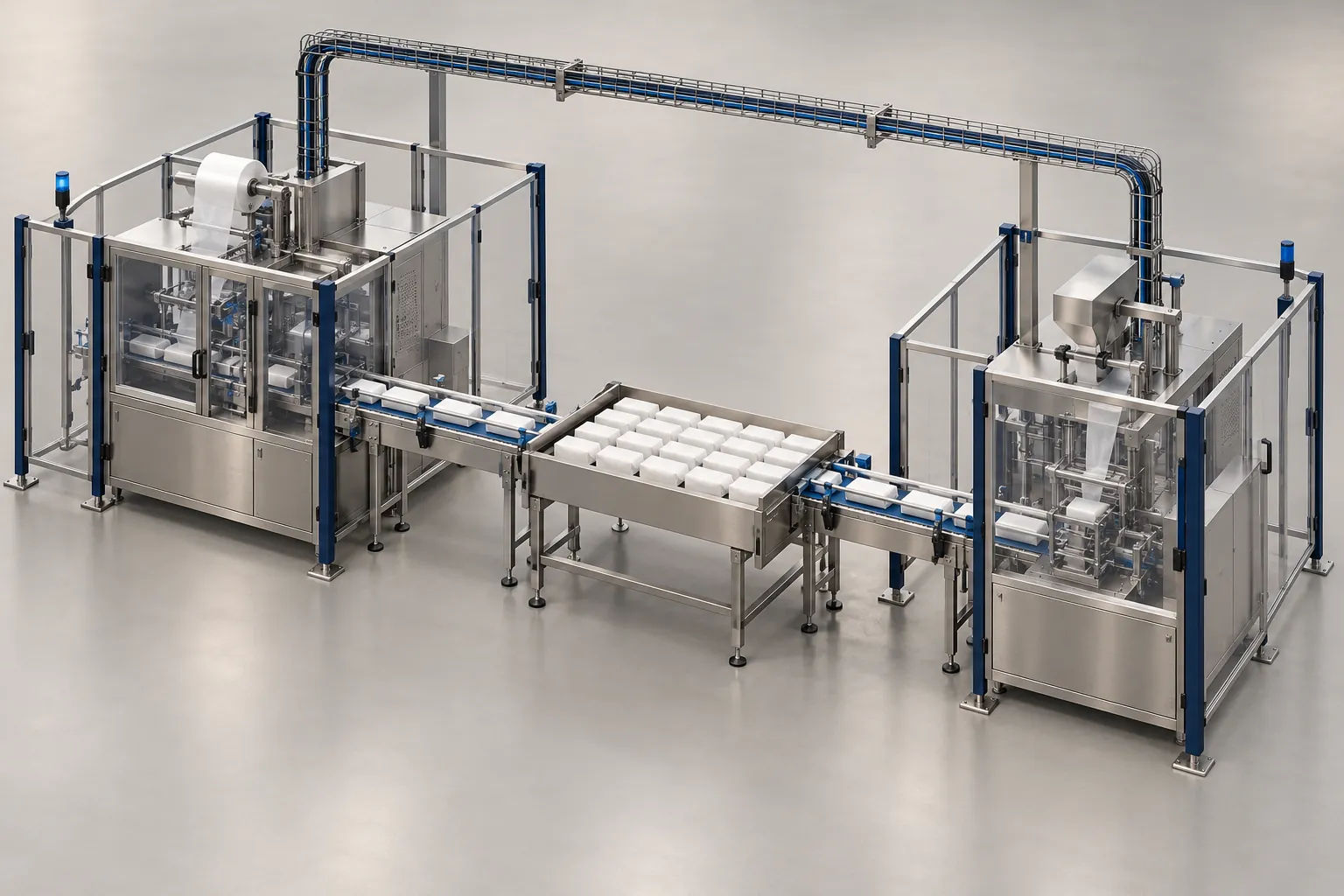
Packaging Line Integration Checklist: Interfaces to Confirm Before Ordering
Checklist of mechanical, electrical, signal, communication, safety and utility interfaces to settle before ordering a machine for a packaging line.
Read guide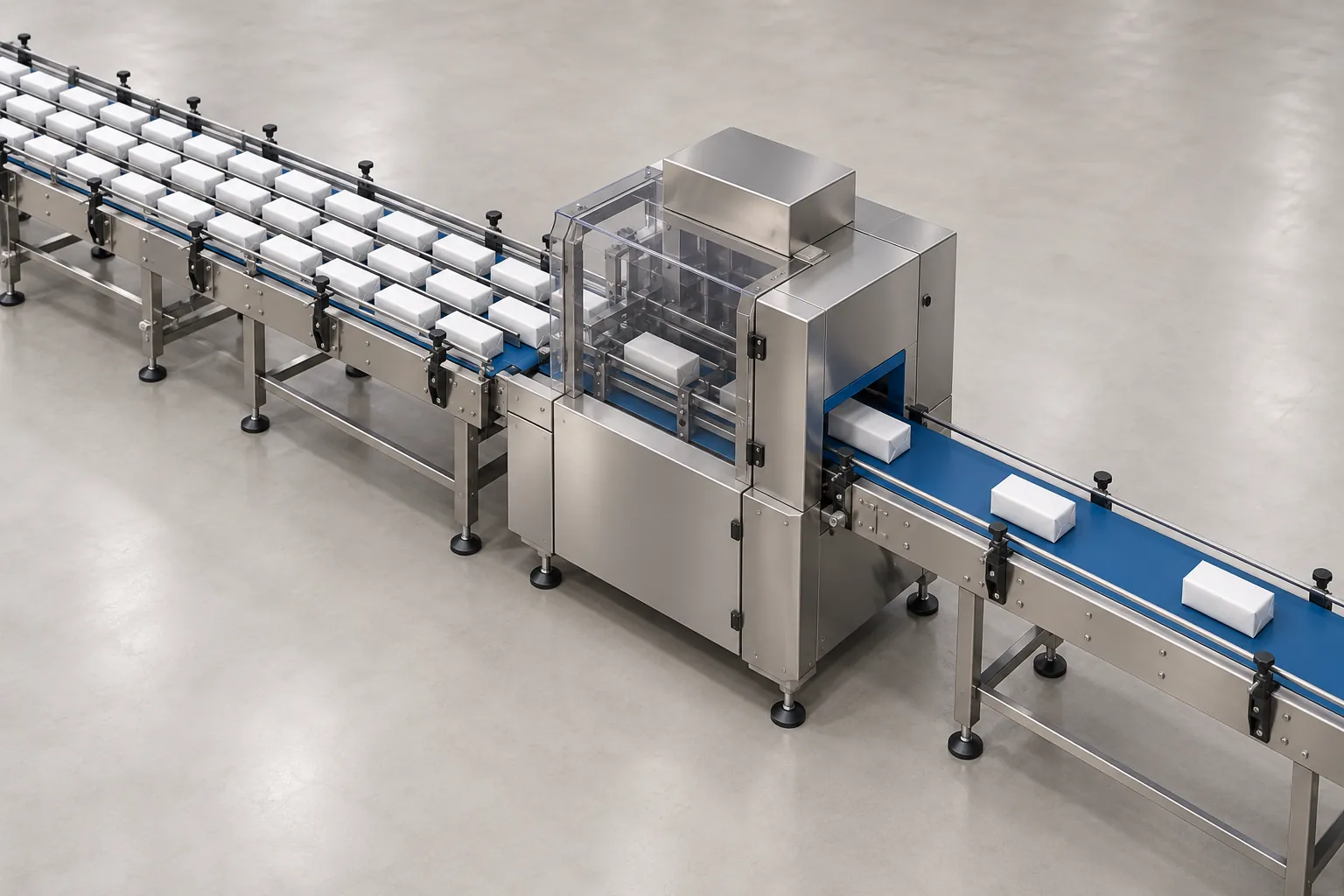
Finding Packaging Line Bottlenecks with Basic Production Data
Identify candidate packaging-line constraints using four analysis groups, measured good-pack counts and running rates, with a worked example and copyable shift log.
Read guide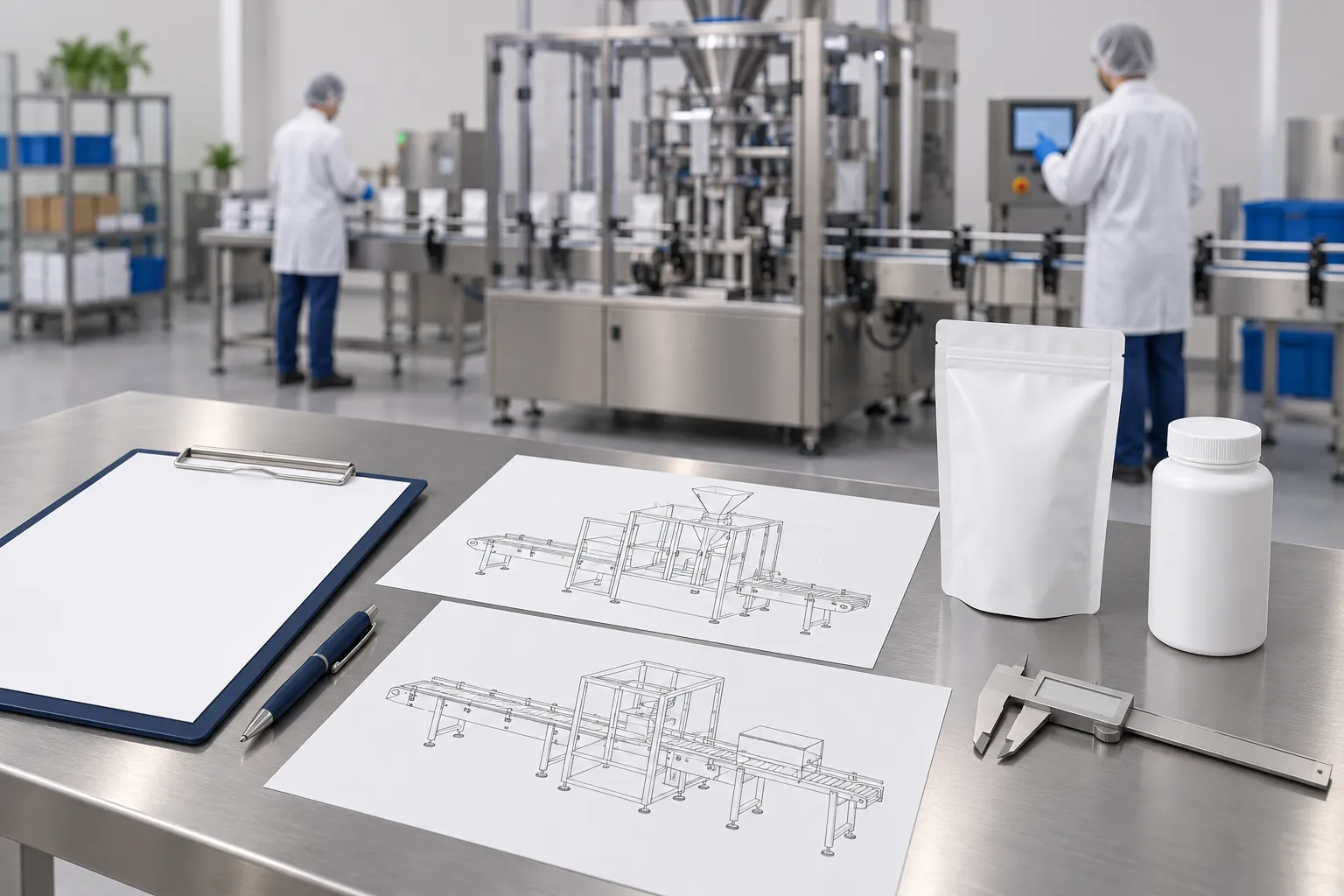
Packaging Machine RFQ Checklist: Information Suppliers Need
A reusable blank RFQ template for packaging machines in nine sections, with the reason suppliers need each item and a list of commonly missed details.
Read guide