
Servo vs. Pneumatic Actuation in Packaging Equipment
Compare servo and pneumatic axes in packaging machines by motion profile, load, changeover, maintenance, utilities and hygiene, plus supplier questions.
Servo axes suit motions that need programmable position, speed and torque profiles and parameter-based changeover. Ordinary open-loop pneumatic cylinders suit simple strokes between fixed ends; servo-pneumatic positioning is a separate configuration to evaluate. Many machines mix both, so the choice is usually made axis by axis.
Applies to: Covers linear and rotary actuation choices on packaging machines such as cartoners, case packers, pick-and-place units and sealing stations. It does not cover hydraulics, specific drive sizing or detailed energy calculations.
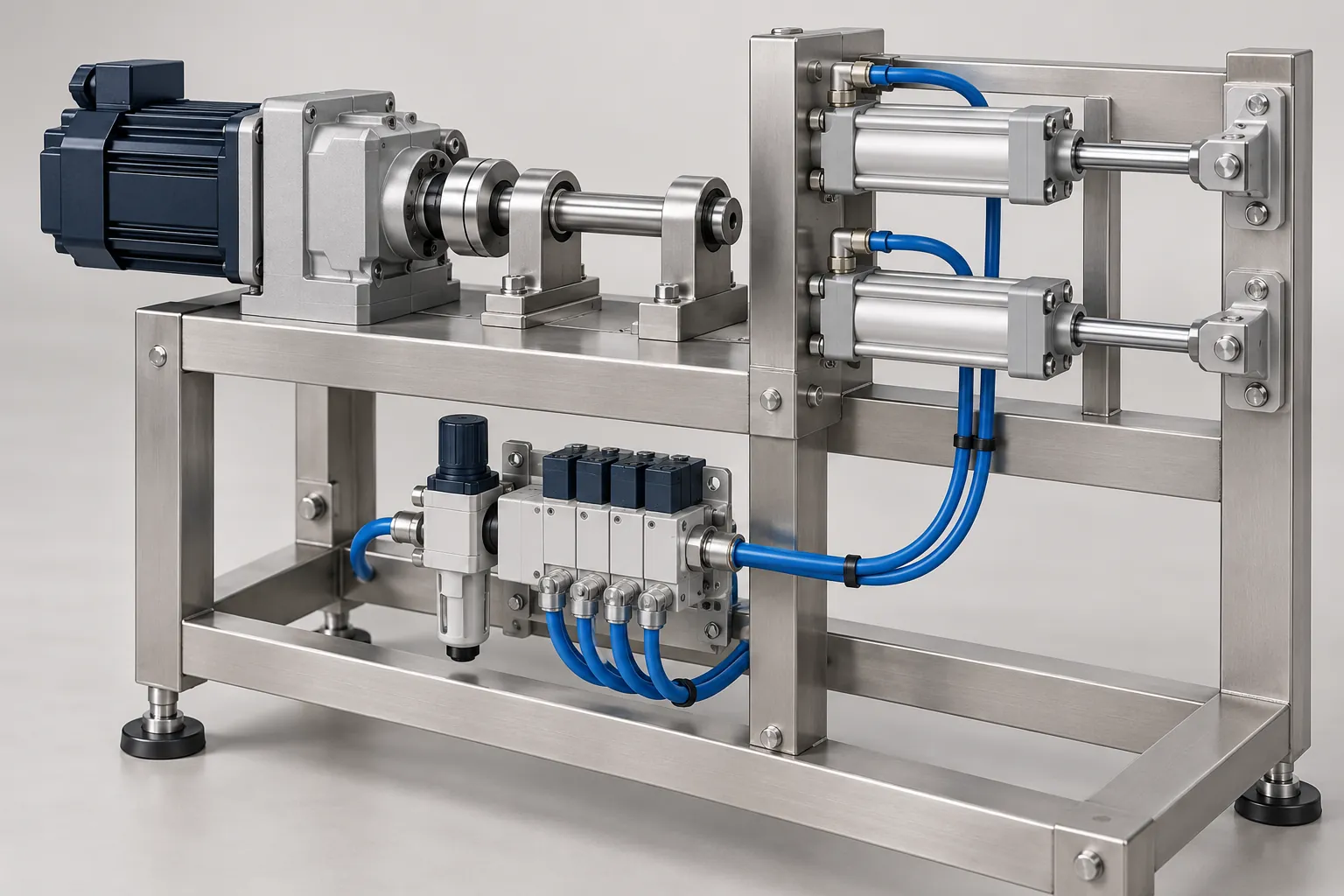
An axis chosen without its changeover and support needs can leave extra manual adjustments or an unsupported drive. Compare servo-electric axes with ordinary open-loop pneumatic cylinders axis by axis: use the required motion and positions, available utilities and maintenance capability as the conditions. This is an editorial comparison from public documentation, not our machine testing.
Swipe sideways to see the other columns. The first column stays visible.
| Condition | Servo-electric scope to review | Ordinary cylinder scope to review |
|---|---|---|
| Motion curve | Programmed profile and synchronization | Stroke, flow adjustment and cushioning |
| Position changes | Recipe positions and verification | Fixed ends and manual stop adjustment |
| Energy supply | Electrical supply and panel cooling | Air pressure, flow and quality |
| Maintenance | Drive tools, skills and parameter backups | Valves, seals, tubing and leak checks |
How each type produces motion
A servo axis is a closed loop. A drive supplies controlled electrical power to a servo motor, and an encoder reports position back to the drive. The controller compares the commanded position with the measured one and corrects continuously. A gearbox or mechanism, such as a belt, screw, cam or linkage, converts the motor motion to the movement the machine needs.
The pneumatic comparison here is an ordinary open-loop cylinder arrangement, not every air-powered actuator. A valve directs compressed air into a cylinder, the piston moves, and the stroke ends at a mechanical stop or a cushion. Sensors at the end of stroke confirm arrival. Flow controls throttle the air to set speed.
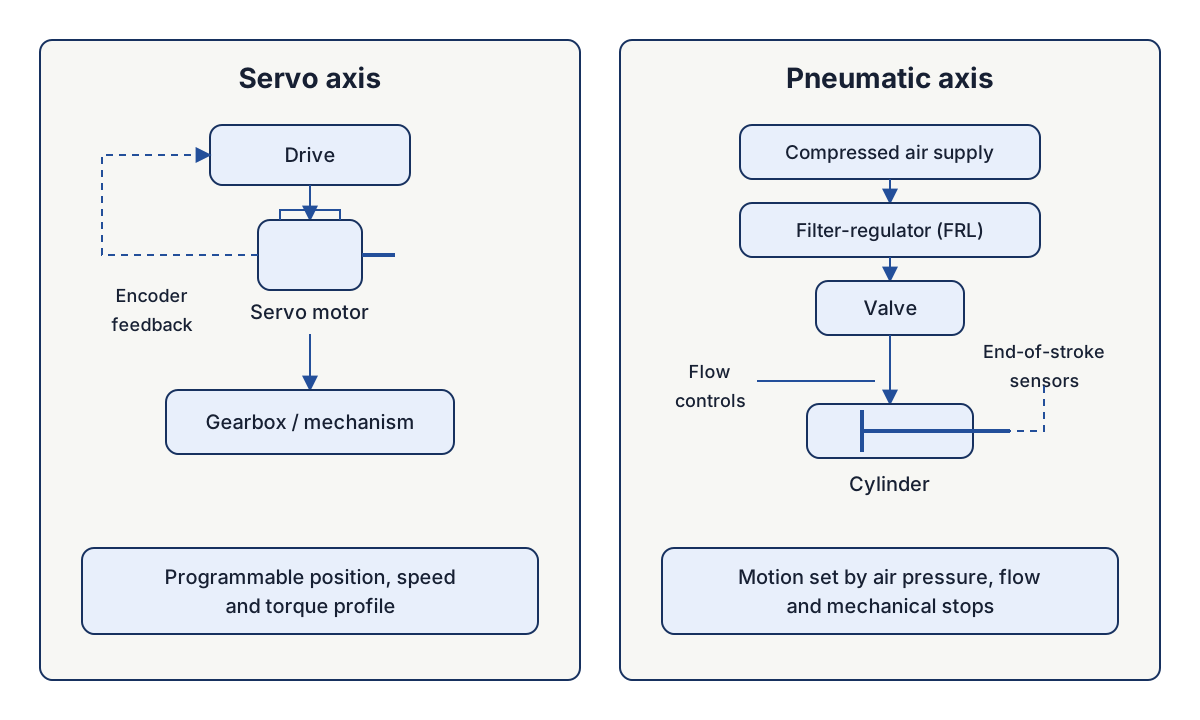
Manufacturer public documentation describes servo feedback returning position and velocity to the drive, and ordinary cylinder speed adjustment through flow controls. Festo also documents servo-pneumatic systems using a displacement encoder, proportional valve and position controller. Those closed-loop air systems are outside this ordinary-cylinder comparison; do not exclude them merely because they use air. Sources are listed below.
Takeaway: Identify whether the quoted pneumatic axis is open-loop or a positioning system.
Conditional comparison
The table lists conditions, not winners. Each row asks which option suits a situation, and your own machine will probably fall on one side for some rows and on the other side for others.
Swipe sideways to see the other columns. The first column stays visible.
| Consideration | Servo suits when… | Pneumatic suits when… |
|---|---|---|
| Motion profile | The motion needs controlled acceleration, a specific speed curve or coordination with other axes | The motion is a simple stroke between two fixed end positions |
| Positioning | Several stop positions or variable stroke lengths are needed | Fixed end positions are enough |
| Load and force | Loads vary or force must be controlled over the stroke | Force is needed mainly at the end of stroke and loads are steady |
| Cycle rate | The axis follows a continuous or indexing motion at the rated speed | The stroke is short and the cycle is within what valves and tubing can serve |
| Format changeover | Positions can be changed by recipe parameters | Positions are changed by moving mechanical stops or hand adjustments |
| Maintenance | The site has staff or service access for drives, motors and parameter backups | The site is comfortable with valves, seals and tubing as wear items |
| Utilities | Electrical supply is easier to provide than clean compressed air | Compressed air is already available and well maintained |
| Hygiene and washdown | Sealed motors and cabling suit the washdown regime | Air-powered parts avoid electrical devices in the wet zone, if the design suits the regime |
| Initial complexity | The project can absorb drive, tuning and programming scope | A simple, quick-to-build motion is the priority |
Rows such as cycle rate and initial complexity depend heavily on the supplier’s design, so ask for the reason behind each axis choice rather than accepting a general claim. Several rows cut both ways. A pneumatic axis can be simple to build, but its flow controls need tuning to reduce impact at the ends of stroke. A servo axis needs commissioning, but afterward its programmed motion can be saved and restored.
Motion profile and programmability
Servo axes can be commanded with defined ramps and can follow a master axis, which matters when product must be handled gently or several motions must stay in step. Pneumatic axes accelerate with air pressure and slow down with cushions or flow controls. For the ordinary open-loop arrangement compared here, motion is adjusted through pneumatic settings rather than a servo position program; evaluate any proposed closed-loop alternative separately.
Load and force
A servo motor with a gearbox can deliver controlled torque through the stroke, which helps when the load changes during the move. A pneumatic cylinder delivers force from pressure acting on the piston area, and it can hold a clamped position with air applied. Whether that holding force is acceptable in a given application, and what happens when air is lost, is a question for the supplier’s design and the risk assessment.
Changeover
Servo axes can store positions as recipe parameters, so a format change can be made from the HMI and then verified by a first-off check. In the ordinary-cylinder arrangement compared here, adjustable stops may need manual setting and marking, so the result depends on the operator following the setting sheet. For that reason the format changeover checklist is affected by actuation choices: how axes are driven partly sets the number of manual adjustments. Neither approach removes the need to verify after changeover.
Maintenance and wear
Pneumatic systems wear in seals, tubing and valves, and their leaks tend to grow slowly. Servo systems wear in gearboxes, belts, bearings and cabling, and their electronics need parameter backups and spare drives. The preventive tasks differ, and both sets belong in a preventive maintenance checklist built from the supplier manual and failure history. EN 13306 defines maintenance terms such as preventive and corrective work.
Utilities and compressed air
Pneumatic axes depend on compressed air supply, air treatment and regulation. ISO 8573-1 describes compressed air purity in classes, and the supplier should state the class the machine needs. Leaks are a typical hidden cost in air systems, and the US Department of Energy publishes a sourcebook on compressed air system performance that covers leaks and energy use. Servo axes move the demand to electrical supply and cabling, and they may add heat that the panel has to dissipate.
Hygiene environment
In dusty, wet or washdown areas, no actuator is cleaner in general. What counts is whether the design meets the cleaning method on the actual machine. Exhaust air from pneumatic components, cable routing for servo motors, enclosure ratings and surface finishes all matter, so ask the supplier how the specific design is meant to be cleaned.
Takeaway: Keep an axis choice conditional on the motion, supply and support requirements.
Mixed designs are common
Many machines use both. A cartoner might use servo axes for the main transport and a pusher that must track product, and pneumatic cylinders for a guide or a gate that opens and closes between two positions. A sealing station might use a servo for the jaw motion and pneumatic clamping elsewhere.
A pusher that tracks product and a gate that only opens and closes are different jobs, and each can get the actuator that fits it. Mixed designs also mean mixed maintenance, since staff must support drives and parameters as well as filters, regulators, valves and cylinders. For end-of-line machines, the cartoner vs. case packer guide shows where each kind of motion tends to appear. The PLC, HMI and motion control guide explains how control scope grows as servo axes are added.
Assumed example. A buyer is reviewing a proposed case packer with six axes. The figures are invented for illustration and are not measured or market data. The supplier lists three axes as servo (infeed, pusher, case lift) and three as pneumatic (case gate, hold-down, ejector). The buyer sorts the six by need. The infeed and pusher need variable positions across formats, so servo is reasonable. The case gate and ejector are fixed two-position strokes, so pneumatic is reasonable. The case lift needs controlled speed to protect the case, so the buyer asks the supplier why servo was chosen. The result is a list of questions, not a verdict.
Takeaway: Record the different support and changeover tasks for both axis types.
Questions to ask suppliers
Ask for information per axis, not only a list of components. Copy one row per axis and attach the supplier’s design evidence; this record is an editorial planning aid.
Swipe sideways to see the other columns. The first column stays visible.
| Axis / requirement | Selected arrangement and reason | Power / air loss state | Evidence / open question |
|---|---|---|---|
- An axis list giving, for each axis, the actuator type, the function and the reason it was chosen.
- Servo data: motor and drive designation, gearbox type, feedback type, and how positions are stored in recipes.
- Pneumatic data: air consumption per cycle, supply pressure and flow needed, the required air quality class, and the position of filters, regulators and lubrication, if any.
- Behavior on stop and on loss of supply: what each axis does when power is removed, when air is lost, or when an emergency stop is applied.
- Adjustment points: which positions are set by recipe and which need hand adjustment or tools, with the setting sheet.
- A spare parts list with wear items for each axis, recommended spares and the typical replacement procedure.
- A maintenance schedule with tasks per axis, referenced to the manual.
- Hygiene and washdown suitability: enclosure ratings, exhaust treatment, cable routing and cleaning instructions.
- Noise and heat data, if relevant to the site, covering both exhaust noise and panel heat.
- Energy and air data, stated as supplier information for your cost model, with the assumptions behind it.
If these numbers feed a cost model, the total cost of ownership guide explains how to organize them.
An existing air supply is an input, not proof of low operating cost: include running demand, treatment and leak condition in the cost comparison. A changing position is a reason to investigate programmed motion, not an automatic servo-electric decision; ask whether a proposed alternative meets the same position and repeatability requirements. For a mixed machine, request support tools and restore records for each drive as well as the air-system maintenance scope.
Takeaway: Keep the axis requirement and evidence beside the chosen actuator.
Comparison checklist
- Every axis is listed with its actuator type and the stated reason.
- Axes that change position between formats are identified, with the adjustment method.
- Behavior of each axis on loss of power, loss of air and emergency stop is described.
- Compressed air requirements, including quality class, are stated and checked against the site supply.
- Electrical supply, cabling and panel heat for drives are accounted for.
- Wear items and recommended spares are listed for both servo and pneumatic parts.
- The maintenance team has the skills and tools for each type, or training is included.
- Hygiene and cleaning suitability is confirmed for the zone where the axis sits.
Takeaway: Resolve loss-of-supply behavior and support access before acceptance.
Limits and on-site verification
This guide compares principles. It cannot size an actuator, judge a particular mechanism or say which choice is cheaper over a machine’s life, because that depends on the application, the site and the supplier’s design.
Confirm on the actual machine with your product and materials:
- Product handling at the rated speed, including gentle handling where the product is fragile.
- Repeatability of positions across several changeovers.
- Behavior after stops, including restarts with product on the machine.
- Compressed air consumption and leak condition in your plant, not only in the supplier’s test area.
Pushers, sealing jaws and lifts can injure. The risk assessment, whose general method is in ISO 12100, identifies the hazards from stored energy in air systems, servo motion and trapped loads. Work on the pneumatic or electrical supply needs isolation and qualified personnel, following the machine manual and site procedures.
Takeaway: Confirm repeatability and stop recovery on the intended machine under approved procedures.
Related decisions
Actuation choices feed into controls, so PLC, HMI and motion control roles is the next read. The preventive maintenance checklist covers the maintenance consequences, and the total cost of ownership guide covers cost.
Public documentation behind the comparison
Reviewed 8 October 2026. Manufacturer documentation supports the control principles only, not comparative performance, energy savings or a recommendation to buy a brand.
- Kollmorgen, Servo System, manufacturer technical documentation, “Closed Loop Servo Systems” and “Feedback Device”: feedback returns motion information for drive correction.
- Festo, Pneumatic cylinders, manufacturer public documentation: valve actuation, cushioning and flow controls for cylinder speed.
- Festo, Servo-pneumatic positioning systems, manufacturer public documentation: displacement encoder, proportional valve and position controller for controlled target position or force. This is the exception to the ordinary open-loop scope.
References
- ISO 8573-1:2010 — Compressed air — Part 1: Contaminants and purity classes — ISO
- Improving Compressed Air System Performance: A Sourcebook for Industry (Second Edition) — U.S. Department of Energy, Office of Energy Efficiency and Renewable Energy, with the Compressed Air Challenge
- ISO 12100:2010 — Safety of machinery — General principles for design — Risk assessment and risk reduction — ISO
- EN 13306:2017 — Maintenance — Maintenance terminology — CEN
Update history
- : First published.
- : Scoped the comparison to ordinary open-loop cylinders, added manufacturer source details and a copyable per-axis record, and redrew the comparison as stacked cards.
Next steps

PLC, HMI and Motion Control: Roles in a Packaging Machine
How the PLC, HMI, motion controller, servo drives, field I/O and safety circuit divide the work in a packaging machine, and what to request from suppliers.
Read guide
Packaging Machine Preventive Maintenance: Building a Site-Specific Checklist
Build a preventive maintenance checklist for packaging machines from OEM manuals, failure history, risk assessment and critical spares, with a task list.
Read guide
Packaging Machine Total Cost of Ownership: A Comparison Framework
Compare packaging machine offers by total cost of ownership: cost components, a fill-in table, an example with invented numbers and a sensitivity check.
Read guide