
Editorial Policy
How RE Digital Editions chooses sources, writes and illustrates guides, handles bylines and dates, and records corrections.
This policy covers how content on RE Digital Editions is researched, written, labeled, and corrected. The site is operated by DeltaSpark. The policy applies to the guides in the five sections described on the About page and to the reference pages in the Technical Library.
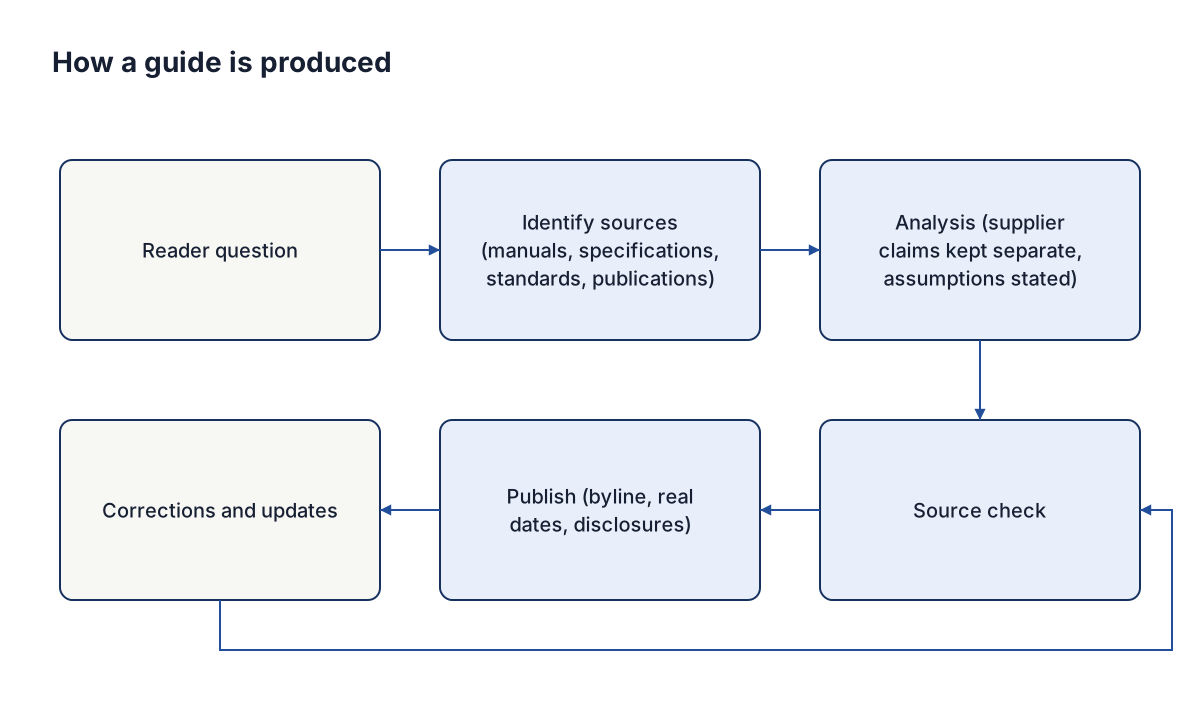
Figure 1 shows the path a guide follows from a reader question to publication and later correction. The sections below take each step in turn.
Byline
The article header shows the substantive update month and year. The explanation of RE Digital Editions Editorial, the editorial byline for content DeltaSpark publishes on this website, stays at the end of a guide and may also appear in structured data. It is not a separate certification body and does not imply a professional credential.
When an article names an individual author, the biography describes only experience that can be verified. A technical-review credit at the end of a guide appears only if a review was completed and the named person agreed to be credited. We do not publish invented job titles, test-laboratory claims, or placeholder author profiles. Authors of historical material stay credited as the original authors and are not presented as current staff.
Evidence and how guides are produced
Each guide starts with a specific reader question, and the sources that can answer it are identified before drafting. We prefer equipment manuals, manufacturer specifications, published standards, papers, and professional publications. Key figures keep their units, materials, operating conditions, versions, and dates. Figures from a supplier are attributed to the supplier, not presented as our measurements.
Sources we use
Each kind of source supports different statements. The table shows how we use each and where its limits lie.
| Source type | How we use it | Limits |
|---|---|---|
| Equipment manuals and manufacturer documentation | To describe how a machine type operates and what information a supplier normally provides | Written for a specific model and version; may not apply to other models or configurations |
| Manufacturer specifications and brochures | To identify which parameters suppliers state and which questions to ask | Supplier statements; conditions of measurement may be missing, and we have not tested them |
| Standards and regulatory references | To point readers to the topic a document covers, described by scope | Applicability depends on the market and product; we do not quote requirements or give legal advice |
| Technical publications, papers, and professional articles | To explain principles and established practice | May be dated, may address different materials or conditions, and vary in how well their method is described |
| Our own analysis | To organize evidence, set out conditions, and build checklists and assumed examples | Not a test result; reflects the evidence available when the guide was written |
Supplier claims and our analysis
Supplier figures are attributed to the supplier, with the unit, material, and operating conditions alongside them where the source gives them. A rated speed or accuracy figure is what the supplier says a machine can do under stated conditions. This publication did not measure it, and the guides do not present it as measured. Our analysis sits in separate sentences and sections, so readers can tell which statements come from a supplier and which from us.
Conditional comparisons
Comparison articles state the conditions under which each option fits, and they avoid unsupported claims such as “best” or “most reliable”. Maintenance and safety content gives no generic settings that claim to apply to every machine, and it never describes how to bypass interlocks or guards. Where safety is involved, guides point to a documented risk assessment and review by qualified people.
Worked examples are labeled “Assumed example” and exist only to demonstrate a method. They are not customer projects, test results, or market data. Their numbers are illustrative, and a plant should replace them with its own records. The guides on packaging line bottlenecks and packaging machine total cost take this approach. Real case material is used only when it is genuine and can be disclosed.
Safety content
Safety content stays at the level of general considerations and pointers. We do not publish settings that apply across machine types, describe how to defeat guards or interlocks, or describe work on energized or otherwise unisolated equipment. Guides that touch on safety send readers to the machine manual, a documented risk assessment, energy-isolation procedures, and review by qualified personnel. A guide does not replace any of these.
How references are cited
References are listed at the end of each guide and described by what the document covers, that is, by scope. We do not infer standard requirements from clause numbers, and we say a standard “requires” something only when that statement is literally the document’s published scope. Readers who need the exact wording of a standard should get the current edition from its publisher, because editions change and applicability depends on the market and the product.
When a guide builds on older publications, it is rewritten from the underlying evidence and not paraphrased sentence by sentence.
Illustrations
Illustrations on this site are original schematic diagrams and editorial illustrations produced to clarify machine interfaces and operating principles. Schematic diagrams are marked as not to scale.
Source verification
Every technical statement is checked against the cited equipment manuals, standards, or engineering publications before publication; any claim that cannot be traced to an identifiable source is removed or rewritten.
Dates
For guides, the header uses Updated <Month Year> for the last substantive update, without a team byline or a daily Published date. The original publication date and detailed update history remain at the end of the guide; structured data retains the true publication and modification dates. We do not change dates to look fresh. Older headers that have not yet adopted this format need a template or content-flag update; the policy does not imply that every page already matches it.
For historical resources in the Technical Library, three dates are kept separate:
- Original resource date: the date of the original item, verified from the original or a reliable source.
- Reference page published: the date this site’s reference page first went up.
- Last substantive update: the date of the most recent change that altered the content in a meaningful way.
Original material keeps its original identity and its true original date. The explanatory page we write about it carries its own dates. The two are never merged into one date field, and a page’s date is not changed to make it look more recent. Search engines draw the same distinction between when a page was published or updated and the date of the event it discusses.
Corrections and long-term maintenance
Substantive corrections and updates are recorded in the Update history at the end of the affected guide. As Figure 1 shows, an update returns to the source check step. A changed statement is traced to its source again before it is republished, and the dateModified value changes only when the content did.
To report an error, use the existing editorial Contact page. Include the article URL, the passage or figure at issue, your proposed correction and the supporting source URL or document edition/page. Messages go to DeltaSpark, the publication operator. This is an editorial corrections route, not a quotation service.
Minor edits, such as fixing a typo or a broken link, leave the visible Updated date alone. A correction that changes a conclusion, a parameter definition, or a recommendation changes it, and the Update history says what changed. We review content when equipment models, manuals, standards, or cited sources change, and we withdraw conclusions that can no longer be supported. We judge a guide by how complete its sources are, how usable its checklists are, and what readers tell us, not by link counts or domain age.
Commercial relationships
The About page introduces the publication. The Commercial Disclosure explains how ownership, supplier, sponsorship, and referral relationships are handled.
Policy update record
8 October 2026 — Added the existing editorial correction route and evidence to include, clarified the header versus end-of-guide date/byline policy, and reorganized the workflow illustration into readable vertical steps. This is a substantive policy update; no original publication date has been invented or reset.