
FAT vs. SAT for Packaging Equipment: Defining Acceptance Criteria
Compare factory and site acceptance tests for packaging machines, and learn how to write acceptance criteria that both buyer and supplier can verify.
Read guideGuides for specifying, comparing and accepting packaging machines: an RFQ template, FAT and SAT criteria, and a total cost of ownership framework.
Buying a packaging machine takes four decisions in turn: what to ask for, how to compare the replies, how to confirm the machine does what was agreed, and what it will cost to run. This section has a tool for each. It is written for buyers, plant and production managers, and the engineers, maintenance and quality staff who support them.
For the RFQ, keep these nine scope headings as a vertical checklist. The RFQ guide supplies the full record:
It does not cover legal contract drafting, financing, used equipment, supplier rankings or product recommendations. It does not give prices, delivery times or performance figures. Choosing a machine type is covered in the packaging section, and line connections and maintenance are covered in the automation and plant operations sections.
Swipe sideways to see the other columns. The first column stays visible.
| Task or process step | What to decide | Guide |
|---|---|---|
| Choose the machine family | Which type of machine suits the product and the pack format | Overview of packaging machine types |
| Check liquid density drift before specifying a filler | How mass, volume and density interact with flow meters and load-cell scales across batches | Net-weight vs. volumetric filling density check |
| Evaluate machinery builders and integrators | How to screen machine OEMs, check controls transparency, and verify service support | Evaluating packaging equipment manufacturers and integrators |
| Prepare the request for quotation | What information every supplier needs so that quotes can be compared | Packaging machine RFQ checklist |
| Check fit with the line | Mechanical, signal, communication and utility interfaces | Packaging line integration checklist |
| Confirm film or container compatibility | Which material properties the machine depends on | Film and machine compatibility guide |
| Plan acceptance | Where and how the machine is tested, and what counts as a pass | FAT vs. SAT for packaging equipment |
| Compare offers over time | Which costs recur, and which assumptions change the ranking | Packaging machine total cost of ownership |
| Check where output is limited | Whether the new machine will be the constraint of the line | Packaging line bottlenecks guide |
When a liquid product is specified by mass or fill level and density shifts with temperature or aeration, use the net-weight and volumetric filling density-drift check to convert batch density swings (mass = volume × density), separate propulsion hardware from flow or weight feedback, and log a paired-batch trial before locking the RFQ.
Before suppliers can quote, they need at minimum the product, the package and materials, the output, the site, the interfaces, the controls, the documents and the acceptance method. The RFQ checklist puts these in nine sections.
The machine type to ask for depends on the product and package format. The overview of machine types shows where each type sits in the line and links to the comparisons.
Heights, transfers, signals, buffers and safety zones must be agreed before design if the machine is to fit the line. The integration checklist covers them.
Packaging material and machine have to match in tension, friction, marks and sealing behavior. The guide to film and machine compatibility lists the properties, and trials confirm them.
Acceptance criteria are written before the tests: test object, duration and sample quantity agreed by both parties, measurement method, pass or fail rule and sign-off. The FAT and SAT guide explains how.
To find which offer costs less over its life, compare acquisition, operation, maintenance, downtime and changeover, and end-of-life costs on the same basis, then test the assumptions. The total cost framework provides the structure.
A faster machine in a line limited elsewhere may add cost but no output. The guide to bottlenecks in packaging lines shows how to check whether the machine is the constraint.
The opening four decisions run through these five project stages: “what to ask for” spans defining needs and writing the RFQ; “compare replies” covers offers; “confirm performance” spans the order/FAT plan and acceptance; running cost is assessed with TCO at comparison and handover.
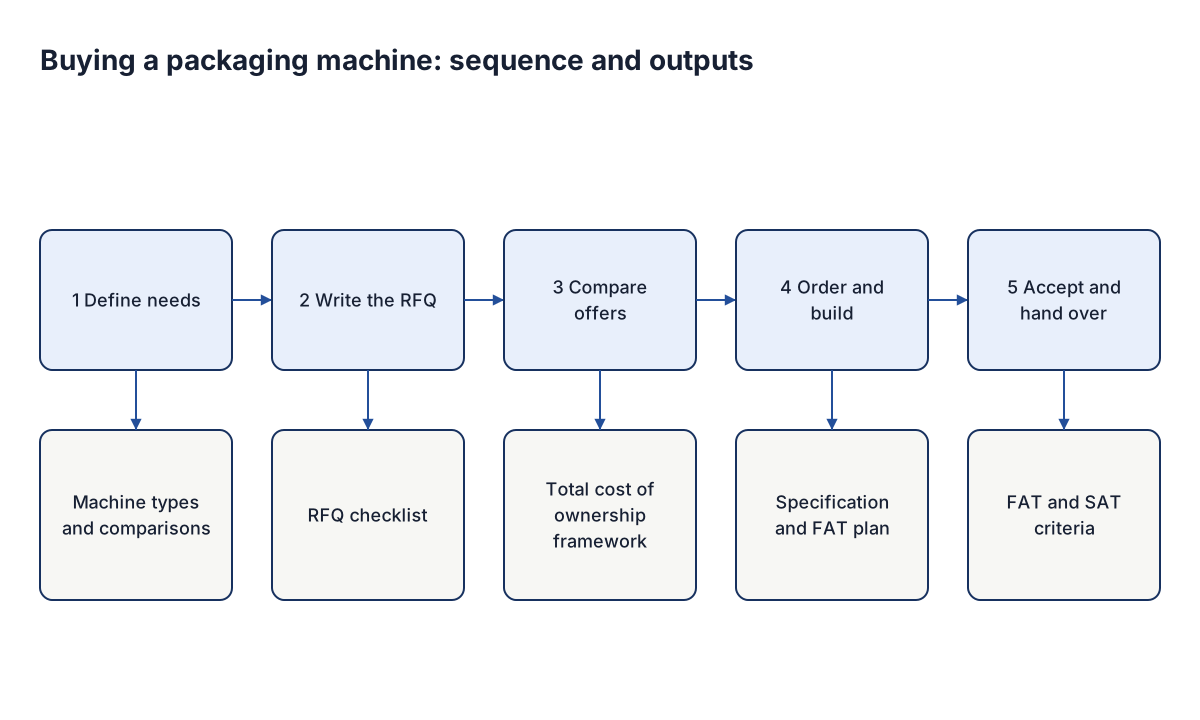
Read the guides in step order even if you are already partway through. A buyer who has received quotations may find that gaps in the RFQ explain why offers are hard to compare. A buyer who has ordered but not agreed acceptance can still write criteria before the factory test. The step outputs are documents you carry from one stage to the next, so each stage builds on what the earlier one settled.
Swipe sideways to see the other columns. The first column stays visible.
| Term | Meaning in these guides |
|---|---|
| RFQ | A request for quotation: the written information sent to suppliers so they can quote |
| Specification | The agreed technical description of what the machine must do and be |
| FAT | Factory acceptance test, carried out at the supplier’s site |
| SAT | Site acceptance test, carried out in your plant on your line |
| Acceptance criteria | The written test object, method, pass or fail rule and sign-off agreed before testing |
| Total cost of ownership | The sum of acquisition, operation, maintenance, downtime and changeover, and end-of-life costs over a chosen period |
| Sensitivity | How much a comparison changes when an assumption changes |
| Interface | A defined connection between the machine and the line, site or utilities |
| Hand-over | Transfer of the accepted machine, documents and training to the operator |
Buying decisions draw on every other section. The packaging section helps define the machine type and pack format, and its overview of machine types is the usual first step. Controls and interfaces that go into the RFQ are covered in the automation section. The plant operations section explains the maintenance and changeover effort that feeds the cost comparison, and materials and inspection covers the film and inspection requirements that belong in the specification.
Compare factory and site acceptance tests for packaging machines, and learn how to write acceptance criteria that both buyer and supplier can verify.
Read guideUse a unit-labelled mass=volume×density worksheet, a control-method matrix and a blank paired-batch trial record before choosing volumetric or net-weight liquid filling.
Read guide
A reusable blank RFQ template for packaging machines in nine sections, with the reason suppliers need each item and a list of commonly missed details.
Read guide
Compare packaging machine offers by total cost of ownership: cost components, a fill-in table, an example with invented numbers and a sensitivity check.
Read guideA practical framework for qualifying packaging machinery builders: OEM vs integrator scope, controls and code access, FAT criteria, and service support you can verify.
Read guide