
FAT vs. SAT for Packaging Equipment: Defining Acceptance Criteria
Compare factory and site acceptance tests for packaging machines, and learn how to write acceptance criteria that both buyer and supplier can verify.
Undefined acceptance can lead to disputed shipment or handover. A factory acceptance test (FAT) checks the machine at the supplier's site with the supplier's utilities and your samples, while a site acceptance test (SAT) checks it in your plant on your line under production conditions. Both need written criteria agreed before the test, covering what is tested, how it is measured and who signs.
Applies to: Covers acceptance testing of new standalone packaging machines and small cells bought from a supplier. It does not set test durations, sample quantities or pass limits, and it is not a validation protocol for regulated products.

Undefined acceptance can turn a failed test into a dispute about shipment or handover. Use FAT to check the agreed machine scope at the supplier’s site and SAT to check it in the installed line, with written criteria and signers for both. Numeric limits, sample counts and test durations come from the project and quality plan.
Swipe sideways to see the other columns. The first column stays visible.
| Decision | FAT | SAT |
|---|---|---|
| Place | Supplier site | Installed plant and line |
| Inputs | Agreed samples, materials and factory utilities | Production materials and actual site conditions |
| Pass evidence | Requirement-linked test and document records | Installed-function and line-interface records |
| Responsibility | Supplier runs; buyer witnesses as agreed | Buyer, supplier and installer by scope |
| Failed item | Log correction and agreed retest; apply shipment gate | Log cause and agreed retest; apply handover gate |
How FAT and SAT fit in a project
The BASF rPCF evidence map distinguishes a methodology certificate from application evidence and customer data acceptance.
The SIG Neo verification register provides an announcement-based example of questions to resolve before an acceptance plan is agreed.
A packaging machine project passes through several stages, and acceptance tests sit at two of them. IEC 62381 is a relevant reference for the terminology of FAT, SAT and site integration testing (SIT). Terms vary between suppliers and industries, so define them in your contract rather than assuming everyone reads them the same way.
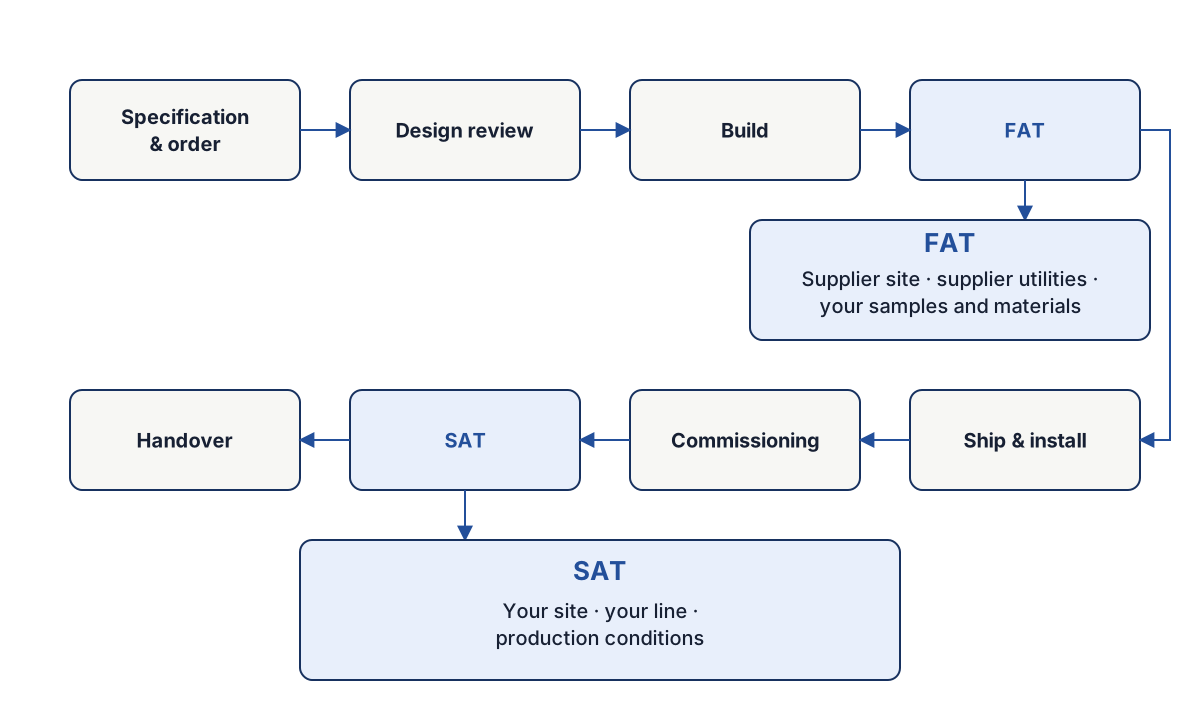
The FAT takes place at the supplier’s site, with the supplier’s utilities and your samples and materials. The SAT takes place at your site, on your line, under production conditions. Commissioning sits between them: the supplier or a contractor installs the machine, connects utilities and brings it to a state where it can be tested. Commissioning is not acceptance.
What FAT is for
A FAT lets you find problems while the machine is still in the supplier’s hands and can be modified without shipping, rigging or lost production. It typically covers checks of the build against the specification, review of documents, functional checks of controls and safety functions, and trial runs with your samples. Finding a fault here costs less than finding it after installation.
Its limit is that the conditions are not yours. The supplier’s compressed air, electrical supply, operators and ambient conditions differ from your plant, and the upstream and downstream machines are absent or simulated.
What SAT is for
A SAT shows that the installed machine works in your plant: with your utilities, connected to your line, operated by your people, and running your production material. It confirms that transport and installation did not damage anything and that the interfaces work. Interface problems are the main reason a machine that passed FAT does not perform in the line, which is why the packaging line integration checklist should be completed before the SAT plan is fixed.
Takeaway: Write the factory-versus-site test split into the acceptance plan.
FAT vs. SAT comparison
The table shows how the two tests differ. It describes typical practice. Your contract may define them differently.
Swipe sideways to see the other columns. The first column stays visible.
| Aspect | FAT | SAT |
|---|---|---|
| Where | Supplier’s site | Your site |
| Purpose | Confirm the machine meets the specification before shipment; find and fix defects early | Confirm the installed machine works in your plant and line, and release it for handover |
| Samples and materials | Your samples and materials sent to the supplier, as agreed; representative of production, including the difficult cases | Production material from your normal supply, or material agreed for the test |
| Operating conditions | Supplier’s utilities, workshop environment, supplier’s operators; neighbors simulated | Your utilities, ambient conditions, line connections, your operators |
| Records | Test report, deviation list, document review, photos; signed by both parties | Test report, deviation list, installation checks, signed handover; kept in your quality or project records |
| Who is responsible | Supplier prepares and runs; buyer witnesses and reviews | Joint: supplier, installer and buyer; buyer often owns the site conditions and material supply |
| If a test fails | Supplier corrects, then repeats the failed item at the agreed scope; shipment waits | Parties find the cause (machine, installation, material or site), agree a correction and retest; payment milestone may be held |
The last row matters most for commercial planning. Decide before the order who corrects a failure, who pays for the retest, and how a failure caused by the site or by your material is treated.
Takeaway: Agree who corrects and funds each class of failure before ordering.
How to write acceptance criteria
Copy one record per requirement. Agree its conditions, sample quantity or duration, measurement method and pass rule before testing; the form below provides no default values.
Swipe sideways to see the other columns. The first column stays visible.
| Acceptance record field | Agreed input / result |
|---|---|
| Requirement ID, revision and FAT / SAT stage | |
| Object or function under test | |
| Product, material, settings and utilities | |
| Sample quantity and test duration (units) | |
| Measurement method, instrument and calibration reference | |
| Pass/fail rule and observed result | |
| Named signer, role and meaning of approval | |
| Deviation, owner, due date and shipment/handover effect | |
| Change record, affected retests and closing evidence |
“Machine works” is too broad: name the function or output and trace it to the specification. Use agreed measurements for package quality, not visual impressions; where inspection equipment supplies the result, identify how that device is checked too.
Conditions that must be written down
Add the conditions under which the test runs. These are the common sources of argument.
- Product, package and material used, with batch records
- Format and settings used, and whether the supplier may adjust settings during the test
- Utilities supplied and their measured state
- Operators and their training status
- Which stops, jams or interventions count against the result and which are excluded
- How output is calculated (net good packs over the agreed period, not display speed)
- Which tools and instruments are used, and their calibration status
- Which documents must be present for the test to start
Link criteria to the specification
Every criterion should trace back to a line in the RFQ or purchase specification. If a requirement is in the specification but no test covers it, either add a test or note that it is verified another way, such as document review. If a test has no requirement behind it, ask why it is there. Criteria for inspection and reject systems need particular care: a vision inspection system is verified by how it detects and rejects defined defects, and it needs a defined set of defective samples and a method to confirm rejection.
Handling deviations and changes
A test may identify deviations. Decide in advance how findings are classified, for example as items that block shipment or handover, items that can be closed later with a date, and items accepted as they are with written agreement. Give each deviation an owner and a due date, and record the closing evidence, not just a tick.
Also agree how changes made during the test are treated. If the supplier adjusts a setting, replaces a part or changes software to pass an item, record the changed settings, part or software version and ask the agreed technical/quality approver to define the affected retest scope. An unrelated passed item need not automatically be repeated, but keep the rationale with the record. Without this rule, a machine can pass on paper in a state that differs from the one shipped.
An open deviation is not automatically permission to ship. Apply its agreed classification: blocking items stay open until closure evidence is accepted; a permitted exception needs written authorization, an owner, due date and any remaining test. Safety and regulated-use acceptance stays with the qualified reviewers and applicable procedures.
For machines that must exchange signals with other equipment, plan how the interfaces are tested at the FAT. Simulators or test rigs can check signals, but only the SAT shows the real exchange with the neighboring machines.
Takeaway: Leave each requirement with a signed result or a documented open deviation.
Packaging line setup: from delivery to SAT
Between shipment and the SAT, the equipment is received, installed, connected and commissioned. Many SAT delays start in these weeks, so agree the order of the steps, who leads each one and what record each produces in the same document as the acceptance plan. Packaging line design and layout decisions, such as machine positions, buffers and access space, are made earlier and fixed in the order and the layout drawing. This section starts when the equipment arrives.
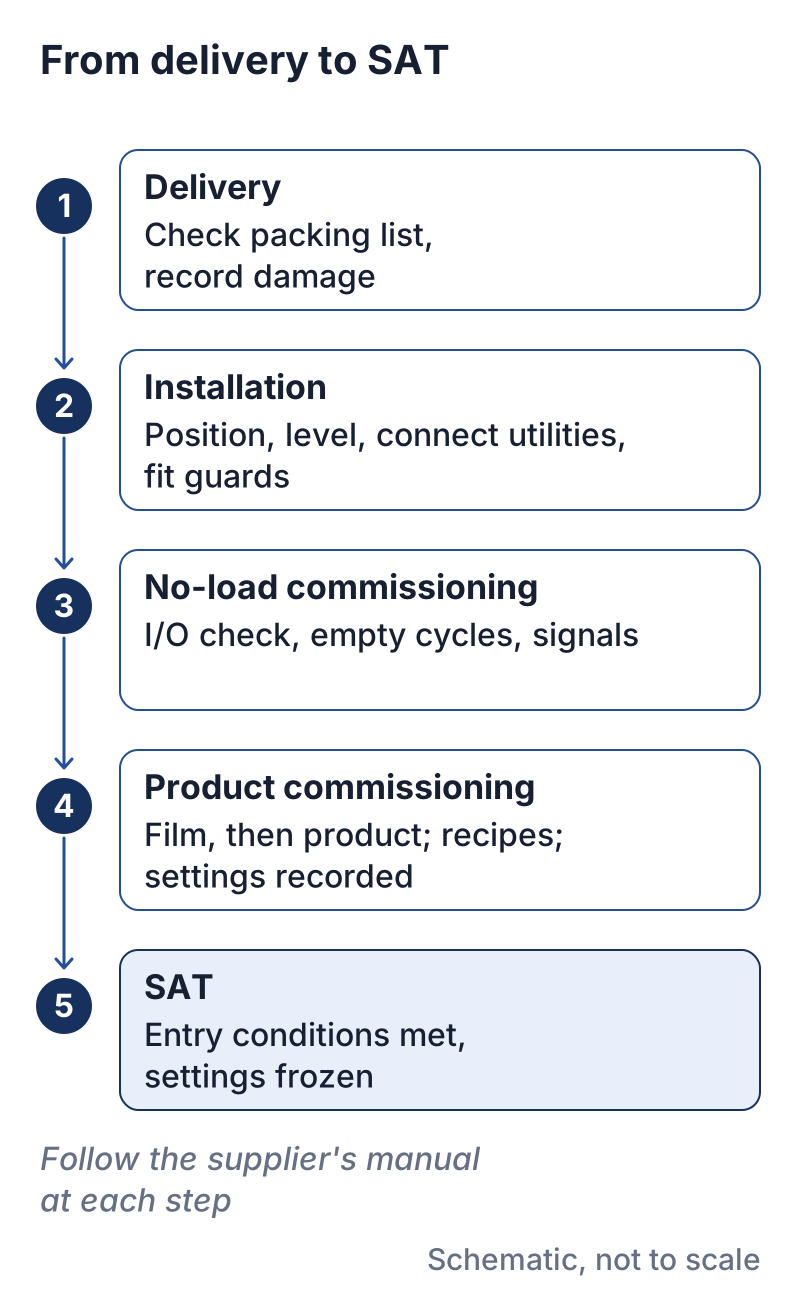
The supplier’s installation manual is the reference for each machine. Manuals for packaging and inspection equipment typically run from mechanical installation to electrical and controller installation, then calibration and setup, before the machine handles product. One in-motion checkweigher manual, for example, tells installers to read its installation, electrical and controller chapters before installing or operating the equipment, and to clear product before zero calibration, then apply test weights for span calibration (section 3.3). The sequence below is a planning framework built on that pattern. It does not replace your supplier’s procedures, and it gives no electrical or safety values.
1. Delivery and receiving inspection
- Check the crates against the packing list and photograph visible transport damage before signing for the delivery.
- Store the equipment as the supplier instructs until it is installed, including any protection against humidity or dust.
- Confirm that FAT items due before shipment were closed or recorded as accepted exceptions.
2. Installation
- Prepare the site to the supplier’s layout drawing and utility list: floor, position, access space, and utilities brought to the agreed connection points.
- Set the machine in position, level and anchor it as the manual describes, and align it with the upstream and downstream conveyors.
- Have qualified people make the electrical and utility connections to the supplier’s drawings and the codes that apply at your site.
- Install guards, interlocks and emergency stops, and check them before any powered movement. Installing and setting up machines are servicing activities under the US lockout/tagout rule, 29 CFR 1910.147, so energy isolation follows your hazardous-energy procedure throughout.
3. No-load commissioning
Automated packaging equipment is usually commissioned in two passes, first without product and then with it.
- Power up and check each input and output (sensors, actuators, signals) against the electrical drawings.
- Cycle the machine without product or packaging material, at low speed first, and confirm direction, sequence, alarms and the safety functions.
- Distinguish zero from span calibration. In the Thompson 4693 manual, section 3.3, product is cleared for zero and test weights are applied for span. That is one manufacturer’s procedure, not a universal empty-conveyor calibration instruction; use the actual machine manual.
- Exchange the interface signals with the neighboring machines while they run empty, including the stop behavior agreed in the line integration checklist.
4. Product commissioning
- Run with packaging material first, then with product, and raise the speed in steps.
- Set and save a recipe for each format in the scope, and tune the machine as the manual describes, for example sealing, registration, dosing and reject timing.
- Set up the inspection devices and challenge them with their test pieces or reference weights. The checkweigher and metal detector guide covers the checks and records involved.
- Record the final settings and software versions. They become the baseline for the SAT and for backups.
5. Handover to the SAT
Start the SAT only when the entry conditions written in the acceptance plan are met: commissioning complete, settings frozen, production material and trained operators available, and open items listed with owners. Commissioning is the supplier or installer bringing the machine to a working state. The SAT is the joint test against the agreed criteria. If settings keep changing during the SAT, the result describes a machine that no longer exists by the end of the test, so changes made during the SAT follow the change rule above.
Takeaway: Freeze the documented machine state before starting the agreed SAT.
FAT and SAT checklist
Use this as a starting list, then adapt it to your machine and contract.
Before the FAT
- Acceptance plan agreed and signed by both parties
- Samples and materials delivered to the supplier, labeled and recorded
- Document set from the supplier received for review (drawings, schematics, manuals, parts list)
- Attendees named, including quality and maintenance staff if relevant
- Safety review status known: the machine’s guarding and safety functions come from the supplier’s risk assessment, which qualified people on both sides should review
During and after the FAT
- Build checked against the specification and drawings
- Controls, alarms, recipes and safety functions checked as agreed
- Trial run with the agreed materials and conditions
- Results measured with the agreed method and recorded
- Deviations logged with owner and due date
- Agreed items closed before shipment, or documented as accepted exceptions
- Both parties sign the report
Before and during the SAT
- Installation checked: position, anchoring, utilities, guarding, connections
- Interfaces to upstream and downstream machines checked
- Production material and operators available
- Trial run under agreed production conditions
- Results measured and recorded using the agreed method
- Training and documentation handover completed
- Open items listed with owners and dates
- Handover signed, with spares and software backups received
Takeaway: Keep the report, deviation list and delivered backup versions together.
Regulated environments
If the machine will be used for products in regulated (GxP) environments, such as pharmaceuticals, your quality system may require a documented verification approach. Relevant references include ISPE GAMP 5, which covers the lifecycle and testing of regulated computerized systems, and ASTM E2500, which describes specification and verification for regulated manufacturing equipment. They may change how test documents are written, reviewed and retained. This guide does not replace them; follow your own quality unit’s procedures.
Takeaway: Have the quality unit approve the verification approach for the intended use.
Questions to ask suppliers
Ask these before the order, so the answers appear in the contract.
- Do you offer FAT, SAT or both, and which are included in the price?
- What does your FAT cover, and what is left to the SAT?
- What do you need from us for the FAT: samples, quantities, timing, documents?
- Can you provide a draft acceptance plan and a sample report format?
- Who may attend the FAT, and how are records shared if we cannot attend?
- How do you handle deviations found in the FAT?
- How is the SAT scheduled, and who supplies utilities, operators and material?
- What happens if the SAT fails, including retest conditions and responsibility?
- How are payment milestones tied to FAT and SAT?
- Which documents are delivered at each stage?
Limits and on-site verification
No FAT can fully reproduce your plant. Product and material variation across batches, operator habits, ambient conditions and line interactions only appear in production, so an accepted machine may still need tuning after handover. Plan for a stabilization period and agree in writing how problems found in it are handled.
Acceptance criteria for safety functions, electrical compliance and regulated use need qualified review. Safety design follows a risk assessment, for which ISO 12100 gives a general method. Do not use an acceptance test to skip or relax any safeguard, and do not alter guards, interlocks or energy isolation for a test. Final values for duration, quantity and limits must come from your own product, process and quality requirements, and from the supplier’s manual.
Related decisions
Total cost depends on how well the machine performs after acceptance, so see the total cost of ownership framework when comparing offers. Keep the acceptance method consistent with what you wrote in the RFQ.
Manual source detail
Reviewed 8 October 2026: Thompson Scale Company, Model 4693 Heavy-Duty In-Motion Checkweigher Manual, version 15.3, section 3.3, “Calibration Procedure”: clear the weigh station for zero and apply test weights for span. Manufacturer procedure for that model/version only; it does not prescribe commissioning for other equipment. The acceptance record and deviation suggestions above are editorial planning aids, not standard-mandated criteria.
References
- IEC 62381:2024 — Automation systems in the process industry — Factory acceptance test (FAT), site acceptance test (SAT), and site integration test (SIT) — IEC
- ISO 12100:2010 — Safety of machinery — General principles for design — Risk assessment and risk reduction — ISO
- 29 CFR 1910.147 — The control of hazardous energy (lockout/tagout) — U.S. Department of Labor, OSHA (eCFR)
- Thompson Scale Company, Model 4693 Heavy-Duty In-Motion Checkweigher Manual, Ver. 15.3 — Thompson Scale Company
- ISPE GAMP 5 Guide: A Risk-Based Approach to Compliant GxP Computerized Systems (Second Edition) — ISPE
- ASTM E2500-25 — Standard Guide for Specification, Design, and Verification of Pharmaceutical and Biopharmaceutical Manufacturing Systems and Equipment Science and Risk Based Approach — ASTM International
Update history
- : First published.
- : Added a section on packaging line setup from delivery through installation and commissioning to the SAT.
- : Added a compact FAT/SAT overview and copyable criterion record; clarified zero/span calibration and open deviations; redrew the project timeline for mobile.
Next steps

Packaging Machine RFQ Checklist: Information Suppliers Need
A reusable blank RFQ template for packaging machines in nine sections, with the reason suppliers need each item and a list of commonly missed details.
Read guide
Packaging Machine Total Cost of Ownership: A Comparison Framework
Compare packaging machine offers by total cost of ownership: cost components, a fill-in table, an example with invented numbers and a sensitivity check.
Read guide
Packaging Line Integration Checklist: Interfaces to Confirm Before Ordering
Checklist of mechanical, electrical, signal, communication, safety and utility interfaces to settle before ordering a machine for a packaging line.
Read guide