
Packaging Machine for a Small Business: Floor Height, Utilities and Changeover Time Before Speed
Check floor-to-ceiling clearance, utility connections and short-run changeover time before choosing a packaging machine for your small business.
Choose your shortlist by checking the proposed installation, electrical and air connections, and a timed product changeover before comparing speed. Use the site-survey and run-record worksheet below to prepare each quotation request.
Applies to: Small-business buyers comparing packaging equipment for short production runs and product changes.

When choosing a packaging machine for a small business, check the proposed installation, utility connections and a timed changeover before comparing speed. For short runs, make your shortlist around the products, packs and transitions you intend to run.
Start with a site survey and a trial request. Ask for an installed layout, an electrical schedule, an air-demand specification and a demonstration that changes from your outgoing product to your incoming product. Use the worksheet near the end of this guide to bring those requests together. For the wider purchasing sequence, return to our packaging equipment buying guides.
Start with the buying decision
Use these questions at the first quotation meeting. Record the answer against the exact configuration under discussion, and keep the drawing and quotation revision together.
| Check | Question to resolve | Request for your purchasing file |
|---|---|---|
| Floor and height | Where will the complete installation fit? | Installed layout, overhead access and support details |
| Electrical supply | Which connections does the quoted configuration require? | Voltage, frequency, phase and current schedule |
| Compressed air | What air quality, flow and pressure are specified? | Demand and treatment requirements at the connection |
| Changeover | When does the next product reach target rate and quality? | Observed transition record with acceptance criteria |
| Output | What will you count and over which production window? | Run time, total count and good count |
Check floor space and floor-to-ceiling height
Mark the proposed equipment position on a floor plan. Measure from the finished floor to the lowest overhead obstruction at that position. Ask the equipment supplier to show the complete installed arrangement, loading access and maintenance access on the same drawing. Include any proposed bench, feeder, hopper or platform in that request.
For a small packaging machine, start by separating the dimensions you have from the installation drawing you want. Here is a scoped dimensional example from the Accutek Mini-Pinch product-page configuration:
Listed length is 33” (83.82 cm).
Listed width is 26” (66.04 cm).
Listed height is 59” (149.86 cm).
Listed weight is Approx. ~45 lbs. (20.41 kg).
An adjustable tabletop stand is listed.
Record the proposed supporting surface and ask for the support reactions and anchoring details for your installation. Match those requests to the building’s floor information. Do not approve the layout until your purchasing file contains the agreed equipment position, access arrangement and support requirements.
Ask the person responsible for the site to walk the delivery route with the proposed layout. Where will equipment enter? Where will packaging materials wait? Where will an operator stand to load, remove or inspect a pack? Mark those positions directly on your drawing, then use the same drawing during the equipment demonstration.
For Weigh Right G-50 direct-fill gross weighers serving rigid containers:
Low-height systems are ideal for low-ceiling facilities.
If ceiling clearance is a deciding question, include a low-height arrangement in the layout request and ask for its complete installed dimensions.

Check electrical supply and compressed air separately
Request a utility schedule for each quoted configuration. Put the machine connection and the available site connection next to each other in your purchasing file. Ask the quotation to identify optional electrical arrangements explicitly.
Accutek Mini-Pinch: product-page configuration
Electrical supply is single-phase.
Electrical rating is 5 amps.
220 VAC is optional.
Electrical specification lists 110/220 VAC 50/60 Hz.
Air requirement is 70 PSI @ 1 CFM.
Keep the optional supply choice in the quotation itself. Ask for the connection location, cable route and installation responsibilities as part of that same discussion.
Viking Masek M400: standard brochure configuration
Standard supply is 208/240V, single phase.
Standard frequency is 60Hz. and current is 20 AMPS.
Air requirement is 12-18 SCFM @ 90 PSI w/o vac.
Retain the air specification’s printed flow unit and condition when transferring it to your site worksheet. Ask for the quoted configuration’s air-treatment requirements and the intended connection point. Include other proposed equipment in the utility review rather than approving the main machine in isolation.
All-Fill archival auger-filler configuration
For the Model B-350e archival brochure configuration:
The brochure identifies this as a semi-automatic auger filling machine.
Motor electrical specification is 208/230/460V, 60 Hz., 3-Phase.
Controls electrical specification is 120V, 60 Hz., Single Phase.
Other electrical ratings are available upon request.
Use the motor and controls entries as separate questions in your electrical review. Request the ratings for the exact machine being quoted, and attach that response to the current quotation.
Air-system selection checks
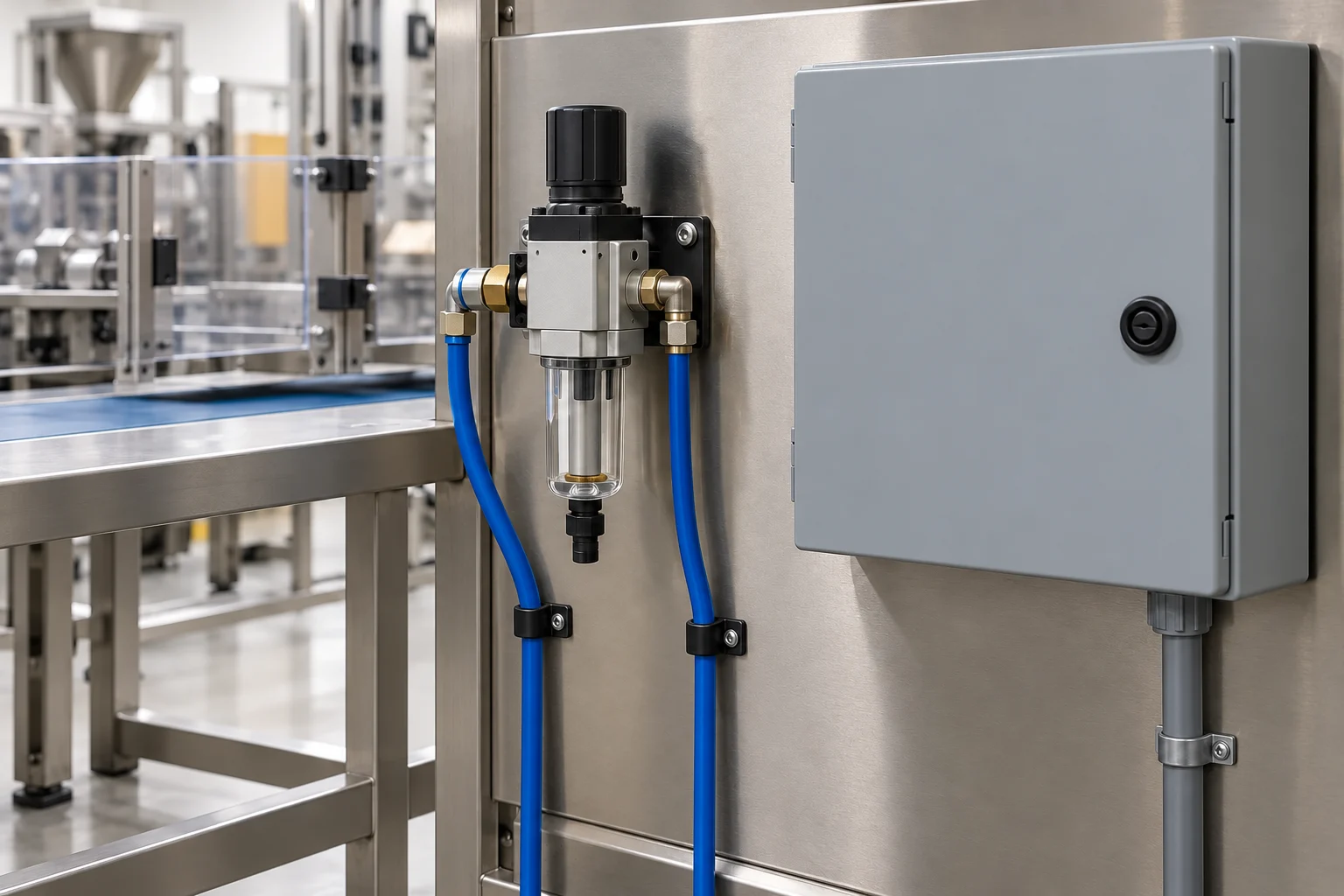
Compressed air needs are defined by air quality, quantity and pressure required by end uses.
Size components for actual flow rates rather than average flow rates.
Excessive entrained moisture can result in pipe corrosion and contamination at the point of end use.
Compressed air should be dried only to the dew point required, using an appropriately sized dryer.
The filter should be sized for minimal pressure differential at the highest connected flow.
Use those checks to structure the air-supply discussion. Request the required air quality, the operating flow and the specified pressure at the equipment connection. Ask for the proposed dryer and filter selection to be documented alongside that demand. Keep the air-system review attached to the machine quotation so that both refer to the same installation.
Semi automatic vs automatic packaging machine: compare the work
For this comparison, write down who performs each action in the proposed setup. Ask the demonstrator to show container or pack loading, cycle initiation, removal, replenishment and the transition to another product. Record the operator assignment alongside the equipment quotation.
For the Accutek Mini-Pinch:
The operator places empty containers beneath the nozzles and uses a foot or thumb activation switch.
Use the demonstration to answer practical questions: who presents the empty containers, who initiates the cycle, and who handles the filled packs? For another proposed machine, ask the same questions and record its own operating sequence. Specify the staffing arrangement you want demonstrated, and use your intended pack presentation during the trial.
Carry broader system questions into the packaging automation selection guide. Keep this purchasing decision focused on the installation and the short-run transition you will ask each candidate to demonstrate.
Measure short run changeover time to target output
Changeover extends from the end of one run to the next run achieving target rate and quality.
Setup replaces tooling and process equipment used for the previous run.
Start-up requires testing and fine-tuning to achieve desired quality and throughput.
Internal changeover steps can only be performed while equipment is stopped.
External changeover steps can be performed while equipment is running.
SMED aims to convert as many internal elements as possible to external elements.
Choose an outgoing product and an incoming product for the demonstration. Agree on the target production rate and the pack-quality acceptance criteria before timing the transition. Record the end of the outgoing run, then keep recording through setup and start-up until the agreed next-run criteria are met.
Ask the demonstrator to identify preparation tasks that can be completed ahead of the stop. Record who performs them, which materials and tools they prepare, and where those items wait. During the stopped period, record each task and its start and finish. Keep adjustment, trial packs and acceptance checks visible in the record.
Ask what the changeover features cover
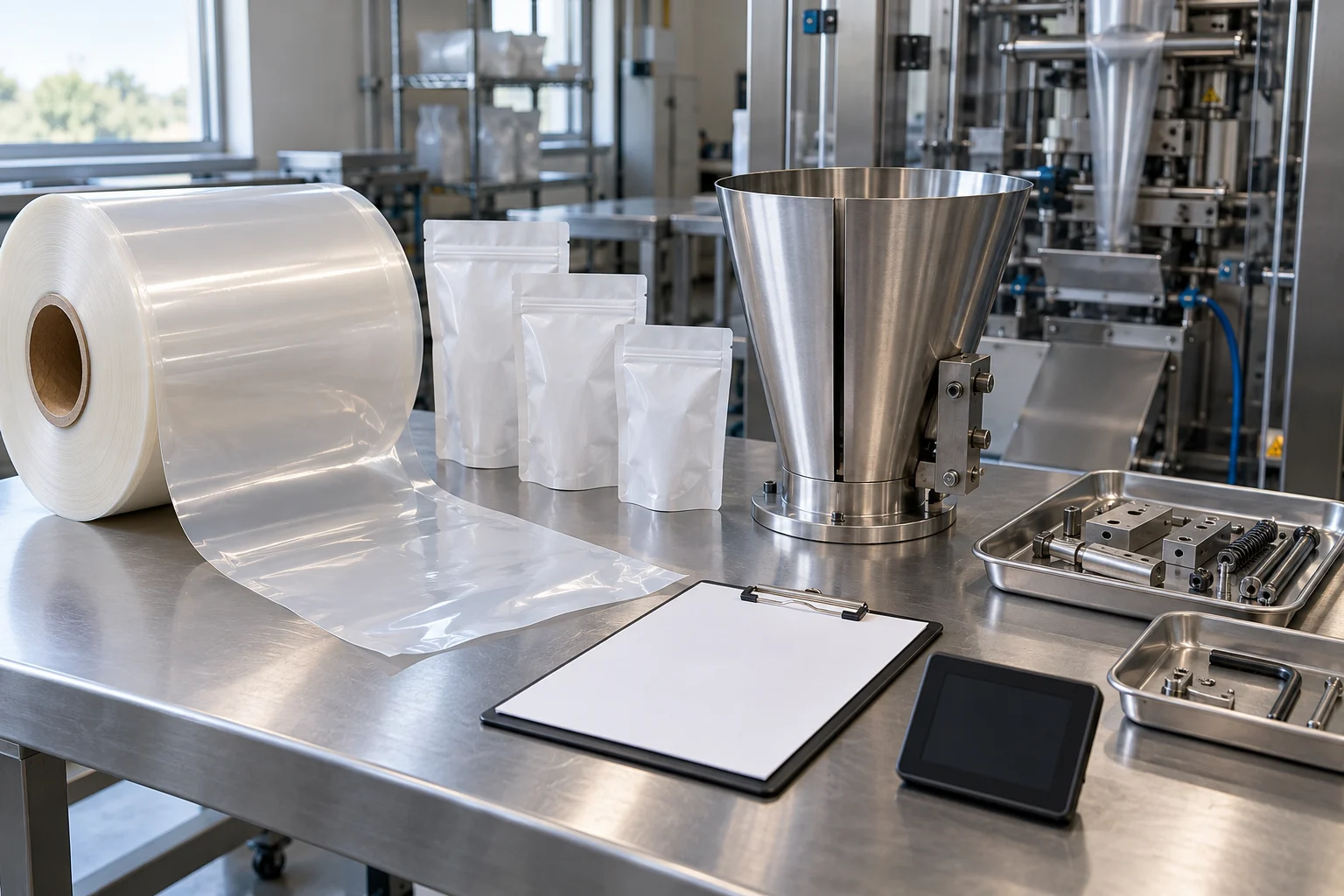
For the Viking Masek M250 brochure configuration:
No tool change-over is listed.
A quick film splice table is listed.
Storage for 100 product recipes is listed.
Ask to see each quoted feature during the transition you selected. Which parts are changed? Which settings are recalled? What remains for the operator to adjust and check? Request the demonstration record with the quotation, then use the same acceptance criteria when planning your factory and site acceptance checks.
Compare a production window, then discuss speed
For the Viking Masek M400 brochure configuration:
Maximum dry-cycle speed is up to 100 cycles per minute.
Label that figure as dry-cycle speed in your comparison. In the product trial, request the actual run time, total pack count and accepted pack count for the agreed production window. Keep the outgoing and incoming products, pack specification, operator assignment and acceptance criteria with those measurements.
Use the following production-accounting relationships:
Run Time = Planned Production Time − Stop Time.
Availability = Run Time / Planned Production Time.
Performance = (Total Count / Run Time) / Ideal Run Rate.
Quality = Good Count / Total Count.
OEE = Availability × Performance × Quality.
Changeover time should be included in Availability.
Apply the formulas to your recorded production window. Agree on the ideal run-rate basis before calculating performance, and define how rejected packs will be counted before calculating quality. Keep the original run record beside the calculations so the quotation discussion can return to the observed events.
For the financial evaluation that follows, use the packaging machine total-cost guide. Carry your measured stop time, staffing arrangement and material usage into that discussion.
Copy this site-survey and changeover worksheet
Complete a copy for each candidate configuration. Put your site measurements in the left-hand file and the quoted equipment requirements in the right-hand file, then record the agreed decision for each item. Attach the proposed layout and the observed transition record before issuing the final equipment request.
| Worksheet item | Record or attach | Your entry |
|---|---|---|
| Proposed installation | Equipment configuration, layout revision and delivery route | ________________ |
| Floor-to-ceiling survey | Lowest obstruction, operating position and requested service access | ________________ |
| Floor and supports | Building floor information, equipment support reactions and anchoring request | ________________ |
| Electrical connection | Available supply and quoted voltage, frequency, phase and current | ________________ |
| Air connection | Specified air quality, flow, pressure and treatment arrangement | ________________ |
| Product transition | Outgoing and incoming product, pack and material | ________________ |
| Acceptance point | Agreed production-rate target and pack-quality criteria | ________________ |
| Transition timing | Outgoing-run finish, setup events, start-up events and acceptance time | ________________ |
| Production window | Planned production time, stop time, run time, total count and good count | ________________ |
| Purchasing decision | Accepted configuration, required changes and demonstration record | ________________ |
Send the completed worksheet with your packaging-machine RFQ checklist. Ask for a response against each requested connection, layout detail and transition criterion, and retain the completed response with the final quotation.
Sources
- Accutek — Mini-Pinch product specifications
- Viking Masek — M Series Intermittent Bagmaker brochure
- Viking Masek — Intermittent Bagmaker M250 brochure
- All-Fill — Model B-350e archival OEM brochure
- Weigh Right — Direct Fill Gross Weighers
- Natural Resources Canada — Energy Efficiency Reference Guide Compressed Air
- igus — Understanding changeover time and how to minimize it
- Vorne — Calculating OEE
- Vorne — OEE FAQ
Update history
- : First published.
Next steps
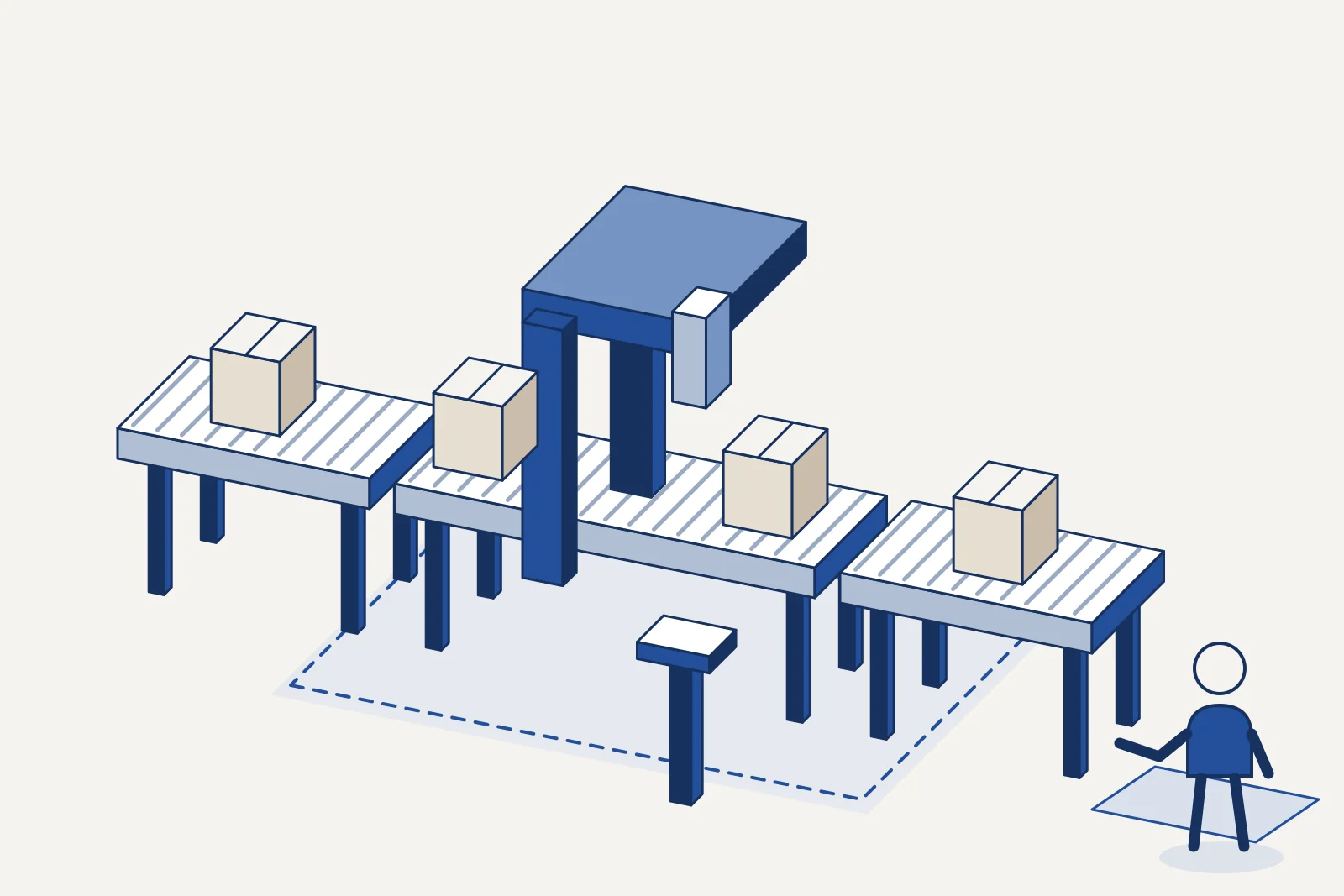
Choose a Packaging Automation System: Scope and Level
Choose packaging automation by the task, format range, operator work and proof required, then use a project checklist to compare scopes.
Read guide
Packaging Machine RFQ Checklist: Information Suppliers Need
A reusable blank RFQ template for packaging machines in nine sections, with the reason suppliers need each item and a list of commonly missed details.
Read guide
Packaging Machine Total Cost of Ownership: A Comparison Framework
Compare packaging machine offers by total cost of ownership: cost components, a fill-in table, an example with invented numbers and a sensitivity check.
Read guide
FAT vs. SAT for Packaging Equipment: Defining Acceptance Criteria
Compare factory and site acceptance tests for packaging machines, and learn how to write acceptance criteria that both buyer and supplier can verify.
Read guide