
Pallet Stacking Patterns: Column, Brick, Pinwheel and Split-Row Compared
Compare column, brick, split-row and pinwheel pallet patterns by layer interlock, box compression, stability, how a palletizer forms each layer and containment.
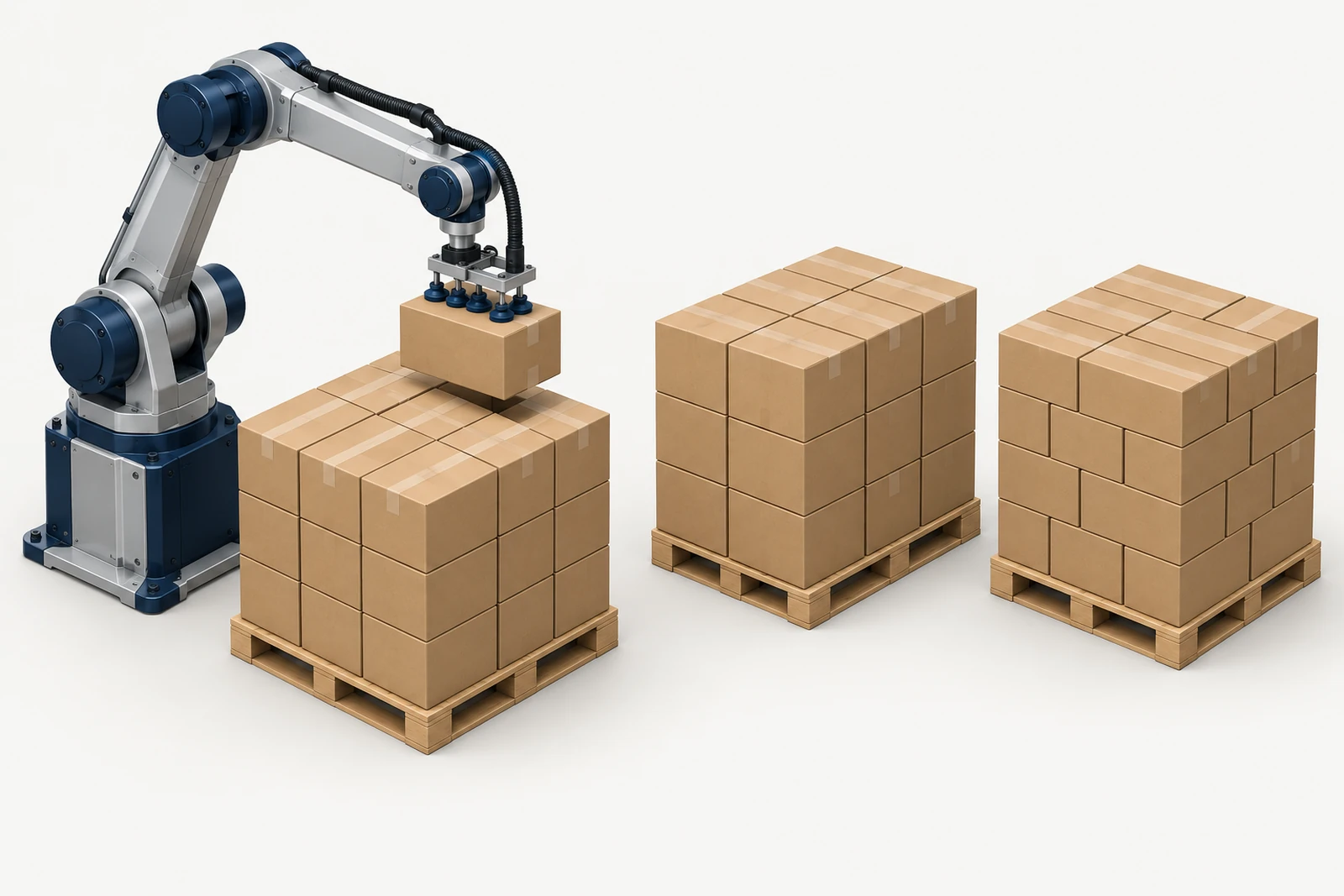
A column pattern keeps each case on the corners of the case below, which preserves box compression strength but leaves the layers unlinked, so the load relies on stretch wrap or other containment. Brick, split-row and pinwheel patterns interlock the layers for stability, but they move load onto weaker box walls, and the palletizer has to turn and arrange more cases to form them. Which one fits depends on the case, the pallet and the shipping conditions, and has to be confirmed by testing.
Applies to: Covers single-SKU loads of rectangular cases built by conventional or robotic palletizers. Does not cover Ti-Hi calculations, pallet calculators, truck or container loading, manual warehouse stacking rules or regulatory requirements.
A pallet pattern decides two things at once: how the load will hold together in storage and transit, and what the palletizer has to do to build each layer. Most pattern guides cover the first. This one compares the four common pattern families on both, so you can shortlist a pattern before asking palletizer suppliers how they would form it.
It is a comparison compiled from published research and manufacturers’ public information, not from our own tests. Stability and strength statements are qualitative. Whether a pattern is stable enough for your load has to be shown by testing.
What do the four pattern names mean?
The four names describe how cases are oriented within a layer and how each layer sits on the one below. A column pattern repeats the same layer so cases stand corner on corner. Brick, split-row and pinwheel patterns change orientation or offset from layer to layer so that cases bridge the joints below. The names themselves are not standardized: a 2017 Virginia Tech thesis on pallet stacking patterns notes that commercial palletizing software packages use their own names and groupings. Published pattern guides apply “brick” especially loosely, to anything from offset rows to any interlocked layout. The definitions below are the ones this guide uses. When you talk to a supplier, exchange layer drawings rather than names.
| Pattern (as used here) | Layer layout | Relationship between layers |
|---|---|---|
| Column | Cases in rows, every layer identical | Each case sits directly on the case below, corner on corner |
| Brick | Cases in rows, all with the same orientation within the layer | Alternate layers are shifted, rotated 180° or mirrored, so joints are offset like bricks in a wall |
| Split-row | Rows in one orientation plus a row or block turned 90°, which splits the layer | Alternate layers mirror the split, so cases bridge the joints of the layer below |
| Pinwheel | Four groups of cases around the center, each turned 90° from the next, sometimes leaving a central gap | Alternate layers are mirrored or rotated, so each case rests on more than one case below |
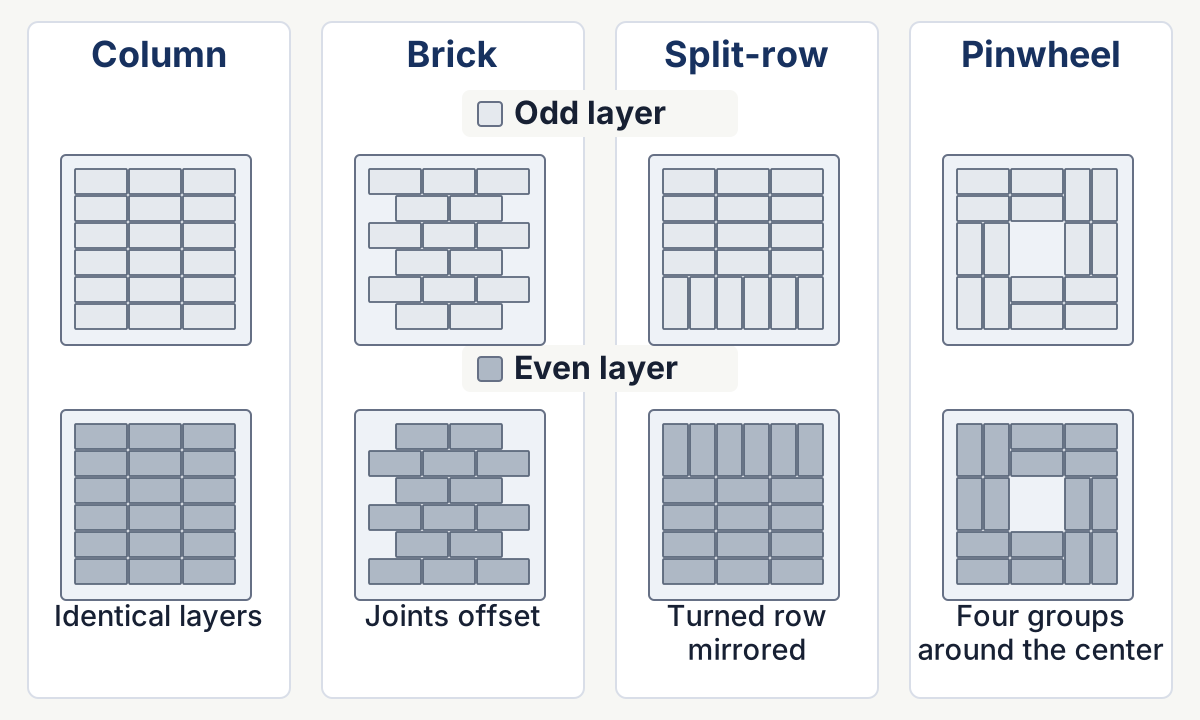
The thesis tested column, split-row and pinwheel patterns, plus hybrids with column-stacked bottom layers and interlocked upper layers. The patterns came from the commercial software CAPE and BestLoad. Hybrids are a real option when the bottom of the load needs strength and the top needs stability.
Column or interlocked: what is the trade-off?
A column stack uses the strongest part of a corrugated case, the corners, but the layers are not tied together. An interlocked pattern ties the layers together but loads the weaker walls of the cases below. Every pattern on this page sits somewhere on that trade-off.
The Virginia Tech thesis summarizes earlier research on both sides:
- Strength. A stacked case carries most of its load at the corners. Interlocking shifts load from the corners to the walls. The studies summarized there estimate the loss in load-carrying capacity at 35% to 55%, depending on the conditions of each study. Treat this as the size of the effect, not a design factor for your case.
- Stability. In an interlocked pattern, each layer holds the cases below it in place by pressing in the opposite direction. Column stacks tend to produce unstable loads that need containment such as stretch wrap, stretch hood, strapping or tie-sheets. Interlocking combined with containment increases overall stability.
- The catch. If interlocking weakens the cases enough that the bottom layer fails, the whole load can become unstable. An interlocked pattern does not make a load safe if the case was sized for column stacking.
The thesis also cites three criteria for judging how stable a pattern is without containment, from Carpenter and Dowsland (1985):
- Each case should be supported by at least two cases below it.
- A high percentage of each case’s base should be in contact with the layer below.
- The pattern should avoid continuous vertical “cuts” that split the load into independent columns.
In the thesis’s own test load, each case in the upper layers of the column pattern rested on one case, while in the fully interlocked split-row and pinwheel patterns each case rested on 2.7 cases on average. The column pattern had seven continuous cuts across the load, and the others had one. These numbers belong to that case and pallet size, but they show how the criteria separate patterns. The thesis did not test a brick pattern. Our reading is that offsetting rows that all run the same way removes continuous cuts in one direction only, so a load that needs joints bridged in both directions usually needs a split-row or pinwheel layout. Check any candidate against the criteria with the real case size.
How do the four patterns compare?
Column stacking keeps the most case compression strength but gives no layer interlock, so stability comes from containment. Brick, split-row and pinwheel patterns trade some compression strength for interlock and ask the palletizer to turn or arrange more cases. The ratings below are qualitative and relative to column stacking. “Forming effort” is our reading of what the palletizer must do, based on the layer definitions above, not a measured rate.
| Pattern | Layer interlock | Case compression | Stability without containment | What the palletizer must do to form a layer | Usually added |
|---|---|---|---|---|---|
| Column | None | Highest, corners aligned | Lowest; layers can shift as columns | Form identical rows; no turning between layers | Stretch wrap or hood, tie-sheets or slip sheets, strapping |
| Brick | Between layers | Reduced, corners over walls | Higher than column | Form rows, often turn one row; alternate the layer program each layer | Stretch wrap; slip sheets if layers must separate |
| Split-row | Between layers | Reduced | Higher than column; depends on how far each case bridges the joints below | Turn a row or block of cases within each layer; mirror on the next layer | Stretch wrap; slip sheets as needed |
| Pinwheel | Within and between layers | Reduced | Higher than column; a center gap reduces support for the cases around it | Turn cases into four orientations per layer; place groups around the center | Stretch wrap; check the center gap |
Space use is not in the table because it depends on the case and pallet dimensions, not on the pattern name. For a given case size, one pattern may fill the pallet deck with no overhang while another cannot. Pattern software is used to find layouts that fill the deck. The thesis selected only patterns with full deck coverage, no overhang and no internal gaps.
How does a palletizer form each pattern?
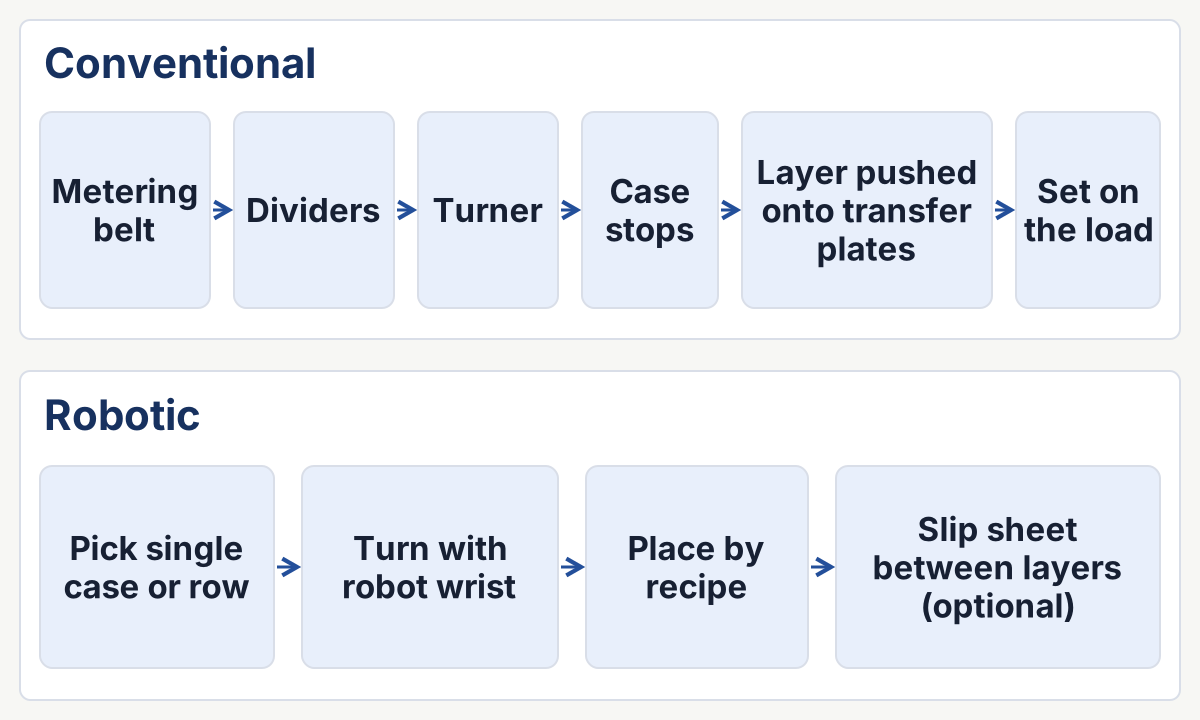
The pattern becomes a machine requirement once you ask how the cases will be turned, grouped and placed. Conventional (layer-forming) palletizers build a whole layer and then transfer it. Robotic palletizers place one case, a group or a row at a time. Each type turns cases differently, so the same pattern can be easy for one and slow for the other.
Conventional layer-forming palletizers
BW Packaging describes this sequence on its Maximizer high-speed case palletizer:
- A metering belt creates a controlled gap between incoming cases.
- Multi-lane dividers position the cases.
- Cushioned overhead turners rotate cases to suit different patterns.
- Full-width pivoting case stops square the cases into a layer in an accumulation area.
- A pusher bar moves the layer onto bi-parting transfer plates, which set it on the load.
Supplier material for Scott’s NexPAL 200HL (Packaging World, September 2026) describes a side-mounted rotating row pusher that lets case infeed and row formation happen at the same time.
On this kind of machine, every case that has to change orientation passes through a turner. Our reading is that patterns with more turned cases per layer, such as pinwheel, ask more of the turner and the row-forming sequence than a column or brick pattern. Ask the supplier whether your pattern can be formed at your target case rate, and how many turning positions it needs.
Robotic palletizers
A robot turns cases with its wrist, so orientation changes come from the program rather than from a turner. Suppliers describe patterns as recipes. ELCAT (supplier-submitted, Packaging World, October 2026) describes cases placed according to a palletizing recipe, with vacuum or mechanical grippers and single or multiple case picking. Applied Manufacturing Technologies (supplier-submitted, Packaging World, September 2026) describes entering case dimensions and selecting a pattern on its cobot palletizer interface.
Picking a whole row is also possible. In a 2015 Packaging Digest plant report, the robot used a fork-style gripper to remove a row of typically three to five cases from the infeed. Our reading is that a robot’s rate depends partly on how many cases it can take per pick in the chosen pattern, and a pattern that needs several orientations can force single-case picks, so ask the supplier how many picks per layer each candidate pattern needs.
Pattern changes are part of format changes. In a 2026 Packaging World report, Boxed Water sends its palletizing system supplier the case dimensions and pallet patterns for each new format, and the supplier updates the palletizer on site or remotely. Treat a new pattern like any other recipe change, as described in the format changeover checklist, and see the PLC, HMI and motion control guide for where recipes sit in a control system.
What containment does each pattern need?
Containment is decided together with the pattern, not after it. A column pattern almost always depends on containment for stability. An interlocked pattern needs less from containment, but usually still has some. The thesis lists stretch wrapping, stretch hooding, strapping and shrink wrap as containment methods, and names stretch wrap as the most common. It notes that wrapping can be manual, semi-automatic or automatic, with automatic machines receiving the load from a conveyor.
Sheets between layers are part of the same decision:
- Slip sheets or tie-sheets. In the Packaging Digest report, the robot placed a slip sheet between layers automatically. The first sheets were too thin for the robot to pick, and a thicker sheet solved it. If you use sheets, their specification is a machine input.
- Sheet dispensing. ELCAT lists interlayer sheet management in its more automated configurations. Confirm whether sheet handling is in the palletizer scope or supplied separately.
Too much containment force can also damage packages, as the thesis notes. That is one reason the wrap specification should be tested on the chosen pattern rather than copied from another product.
How should you choose a pattern?
Start from the case and the shipping conditions, shortlist one or two patterns, then let the palletizer supplier show how it would form them. A pattern that looks best in software can still fail on compression, stability or forming rate.
As a starting rule: if the case was designed for corner loading and has little compression margin, start with a column pattern and plan containment and sheets around it. If the case has margin for an interlocked pattern and the load needs to hold together with less containment, compare split-row and pinwheel layouts that bridge joints in both directions. If the case is weak at the bottom layers but the top of the load needs stability, consider a hybrid with column-stacked bottom layers and interlocked top layers, as tested in the thesis. Each rule is a starting point for testing, not a conclusion.
Inputs to collect first. Soontrue’s list of information needed for a robotic palletizing project covers most of them:
- Case length, width, height and weight, and whether the case is designed for column or interlocked stacking.
- Pallet dimensions and any customer pallet or overhang rules.
- Target stack height and number of layers.
- Case rate from the line, and whether it varies by SKU.
- Conveyor height, case orientation and spacing as the cases arrive.
- Containment method and whether slip sheets or tie-sheets are used.
- Available floor space.
Steps:
- Generate candidate layouts in pattern software for the case and pallet, keeping only those with full deck coverage and no overhang, unless overhang is accepted.
- Check each candidate against the three stability criteria above and against the case’s compression design. If the case was designed for column stacking, an interlocked pattern needs a case strength review.
- Ask each palletizer supplier how it forms the shortlisted patterns, including turning, picks per layer and the rate it can sustain.
- Specify containment and sheets for the chosen pattern.
- Test a full load with the real cases, pattern and containment under the handling and transport conditions you expect, then record the result in the acceptance plan.
As the last machine in the line, the palletizer can become the constraint when upstream output rises, a point made in both Soontrue’s WP30 material and Scott’s NexPAL release. The bottleneck guide shows how to check whether it is.
Questions for palletizer suppliers
- Can the machine form each shortlisted pattern at the target case rate? Please state the rate for each pattern separately.
- How are cases turned (turner, robot wrist), and how many turns does each layer of each pattern need?
- How many picks per layer does each pattern need, and can the gripper take rows or groups?
- How is a new pattern created and loaded, and who can do it: operators, maintenance or only the supplier? Is remote update possible?
- Are slip sheet or tie-sheet dispensing, pallet dispensing and stretch wrapping in scope, and what sheet specification does the machine need?
- What infeed conditions does the palletizer need: case orientation, spacing, conveyor height and the signals from upstream equipment? The line integration checklist lists the interfaces to assign.
- How will pattern accuracy and load quality be checked at factory and site acceptance? See the FAT and SAT guide.
For the case packing and sealing steps that feed the palletizer, see the cartoner and case packer comparison.
Limits and verification
This comparison describes general tendencies. It cannot tell you whether a specific load is stable or strong enough:
- The compression loss range comes from earlier studies with their own cases and conditions. It shows the direction and rough size of the effect, not a value for your case.
- The pallet deflection results in the thesis showed that interlocking reduced pallet deflection by up to 53%, but only under the support conditions where deflection was large. The author states that the results are not an adjustment factor for industry use.
- Forming effort in the comparison table is our reading from the layer definitions and manufacturer descriptions. The supplier’s demonstration with your cases is the evidence.
- Stability depends on case, pattern, sheets and containment together. Test full loads under the handling and transport conditions you expect before releasing a pattern.
- Storage, handling and transport rules vary by customer and market, and this guide does not cover them.
Palletizer cells contain moving layer heads, robots, pallet conveyors and lifts. Entering the cell to clear a jam or adjust a pattern should follow the machine’s energy isolation procedure, with guards, light curtains and interlocked doors kept in place. The installation’s risk assessment sets the guarding.
Frequently asked questions
What is the correct way to stack cases on a pallet?
There is no single correct pattern. Column stacking keeps case compression strength but needs containment. Interlocked patterns add stability at the cost of compression. Choose from the case design and shipping conditions, then test the full load.
How do you correctly layer product on a pallet?
Fill the pallet deck without overhang where possible, support each case on at least two cases below if the pattern is interlocked, avoid continuous vertical splits, and add slip sheets and containment as the load requires. Check the result with a full-load test.
Method and sources
This guide compares pattern families using one third-party research source, a Virginia Tech thesis that also summarizes earlier studies, together with manufacturers’ and trade media’s public descriptions of palletizers. The pattern definitions are our own, because published names differ. Strength and stability statements are qualitative or are attributed to the study that produced them. Forming effort is our inference and is labeled as such. We did not test any pattern or machine. In a search of US desktop results for “pallet stacking patterns” on October 7, 2026, the top results were general warehouse stacking guides, pattern charts and calculators, without a comparison that connects patterns to how a palletizer forms them.
Sources, all accessed October 7, 2026:
- Eduardo Molina Montoya, “Investigation of Pallet Stacking Pattern on Unit Load Bridging”, M.S. thesis, Virginia Tech, May 2017.
- BW Packaging, “BW Packaging Maximizer Series High-Speed Case Palletizer”, product page.
- Jack Mans, “Heavy duty palletizing”, Packaging Digest, March 12, 2015.
- Packaging World, “Boxed Water Brand Hands Heavy Case Stacking to Robotics”, July 2, 2026.
- Packaging World, “Scott Technology Addresses Factory Space Constraints with a Compact, High-capacity Palletizer”, supplier-submitted, September 23, 2026.
- Packaging World, “CRX-Based Collaborative Palletizing Solution”, supplier-submitted (Applied Manufacturing Technologies), September 25, 2026.
- Packaging World, “ELCAT Food Technology Introduces Three Levels of Robotic Palletizing Automation”, supplier-submitted, October 1, 2026.
- Soontrue, “WP30 Robotic Palletizing System: Automatic Carton Palletizing at Propak Cape 2026”, September 22, 2026.
For where palletizing sits in a complete line, see the overview of packaging machine types and the packaging automation guides.
References
Update history
- : First published.
Next steps
Packaging Line Integration Checklist: Interfaces to Confirm Before Ordering
Checklist of mechanical, electrical, signal, communication, safety and utility interfaces to settle before ordering a machine for a packaging line.
Read guide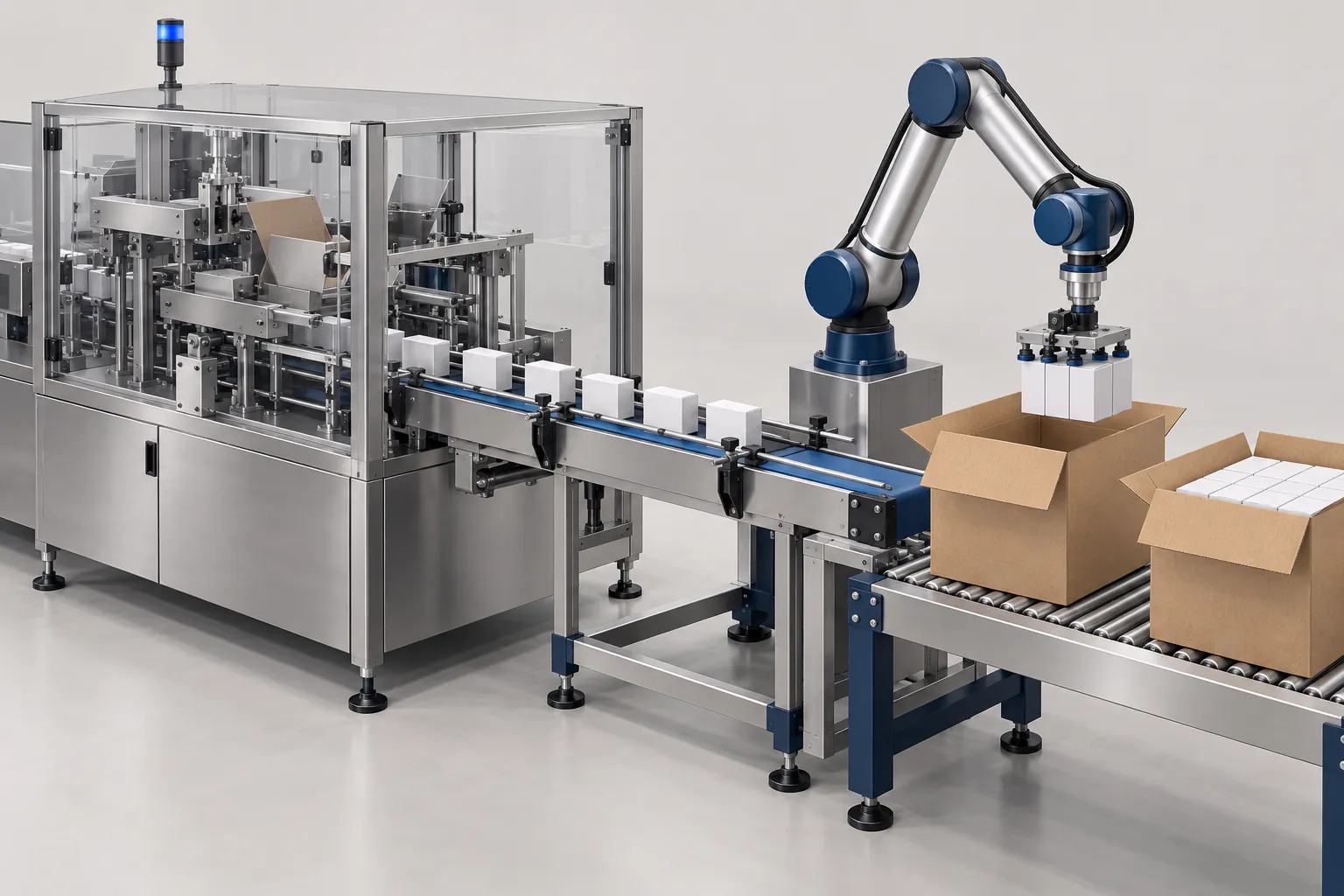
Cartoners vs. Case Packers: Where Each Fits in a Packaging Line
Compare cartoners and case packers by packaging level, loading style, product orientation, counting and end-of-line interfaces, with questions for suppliers.
Read guide
FAT vs. SAT for Packaging Equipment: Defining Acceptance Criteria
Compare factory and site acceptance tests for packaging machines, and learn how to write acceptance criteria that both buyer and supplier can verify.
Read guide