
Auger Fillers vs. Multihead Weighers: Matching the Dosing System to the Product
Compare auger fillers and multihead weighers by dosing principle, product flow, fragility, dust, cleaning and mixes, with supplier questions and trial guidance.
A mismatched doser can cause fill-weight errors or product breakage. An auger filler suits powders and fine granular products that can be metered by volume, when bulk density is consistent enough for the target dose. A multihead weigher suits free-flowing granules, pieces and mixes that can be weighed in separate hoppers. The two are not direct substitutes, and many products suit only one.
Applies to: Covers screw-type auger fillers and combination (multihead) weighers feeding bags, pouches or containers. Does not cover liquid filling, linear weighers or machine-specific settings. Cup filling versus screw transport is a separate paired-lot guide.
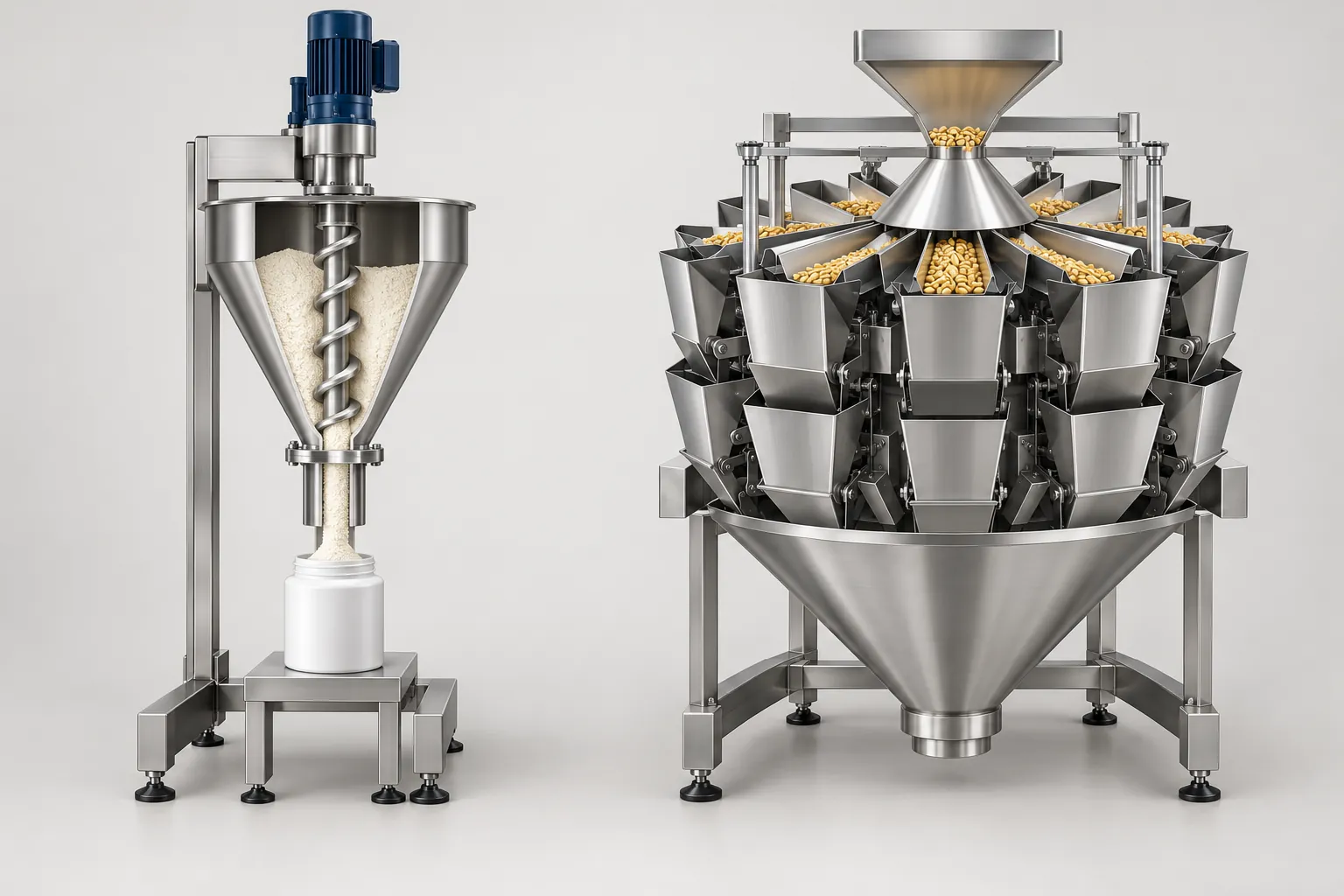
A dosing mismatch can increase fill variation, giveaway or broken product. Start with an auger for a powder that can be screw-metered, or a combination weigher for pieces that can feed separate weigh hoppers, then verify the choice with representative material.
This is a comparison from public manufacturer descriptions, not our own machine tests.
Swipe sideways to see the other columns. The first column stays visible.
| Input | Evidence | Decision it supports |
|---|---|---|
| Material form | Representative powder, granule or piece sample | Screw handling or hopper feeding |
| Bulk-density variation | Lot measurements and fill-weight results | Volumetric control or weight feedback |
| Fragility | Damage after the proposed transfer path | Accept or reject the handling route |
| Cleaning | Product-contact parts and site method | Check changeover and residue |
| Validation | Target dose, speed and agreed sample plan | Compare variation and acceptable output |
How the two dosing principles work
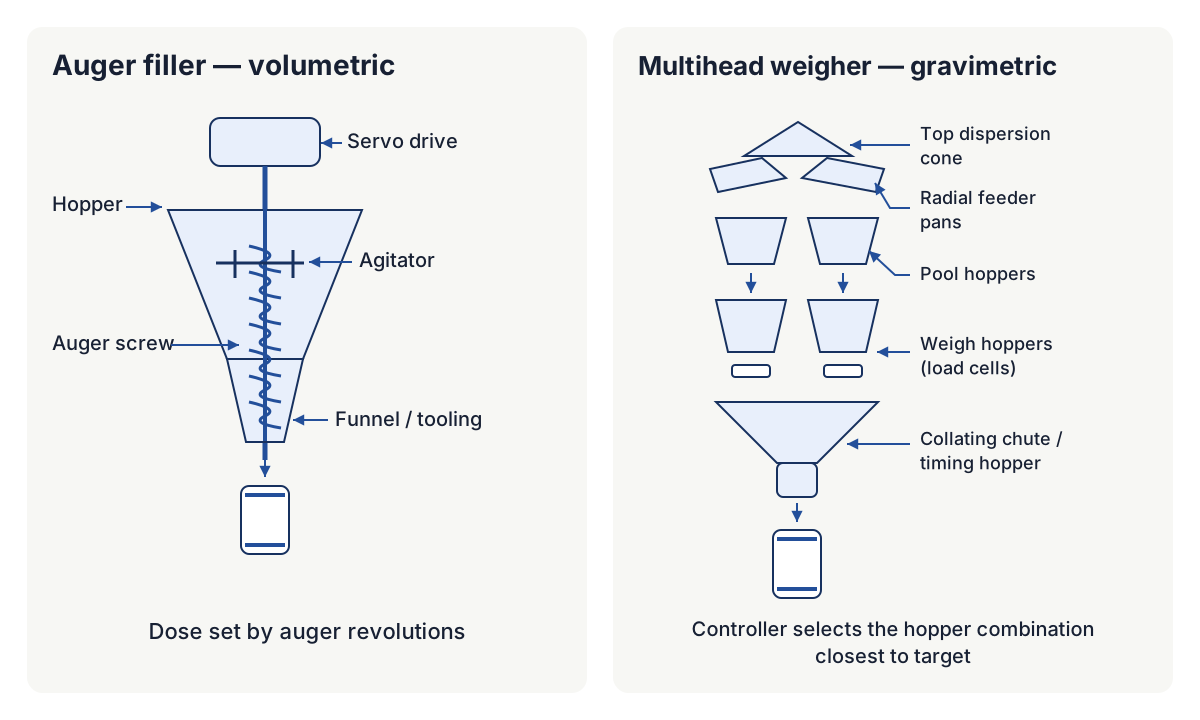
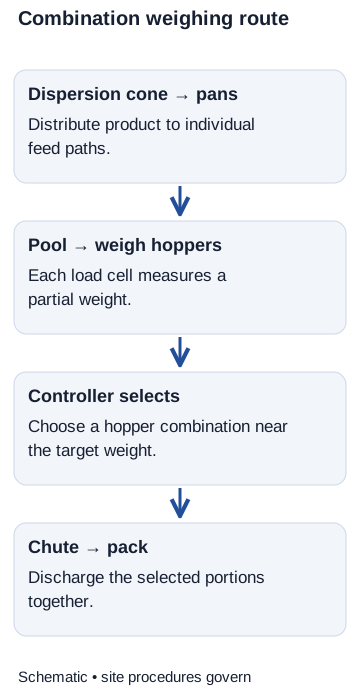
Figure 1 shows both systems. The volumetric auger route uses screw revolutions; the combination route uses measured hopper weights.
Auger filler (volumetric)
Product sits in a hopper, usually with an agitator to keep it moving toward the screw. A servo drive turns the auger screw inside a funnel or tube. In volumetric operation, screw geometry and revolutions set the intended volume; consistent filling of the screw flights matters. The product leaves through the funnel into the container or bag.
The result is a volume. To get the intended weight, the product’s bulk density must be steady, or the system must be adjusted for changes. Some auger systems add weight feedback from a scale to correct the dose, but the core principle is still metering by screw revolutions. The auger and funnel, called the tooling, are sized to the container opening and dose range, so changing product or pack often means changing tooling.
Multihead weigher (gravimetric)
A multihead weigher divides product among a ring of weigh hoppers, each fitted with a load cell. Product enters through a top dispersion cone and travels along radial feeder pans to pool hoppers and then to weigh hoppers. The controller reads the weight in each hopper and selects the combination of hopper contents closest to the target weight. Those hoppers release into a collating chute or timing hopper, which delivers the dose to the packaging machine.
Because the weigher chooses among many partial weights, it can reach a target with products whose individual pieces vary in size, such as snacks, confectionery, fresh produce pieces or frozen items. It does not rely on constant bulk density. Its performance depends on how evenly product feeds the pans and how the pieces behave in the hoppers.
Takeaway: Shortlist a route from the feed path, then test the actual product.
Comparison by product characteristic
The table shows which properties push toward one system. It is a screening tool: a product can fit more than one row, and the final answer needs a trial.
Swipe sideways to see the other columns. The first column stays visible.
| Product characteristic | Auger filler may suit when | Multihead weigher may suit when |
|---|---|---|
| Fine powder | The powder can be moved by a screw without bridging or packing, and bulk density is consistent enough for the dose | Usually unsuitable for fine dusty powder on a standard combination weigher; a specialized design needs product-specific feed, weighing and dust-control validation |
| Granules and free-flowing pieces | The granules are small and uniform, and dosing by volume gives results the application accepts | Pieces flow through the feeder pans and hoppers without clumping, and a weight-based dose is required |
| Fragile or breakable products | The product tolerates being moved by a screw, which can crush or smear some products | The gentle path through pans and hoppers keeps damage within limits, which the trial should confirm |
| Sticky or cohesive products | Cohesion is moderate and the agitator and screw clear the product without smearing | Stickiness is low enough that product does not adhere to pans and hoppers; coatings and special surfaces are sometimes offered |
| Dusty products | A dust-sealed hopper, funnel and dust extraction can be fitted around the dosing and fill area | Dust is limited, because dust gets into load cell areas and complicates cleaning |
| Hygiene and cleaning | The auger, funnel and hopper can be removed and cleaned between products, as the hygiene requirement demands | Pans, hoppers and chutes are designed for the washdown or dry-cleaning method the site uses |
| Mixes and multi-component products | The product is a single powder or a pre-blended mix that does not separate during dosing | Each component can be fed to separate hoppers, or a mix of similar pieces flows evenly |
| Irregular piece sizes | Not usually, because screw dosing assumes small, regular particles | Pieces vary in size, so the combination logic compensates for the variation |
Where each system is common
Auger fillers are common for powders such as flour, spices, protein blends or chemical powders, often into jars, cans or pouches. Multihead weighers are common for snacks, nuts, frozen vegetables, confectionery and hardware items fed to a bagging machine. Both appear in some food and non-food applications, but common use does not prove fit. Check with your own product.
They are not substitutes
Do not infer hopper feeding from the fact that a powder sits in a hopper, or assume a screw can handle a mixture of fragile pieces. If a product seems to fit both, it is usually a granular or small-piece product with fairly steady density. The choice then comes down to accuracy needs, speed, cleaning and cost of change. Linear weighers and vibratory feeders are outside this guide. To separate a gravity cup from screw transport, and to record both on the same two lots, use the auger and volumetric cup filler trial.
Takeaway: Reject candidates that cannot handle your dust, damage or cleaning limits.
What dose accuracy depends on
At a fixed metered volume, a denser powder gives a heavier fill. If lot-to-lot density or feed variation prevents the required weight control, evaluate weight feedback or gravimetric auger operation rather than assuming a standard multihead weigher solves the powder-handling problem. All-Fill’s public technology description explains this distinction.
The machine type alone does not set accuracy. For an auger filler, the main influences are how stable the bulk density is, how consistently product is fed to the screw, the match between tooling and product, and how the container is positioned. For a multihead weigher, they are the feed rate to the pans, the number of heads, how many hoppers contribute to each dose and how the product behaves while falling into the next machine. Over-filling to protect against under-weight packs costs money, so what matters is the variation from pack to pack, not only the average.
Statutory and customer rules for net content differ by market and product. Relevant references include international recommendations on the quantity of product in prepackages, and the buyer needs to know which rules apply to the product and market before setting a target. Checking packs after the machine is common, and the comparison of checkweighers and metal detectors explains how a checkweigher verifies package weight.
Assumed example, not measured data. A plant fills a powder whose bulk density varies between batches. A volumetric auger dose set once would shift in weight with each batch. The buyer asks the supplier how the filler compensates, for example by adjusting revolutions after a weight check, and asks for a trial with samples from two different batches. A second plant fills a mix of irregular pieces and sees little value in a volume dose, so it requests a trial on a multihead weigher with its own mix and asks how many hoppers feed each dose.
Takeaway: Compare the mean and spread across representative batches.
Questions to ask suppliers
Ask for written answers that refer to your product.
- Which dosing principle the quote uses, and why the supplier considers it suited to your product description.
- The dose range and container or bag sizes the quoted tooling or hopper set covers.
- What accuracy statement the supplier makes, how it is defined (for example, standard deviation or the share of packs within a stated range), at what speed and with which product.
- Whether samples can be tested, how many, and which measurements the supplier records.
- How the system handles variation in bulk density, piece size and moisture, and whether weight feedback is included.
- How dust, spillage and product residue are controlled around the dosing point.
- What parts contact the product, their materials and how they are removed and cleaned, and whether the design follows hygienic design principles that suit your product and market.
- What changeover steps are needed between products and pack sizes, and how long they take for a trained operator.
- How the dosing unit communicates with the packaging machine and the line controller: signals, timing, fault handling.
- The safeguarding approach for moving parts, the documentation delivered and the relevant safety references for the target market.
- Recommended spares and wear parts, such as augers, funnels, feeder pan surfaces or load cell parts.
Takeaway: Request the same accuracy definition and trial conditions from each supplier.
Sample trial checklist
- Representative product samples are available, including worst-case batches such as high moisture, fines or oversized pieces.
- Target dose, tolerance and container or bag are written down.
- The trial plan states the speed, the number of packs and the measurements to record.
- Dust, spillage and residue are observed and noted, not only dose weight.
- Product damage, such as breakage or smearing, is inspected.
- Cleaning and changeover are demonstrated at least once with the actual parts.
- Results are recorded by someone from the buyer’s quality or production team.
Trial record to copy
Record each lot and operating condition separately. Define the variation metric and acceptance limits in the trial plan.
Swipe sideways to see the other columns. The first column stays visible.
| Field | Trial entry |
|---|---|
| Batch / product / configuration | ________ |
| Target dose / acceptance source | ________ |
| Speed / sample count / measurement method | ________ |
| Mean fill / spread metric and result | ________ |
| Breakage / dust / residue after cleaning | ________ |
| Result / unresolved issue / sign-off | ________ |
Takeaway: Keep dose results and damage/cleaning observations in the same trial record.
Limits and on-site verification
This guide describes principles and common product fit. It cannot predict accuracy or speed for a specific product, because bulk density, flow, moisture and piece shape change from lot to lot. Plan a representative sample trial and subsequent site acceptance with production material. See the guide on choosing between VFFS and premade pouch machines for how the dosing unit pairs with the packaging machine, and the preventive maintenance checklist for planning routine care of feeders, load cells and screws.
Auger screws, agitators, feeder drives and hopper gates can trap or pinch, and dosing areas can create dust. The safeguarding design needs a risk assessment following the method in ISO 12100 and review by qualified personnel. Clean and adjust only under the site’s energy isolation procedures, and never with guards or interlocks bypassed.
Related decisions
For liquids and pastes, see the piston and pump filling comparison. To place the dosing step among the other machines, return to the overview of packaging machine types. When the choice is made, include trial and acceptance requirements in your RFQ.
Method and source review
Reviewed October 8, 2026. Manufacturer descriptions support mechanisms, not comparative performance:
- All-Fill, Auger Filling Technology, “Principles” and powder/tooling sections: screw geometry, revolutions, flight filling and bulk density; weight filling when closer dose control is required.
- Ishida, combination weighing principle, mechanism section (Japanese): weigh partial quantities, select a combination and discharge it. This supports the weighing route, not a claim that all powders suit it.
Product fit and acceptance remain trial decisions. The blank record is an editorial aid, with no invented performance figures.
References
- OIML R 87:2016 — Quantity of product in prepackages — OIML
- EHEDG Guideline 8 — Hygienic Design Principles (Fourth Edition) — EHEDG
- ISO 12100:2010 — Safety of machinery — General principles for design — Risk assessment and risk reduction — ISO
- EN 415-10:2014 — Safety of packaging machines — Part 10: General requirements — CEN
Update history
- : First published.
- : Pointed cup-versus-screw dosing to the paired-lot trial guide.
- : Clarified powder exclusion and dosing mechanisms, added five decision inputs and a batch trial record, and separated mobile dosing diagrams.
Next steps
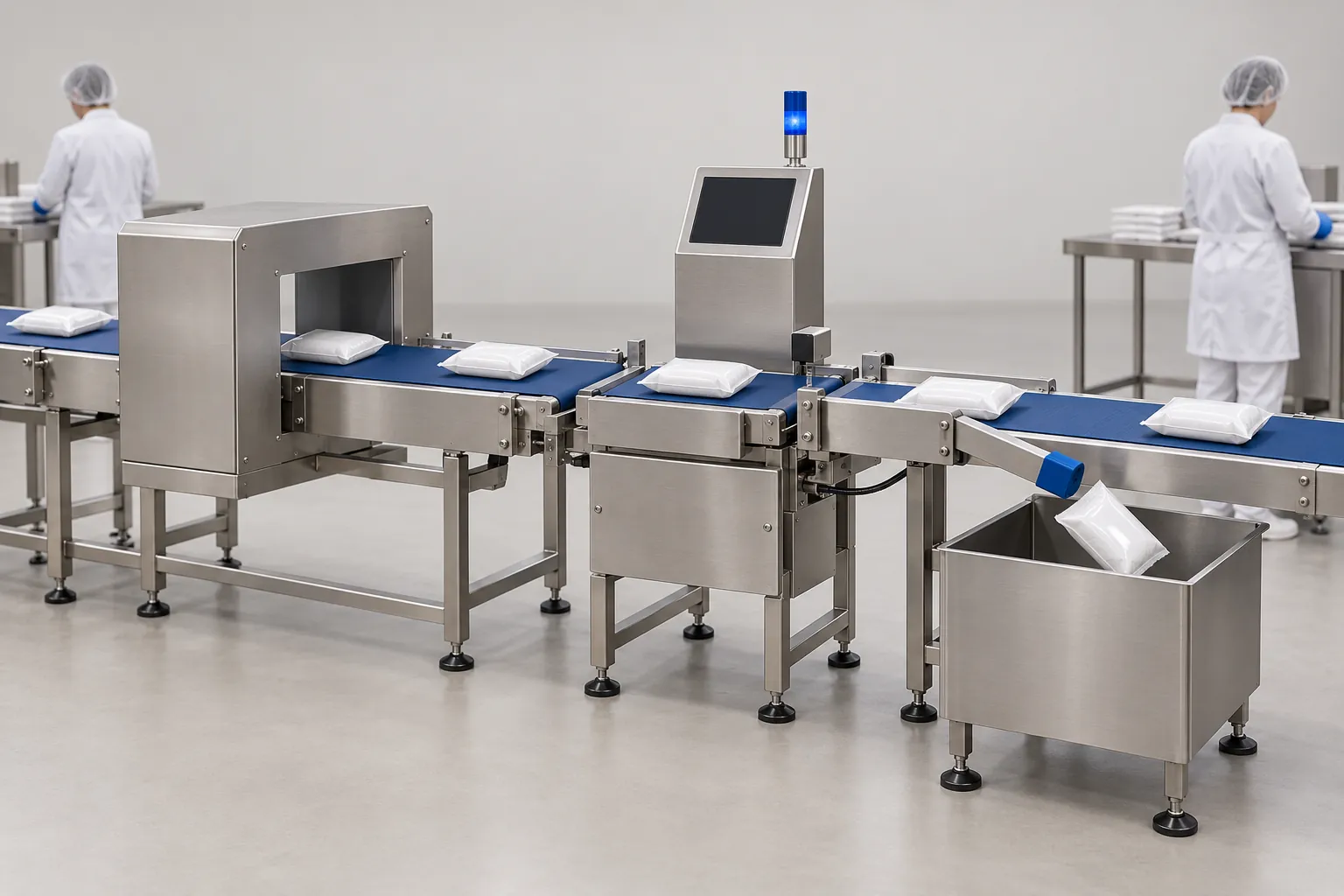
Checkweighers vs. Metal Detectors: Different Inspection Jobs
A checkweigher verifies package weight and a metal detector controls metal contamination. See why one cannot replace the other and how to plan rejects and records.
Read guide
Piston vs. Pump Filling: Questions to Ask Before Choosing
Compare piston and pump filling systems by viscosity, particulates, shear, cleaning, product changes, containers and metering method, with supplier questions.
Read guide
Packaging Machine RFQ Checklist: Information Suppliers Need
A reusable blank RFQ template for packaging machines in nine sections, with the reason suppliers need each item and a list of commonly missed details.
Read guide