
VFFS vs. Premade Pouch Machines: How to Choose
Compare VFFS and premade pouch machines by bag style, product, changeover, film or pouch supply, appearance, footprint and staffing, with questions for suppliers.
Start from the target pouch and material supply: compare VFFS for roll film with fill-and-seal equipment for finished pouches. Stand-up and zipper formats can overlap between designs. Confirm the actual forming or pouch-handling configuration, changeover steps and trial results before choosing; neither route has a universal cost advantage.
Applies to: Covers vertical form-fill-seal machines and rotary or linear premade pouch machines for dry, granular, powder and some liquid products. Does not cover horizontal form-fill-seal, thermoforming or machine-specific settings.
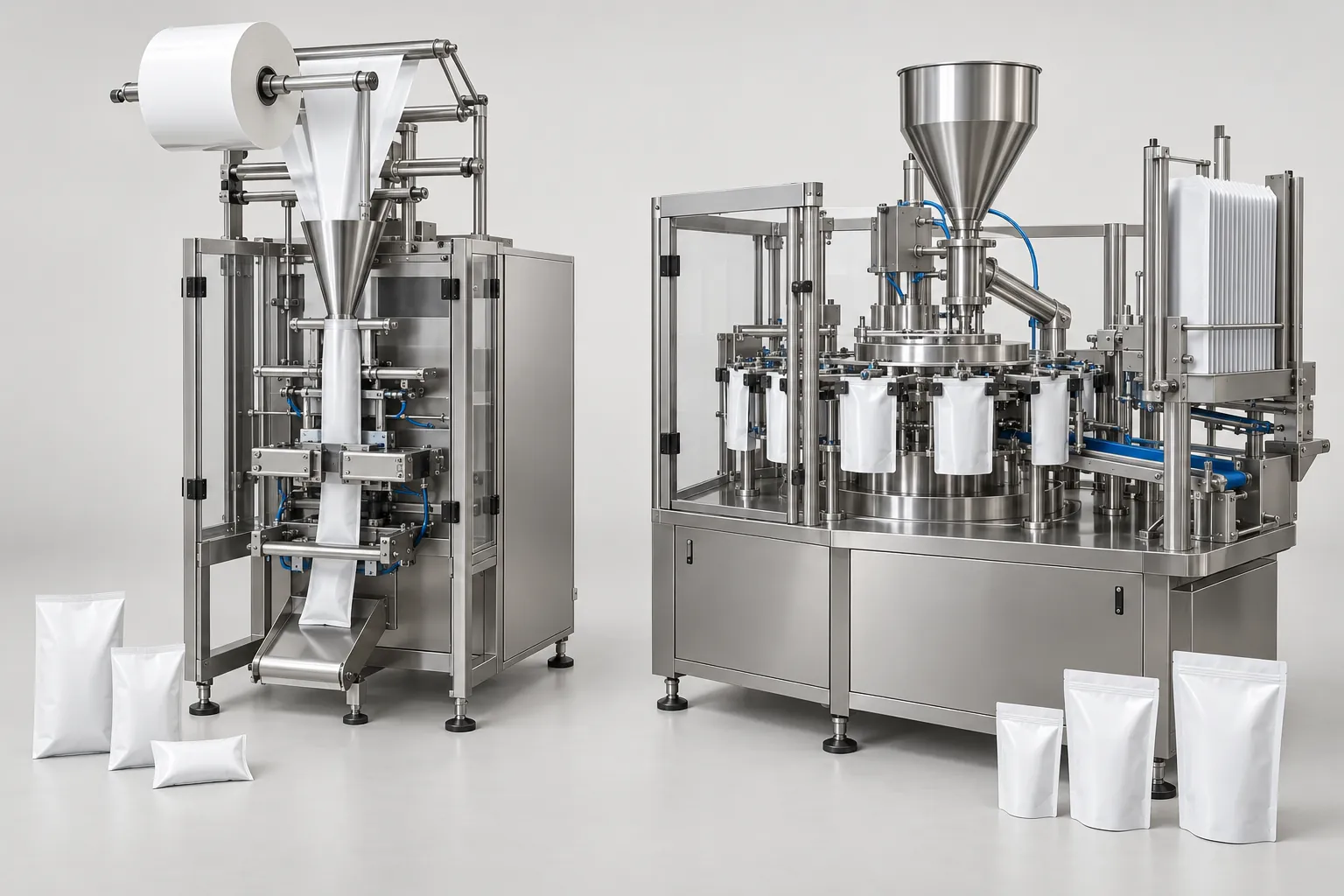
Choosing a machine before settling the pouch can leave the project with incompatible material or avoidable change parts. Compare the target pack and its supply route first, then the operating conditions.
Swipe sideways to see the other columns. The first column stays visible.
| Input or item | Value or source to collect | Why it matters |
|---|---|---|
| Roll film or finished pouches | Material specification and supplier drawing | Identifies forming versus pouch handling |
| Target bag shape | Approved sample, dimensions and closure | Filters candidates; stand-up and zipper designs can overlap |
| Changeover frequency | Format list and changes per shift | Sets which width, length and tooling changes to demonstrate |
| Supply risk | Qualified sources, lead times and minimum orders | Tests whether the chosen material route is practical |
| Verification evidence | Product/material trial and agreed acceptance record | Confirms output, seals and changeover on the actual configuration |
How each machine works
Figure 2 shows each route as a vertical sequence. They do the same job, putting a measured quantity of product in a sealed flexible pack, but they build the pack at different points.
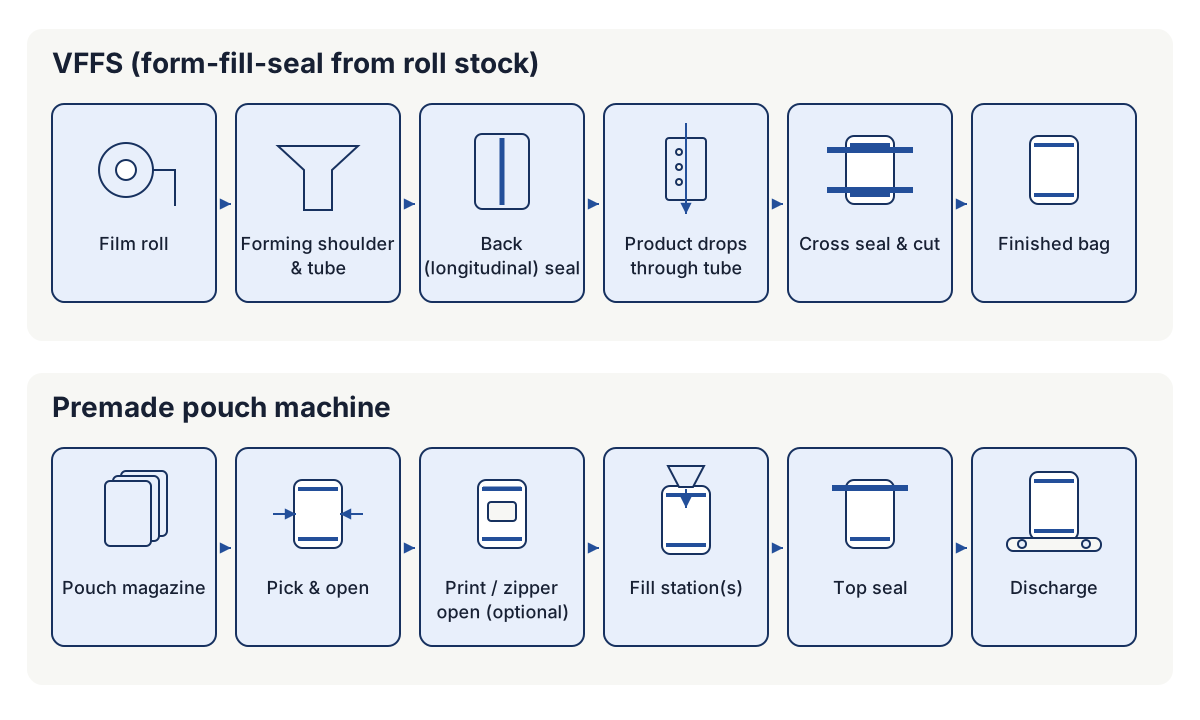
VFFS (form-fill-seal from roll stock)
A VFFS machine starts with a roll of film. The film passes over a forming shoulder and wraps around a vertical forming tube. A back seal, also called a longitudinal seal, joins the edges of the film into a tube. The product drops through the tube, often from a weigher or a filler above it. A cross seal closes the bottom of the next bag and the top of the one below it, and a cut-off separates the finished bag.
The pack is made at the same moment it is filled, so the forming tube size and the cut length set the bag size. Changing bag width usually means changing the forming set. Changing bag length is typically a setting.
Premade pouch machine
A premade pouch machine does not make the pouch. It receives finished pouches, usually stacked in a magazine or hung on a feeding mechanism. The machine picks each pouch, opens it, fills it at one or more fill stations, and seals the top. Many machines offer optional steps such as printing a date, opening a zipper, adding a gas flush or a second seal.
The pouch carries the shape, print and closure features. Rotary machines move pouches along grippers through a series of stations, and linear versions do the same in a line. The number of stations depends on the product and the options needed.
Comparison by package format
Pack format is usually the strongest filter, so start there. The statements in the table are general and individual machine designs can reverse them, so confirm them with the supplier for your target pack.
Swipe sideways to see the other columns. The first column stays visible.
| Package format | VFFS may suit when | Premade pouch machine may suit when |
|---|---|---|
| Pillow bag | A simple bag with a back seal and two crimps meets the sales requirement and the pack is made from roll film | Rarely the first choice, unless the same machine must also run other pouch styles |
| Gusseted (side-gusset or block-bottom) bag | The supplier offers a forming set for the gusset style, and the product fits a bag of that shape | A flat-bottom pouch with a separate premade structure is preferred |
| Stand-up (doypack-style) pouch | A VFFS variant or add-on can form a bottom gusset for the pack and the shape is acceptable | The pouch must stand reliably, have a defined shape or use a bottom seal structure that a former cannot produce |
| Zipper or other resealable pouch | The supplier can add a zipper applicator on the machine and the film or zipper supply is available | The resealable feature is part of a premade pouch and the machine opens and seals it |
| Shaped, spouted or specialty pouch | Not usually, because forming tubes make straight tubular packs | Premade pouches carry the shape, and the machine is built or configured to handle that pouch |
If the pack is a pillow bag and the product suits a drop from above, VFFS is often the starting point. If the pack must stand, close again or have a spout, a premade pouch route is often the starting point. Between these ends there is overlap: a stand-up or zipper label alone does not exclude VFFS. Request the exact forming/add-on or pouch-opening configuration and a matching sample. Takeaway: Shortlist the route that can demonstrate the required pack, rather than choosing from the pouch name alone.
What “pouch packing machine” covers
For a proposed coffee valve pouch, use the SunDance announcement line checks to identify the drawings and samples needed for a premade-pouch review.
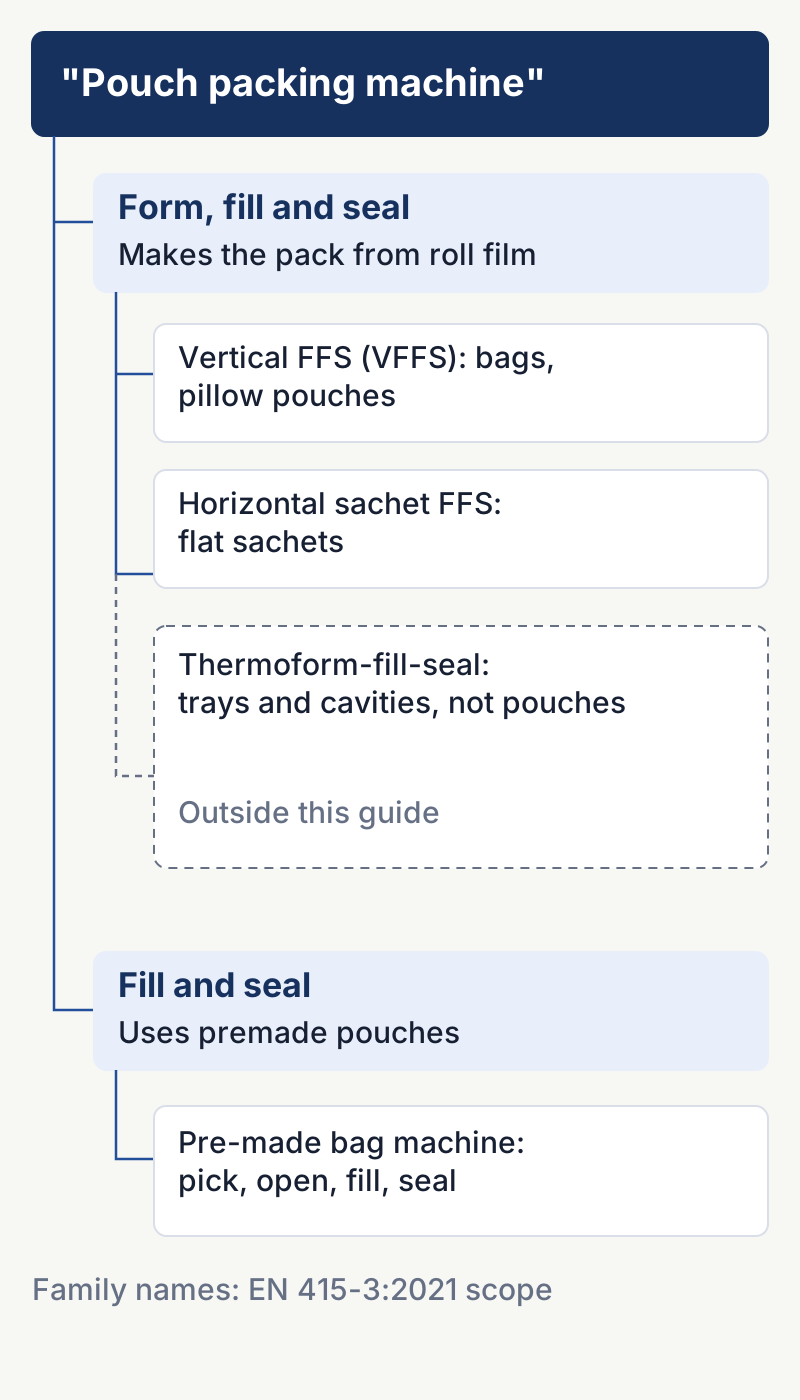
“Pouch packing machine” is a sales term, not a machine type, and listings under it show two different families. European machine safety standard EN 415-3:2021 is titled “Form, fill and seal machines; fill and seal machines”, and its scope separates them in the same way:
- Form, fill and seal machines make the pack from roll film on the machine, then fill and seal it. The scope lists vertical form, fill and seal machines, horizontal sachet form, fill and seal machines, flow wrapping machines, tubular bag, mandrel and thermoform, fill and seal machines.
- Fill and seal machines receive a pack that was made elsewhere. For pouches the scope names the “pre-made bag, erect, fill and seal machine”, which is the premade pouch machine compared on this page. Cup or tub and sack fill and seal machines belong to the same family.
Operating manuals make the distinction concrete. The Sal-Tech STEP VFFS operation manual, section IV, identifies the film-roll, forming and sealing systems and describes film passing from the reel through rollers into the former. The SME MD-RZ premade-pouch operation manual, sections V and VII, instead describes bag feeding, bag opening, filling, heat sealing and discharge. Those are examples of the two families; their station layouts and options belong to the documented models, not every pouch machine.
So when a supplier offers a pouch packing machine, ask which family it belongs to. If the machine takes roll film, it is a form-fill-seal machine, usually a VFFS for bags and pillow pouches or a horizontal machine for flat sachets. If it takes a stack of finished pouches, it is a premade pouch, or pick-fill-seal, machine. The difference decides what you buy as packaging material, how you change size and what the pack can look like, as the rest of this guide explains.
Swipe sideways to see the other columns. The first column stays visible.
| Machine | What it starts from | Typical packs | Covered here |
|---|---|---|---|
| Vertical form-fill-seal (VFFS) | Roll film, formed around a tube | Pillow and gusseted bags; some stand-up styles with add-ons | Yes |
| Premade pouch (pick-fill-seal) | Finished pouches from a pouch supplier | Stand-up, zipper, spouted and shaped pouches, flat pouches | Yes |
| Horizontal sachet form-fill-seal | Roll film, formed horizontally | Flat sachets and small pouches | No, see the stick pack and sachet comparison |
| Thermoform-fill-seal | Roll film or sheet, heated and formed into cavities | Trays and cavity packs sealed with a lid film, not pouches | No |
Thermoforming packaging machines often appear next to pouch machines in search results. A thermoform-fill-seal machine is also a form-fill-seal machine in the EN 415-3 list, but it forms cavities rather than a bag, so it competes with tray packing rather than with pouches. Machines that only thermoform packs, without filling and sealing, are excluded from EN 415-3 and referred to EN 12409. For the wider map of packaging machine types, including cartoning and case packing, see the overview of packaging machine types.
An “automatic packing machine” in either family still needs a dosing unit, such as a multihead weigher, auger filler or liquid filler, and the dosing choice is a separate decision covered in the dosing section below.
Comparison by operating factor
The next table covers factors that matter once the pack format allows both routes. Treat every row as a question to test, not a ruling.
Swipe sideways to see the other columns. The first column stays visible.
| Factor | VFFS | Premade pouch machine |
|---|---|---|
| Product | Suits free-flowing and many irregular products that can fall through a tube, when the dosing unit above can deliver on time. Sticky, dusty or fragile products need attention to the product path and sealing area | Suits many dry, granular, powder, liquid and paste products when the fill station is matched to the product. A wider mouth opening may help with large pieces and cleaner fills |
| Changeover | Changing bag width usually involves changing the forming set and related parts, and length is often a setting. Match the changeover time to the number of changes per shift | Changing pouch size often involves adjusting gripper spacing, magazine guides and fill tooling. Some machines are designed for quick size adjustment within a range |
| Film vs premade pouch supply | Buys roll film. Compare material, conversion and measured waste on the same pack and purchasing basis; film must suit forming and sealing | Buys finished pouches. Compare matched material, size, order quantity and included conversion costs; pouch consistency affects picking and opening |
| Pack appearance | Gives bags with a back seal and crimps. Print is on the film and registered by a mark sensor. Shape options are limited by the tube | Gives pouches with printed fronts, defined bottoms and optional features such as zippers or spouts, as made by the pouch supplier |
| Footprint | Usually tall and narrow, with the weigher or filler above the machine. Check ceiling height and platform requirements | Usually wider and lower, though a rotary arrangement and its feeders take floor space. Check access for pouch loading |
| Staffing | Operators load film reels, splice, monitor sealing and adjust forming parts when changing sizes | Operators load pouches into the magazine, monitor pick and open reliability and manage pouch supply |
| Speed | Rated speeds vary widely by design. Confirm the rated speed in packs per minute for your product and bag, not for a reference product | Rated speeds vary widely by design. Confirm the rated speed for your pouch size and fill, and check what happens when the product needs a second fill or a zipper step |
Product and dosing
Choose the machine and the dosing method together. VFFS machines are usually paired with a multihead weigher for snacks and free-flowing pieces, or with an auger filler for powders. Premade pouch machines can use the same dosing systems or liquid and paste fillers. The comparison of auger fillers and multihead weighers covers the trade-offs.
Products that dust, cling or contaminate the seal area need attention on both routes. Product in the seal is a frequent cause of weak seals in both cases, and each machine handles it differently. Ask suppliers how the machine manages product near the seal, and test with your own product.
Changeover
Count how many pack sizes will run and how often they will change. A plant that runs one bag size for weeks has different needs from one that runs several sizes each day. Ask which adjustments, indicators, parts and stored recipes are provided, and time the complete changeover. A length change and a width change are different trials: record film advance/registration settings for length and the forming set or pouch-handling parts for width. The format changeover checklist lists what to plan for and how to record each step.
Film versus premade pouch supply
This is often the deciding commercial factor, and it combines cost, supply security and handling. Compare delivered quantities and storage requirements for the proposed film reels and pouch cartons. Check whether the proposed VFFS configuration can reproduce the required print, shape and closure, or whether these need to be supplied in a finished pouch. Questions to settle:
- Who supplies the film or pouches, how many sources are qualified, and what lead times and minimum quantities apply?
- Are film specifications such as seal layer, thickness, friction and print registration suitable for the machine? The guide on film and machine compatibility covers this.
- Are pouch dimensions and stiffness consistent enough for reliable picking and opening?
- How much waste do changeovers and start-ups create in each case?
Pack appearance
A VFFS pack has a back seal, usually on the back of the bag, and crimps at top and bottom. Many retail products are sold this way. A premade pouch can have a printed front panel without a visible back seal, a stand-up base and a resealable closure. If shelf presentation or consumer use is a key requirement, take samples of both formats to the marketing and quality teams before deciding.
Footprint and staffing
Measure the available floor area, ceiling height, access aisles and utilities before shortlisting. A VFFS machine and its weigher platform may need height. A premade pouch line may need floor area and a clear route for loading pouches. Staffing depends on how much loading, splicing, adjusting and inspection the machine requires. Take that from the supplier’s description of operator tasks and test it during trials, instead of estimating it from rated speed.
Illustrative scenario, not measured data. A plant packs a dry product in one bag size and expects to change size rarely. The pack is a pillow bag with no resealable feature. The buyer lists what each route needs: roll film and a forming set for one VFFS size, versus a pouch supplier and a magazine for premade pouches. The buyer takes VFFS forward as a candidate for the simple roll-film pack; a cost preference remains open until comparable quotations and waste records are available. If the same plant later needs a stand-up zipper pouch, the comparison is repeated for that pack, and the answer may change.
Takeaway: If both routes meet the pack requirement, compare demonstrated changeover, handling, supply and cost records under the same conditions.
Copyable route and cost record
Copy these blank rows into your project record; use one row per candidate. Leave unknown costs blank rather than treating them as zero.
Swipe sideways to see the other columns. The first column stays visible.
| Bag sample / drawing; product; format list | Candidate route / configuration | Exclusion reason or open condition | Trial evidence / result |
|---|---|---|---|
| — | — | — | — |
Swipe sideways to see the other columns. The first column stays visible.
| Cost item | Shared comparison basis | VFFS quotation / record | Premade quotation / record |
|---|---|---|---|
| Packaging supply | Same material structure, size and purchase quantity; identify included conversion | — | — |
| Start-up and changeover waste | Same product, format sequence and accepted-pack count | — | — |
| Labor and change parts | Same tasks and operating window | — | — |
Questions to ask suppliers
For either machine type, request answers in writing so quotes can be compared.
- Which pack styles and size ranges the machine runs, and which parts change between them.
- The rated speed in packs per minute for your product, bag or pouch size and fill weight, and the conditions behind that rating.
- Whether the supplier will run a trial with your product and your film or pouches, and what data they record.
- The film or pouch specification the machine expects, including seal layer type, thickness range, roll dimensions or pouch dimensions and tolerances.
- How the machine handles product in the seal area, and what sensors, shakers or air options are offered.
- The changeover steps, the tools needed and whether stored recipes are available.
- Which dosing or filling equipment the quote includes and how it interfaces with the machine.
- The safeguarding approach, relevant safety references for the target market, and the documentation delivered.
- How the machine reports faults, film or pouch run-out and downstream blockage to a line controller.
- Recommended spares and wear parts, such as sealing jaws, knives and pouch grippers.
Selection checklist
- The required pack styles are written down, with sample packs or drawings.
- The product has been described by flow, size, density, dust and stickiness, and samples are ready.
- The number of formats and the expected changeover frequency are known.
- Film or pouch suppliers are identified, with specifications and lead times.
- Marketing and quality have reviewed pack appearance samples.
- Floor area, ceiling height and utilities for each option have been checked against the site.
- Operator tasks per shift are listed for each option.
- Trial conditions are agreed: product, material, rate and what will be measured.
- Acceptance criteria are defined, linked to factory and site acceptance testing.
Limits and on-site verification
This comparison describes typical differences. Machine designs overlap, and a given VFFS machine may offer features usually associated with premade pouch machines, or the reverse. The guide cannot settle which route suits a specific product, because that needs real product, real packaging material and the actual machine under production conditions.
Test seal integrity, fill accuracy, pack appearance and changeover time with your own product and material before committing, and again during acceptance. Machine manuals define the permitted adjustments and maintenance. Form-fill-seal machines have heated sealing jaws, cutting knives and other heated parts, so the safeguarding design needs a risk assessment following the method in ISO 12100 and review by qualified personnel. Relevant references include EU safety requirements for form, fill and seal machines, general safety requirements for packaging machines and a United States safety standard for packaging and processing machinery; which apply depends on the market and the product. Clearing a jam or cleaning near the jaws and knives happens only under the site’s energy isolation and safe-working procedures.
Related decisions
If the pack under consideration is a small single-serve format, see the stick pack and sachet comparison. To see where either machine sits among other equipment, return to the overview of packaging machine types. When you are ready to turn the choice into a request, use the RFQ checklist.
References
- EN 415-3:2021 — Safety of packaging machines — Part 3: Form, fill and seal machines; fill and seal machines — CEN
- EN 415-10:2014 — Safety of packaging machines — Part 10: General requirements — CEN
- ANSI/PMMI B155.1-2023 — Safety Requirements for Packaging and Processing Machinery — PMMI
- ISO 12100:2010 — Safety of machinery — General principles for design — Risk assessment and risk reduction — ISO
Update history
- : First published.
- : Moved pack selection ahead of terminology; added matched cost and route records and clarified overlapping formats and changeovers.
- : Added what "pouch packing machine" covers, using EN 415-3 family names and actual VFFS and premade-pouch operation manuals.
Next steps
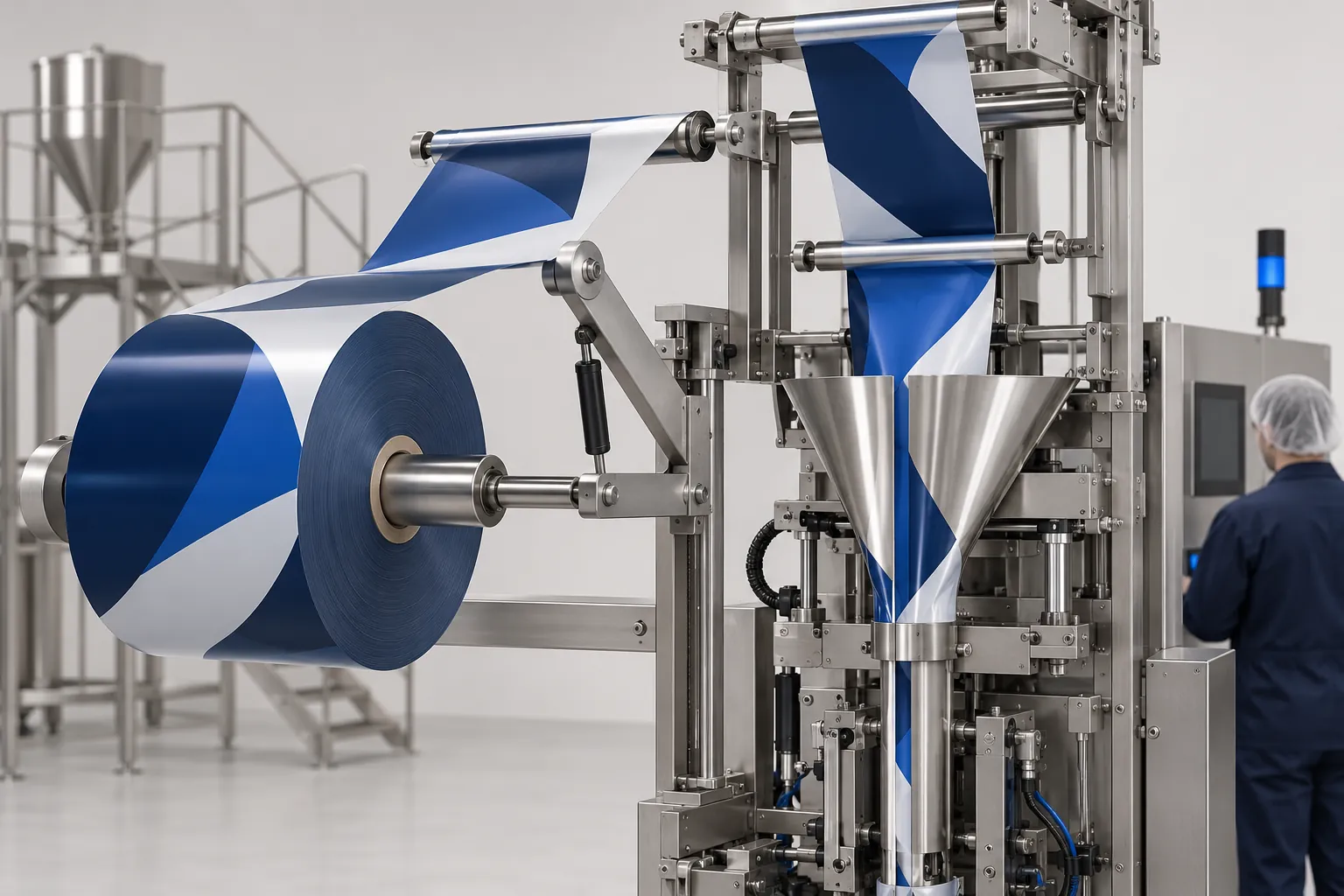
Packaging Film Compatibility: Questions Beyond Film Thickness
Follow the film path from reel to cut-off and list what to ask the film and machine suppliers about tension, friction, registration marks and sealing.
Read guide
Stick Packs vs. Sachets: Choosing a Single-Serve Format
Compare stick packs and 3-side or 4-side seal sachets by seal structure, dose, opening, film use, display and multi-lane machine configuration for buyers.
Read guide
Packaging Machine RFQ Checklist: Information Suppliers Need
A reusable blank RFQ template for packaging machines in nine sections, with the reason suppliers need each item and a list of commonly missed details.
Read guide