
Stick Packs vs. Sachets: Choosing a Single-Serve Format
Compare stick packs and 3-side or 4-side seal sachets by seal structure, dose, opening, film use, display and multi-lane machine configuration for buyers.
The wrong opening or product path can cause spills or unusable packs. A stick pack suits a narrow, elongated single dose that is poured or tipped out, and it is formed with a back seal plus top and bottom seals. A 3-side or 4-side seal sachet suits a flatter, wider pack that is torn or cut open, or that needs more print area. The choice depends on the dose, the product, the opening method and how the packs are displayed or cartoned.
Applies to: Covers vertical stick pack and sachet machines for powders, granules, liquids and pastes in single-serve portions, including multi-lane configurations. Does not cover bottle, bulk bag or tray packaging, nor machine-specific settings.
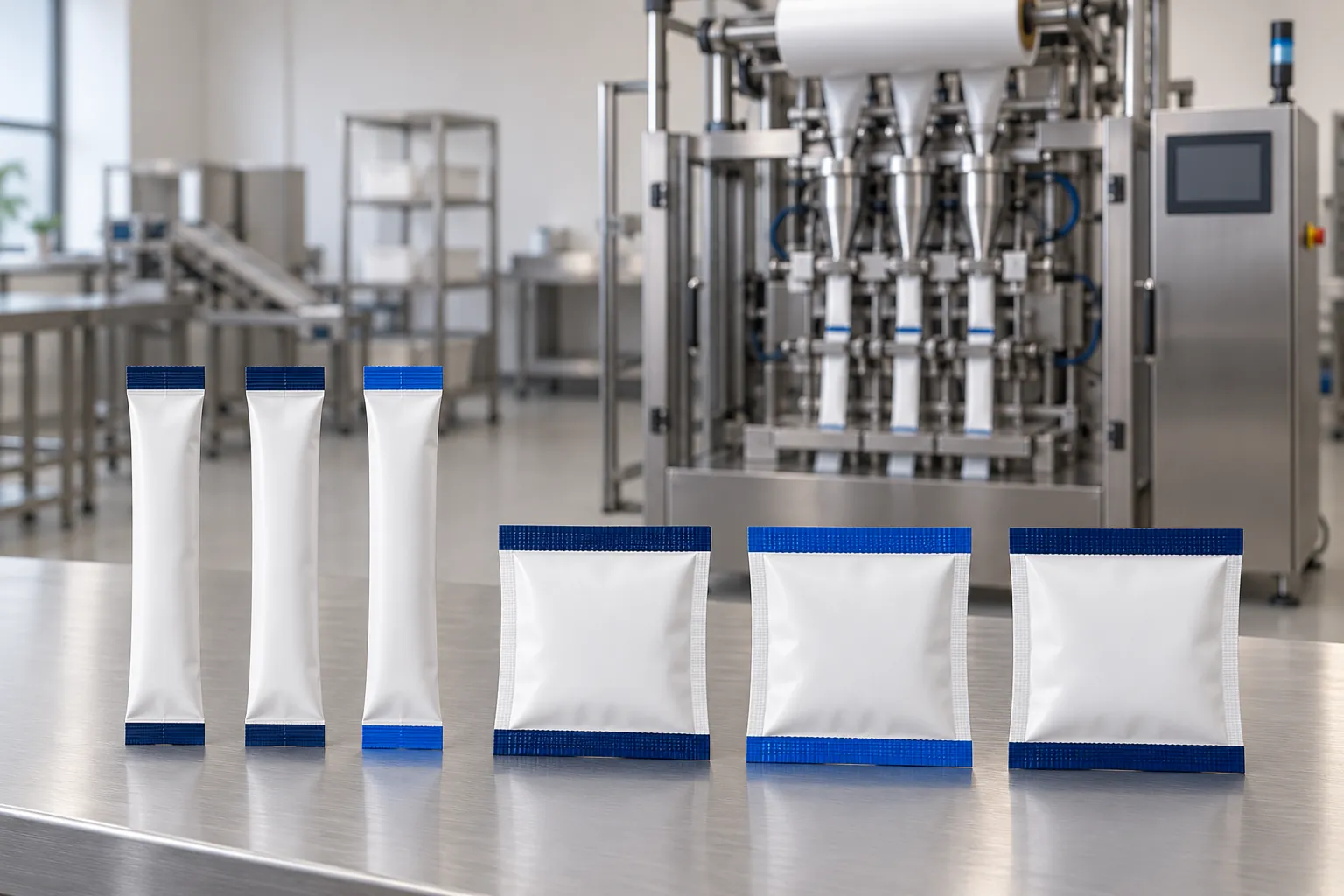
The wrong opening or filling path can spill a dose or leave product trapped in the pack. Compare the seal structure and intended use first, then check dosing, film and lane configuration.
Swipe sideways to see the other columns. The first column stays visible.
| Format | Seal structure | Opening / product path | Print area |
|---|---|---|---|
| Stick pack | Longitudinal back seal plus top and bottom | Defined top opening; narrow pouring path to verify | Narrow panel; confirm artwork space |
| 3-side sachet | One fold edge; three sealed edges in this example | Notch or cut edge; flatter fill/use path | Wider flat panel |
| 4-side sachet | Four sealed edges; no unsealed fold edge | Defined torn/cut edge; confirm discharge | Flat panel with perimeter seal margins |
This comparison is compiled from public descriptions, not our own machine tests. The seven-step process follows the format overview, so use it to identify the operation scope after choosing a candidate pack.
How each format is formed
Both formats use reel-fed film, but the forming geometry differs: sticks form a narrow tube; the sachet examples form a flat pocket with defined edge seals.
Stick pack
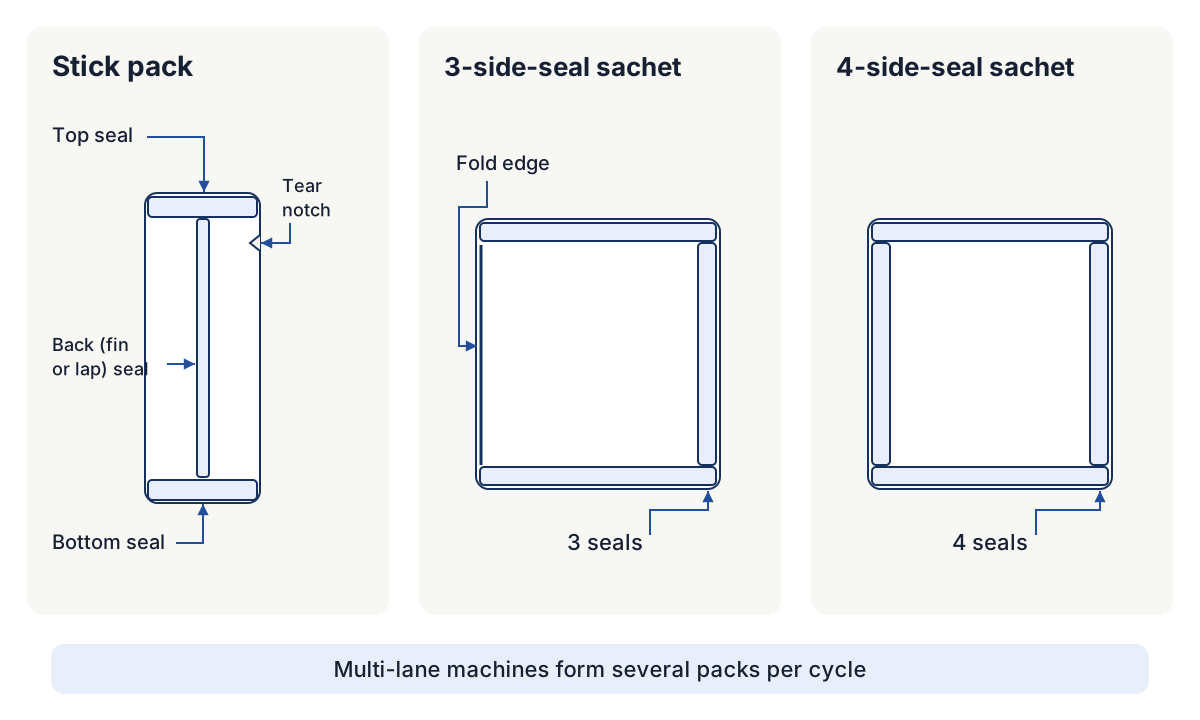
A stick pack is a narrow, long pack. The film is formed around a small forming tube and its edges are joined with a back seal that runs along the length of the pack. The back seal is either a fin seal, where the inner surfaces of the film meet and are pressed together, or a lap seal, where one edge overlaps the other. Transverse jaws then make the bottom seal, product is dosed into the tube, and the top seal closes the pack and starts the bottom seal of the next one. A tear notch near the top seal lets the consumer open the pack by hand.
The result is a tubular pack with three seals: the back seal, the top seal and the bottom seal.
3-side-seal sachet
A 3-side-seal sachet is a flat pack. In one common arrangement, the film is folded lengthwise so the fold forms one edge, and seals close the other three sides, usually the top, the bottom and one side. The fold edge is not a seal. Confirm the fold and the actual sealed edges on the proposed pack drawing.
4-side-seal sachet
A 4-side-seal sachet is also flat, but all four edges are sealed. It is typically made from two webs, or from a folded web with an additional seal. With no fold edge, every side is a sealed edge. This structure is used where a flat, even pack with seals all around is wanted, for example for a wafer-like or flat insert product.
Multi-lane machines
Because the packs are small, many machines form several packs side by side. As the diagram notes, a multi-lane machine forms several packs per cycle. The film web is wide, and several forming tubes or sealing stations run across it. The web is then cut into individual packs or into continuous strips.
How a stick packing machine works
A stick pack machine is a vertical form-fill-seal machine built for narrow packs. Many stick pack machines are multi-lane machines, which take one wide reel of film and turn it into several rows of sticks at once. The sequence below follows a supplier’s published description of the process (Burgen Machine, “What Is a Stick Pack Machine?”, supplier source); individual machines differ in the order and design of some steps, so check the sequence against the manual for the machine you are offered.
The manufacturer’s public ST600 description independently lists powered unwind/tension control, film slitters and forming tubes set per bag size, plus optional length adjustment and opening features. It supports those operation categories, not the timing sequence of every model. The previously cited third-party operator-manual copy could not be verified for version and page locations, so its model-specific explanation has been removed.
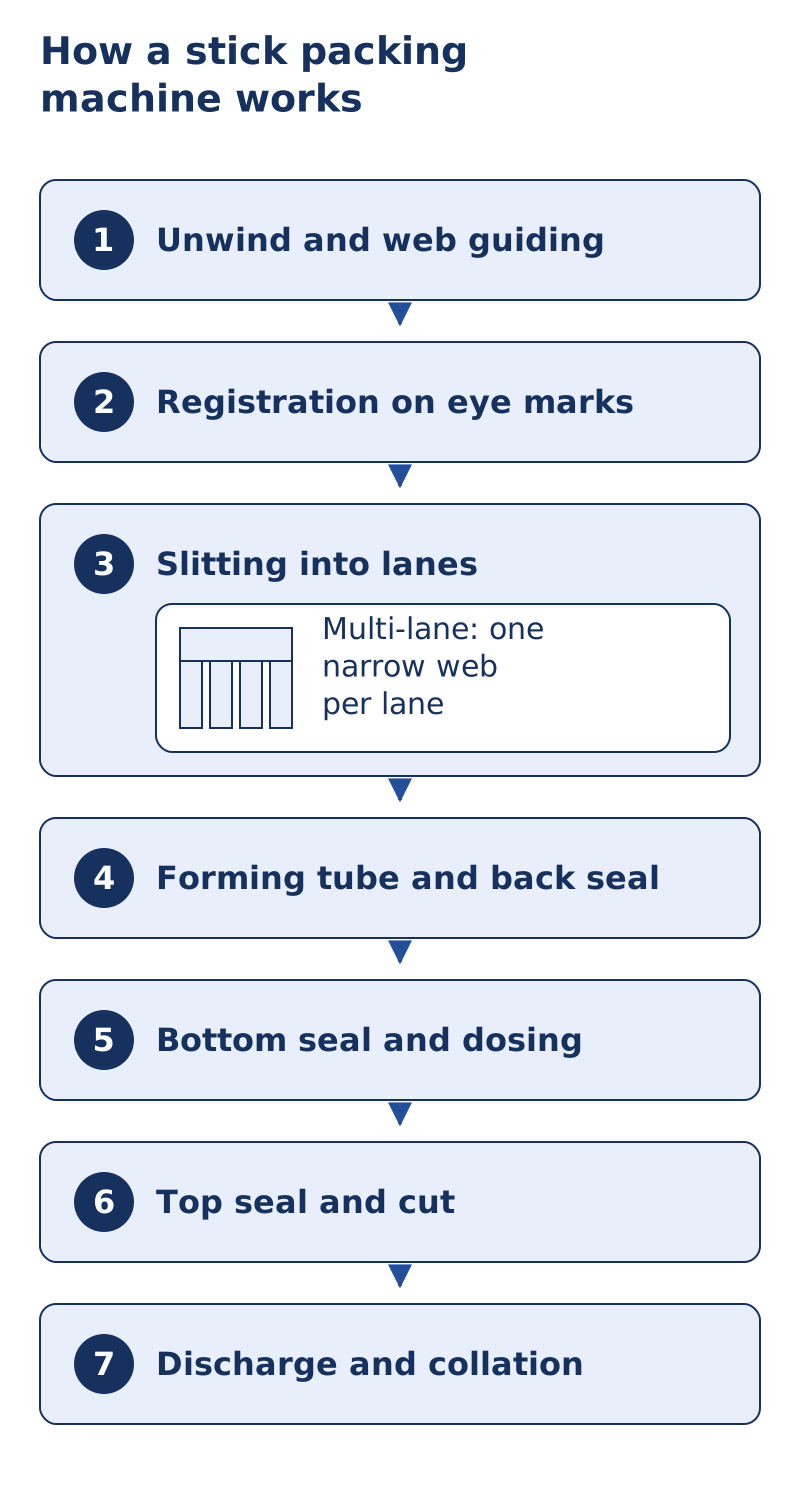
- Unwind and web guiding. The film comes off the reel under controlled tension, and a web guide keeps its edges from wandering.
- Registration. On printed film, a photo-eye reads the eye marks so that each stick is cut in step with the artwork.
- Slitting into lanes. On a multi-lane machine, a slitter divides the wide web into narrow webs, one for each lane.
- Forming and back seal. Each narrow web is folded around its own forming tube, and a longitudinal seal, the back seal, closes it into a tube as a lap or fin seal.
- Bottom seal and dosing. A transverse seal closes the bottom of the tube, and the dosing system fills each lane through its tube: augers for powders, cup or volumetric systems for granules, and pumps or pistons for liquids.
- Top seal and cut. The transverse jaws seal the top of the filled stick, which also forms the bottom seal of the next one. A knife cuts the sticks to length, and a tear notch is made where the pack design calls for it.
- Discharge and collation. The sticks leave the machine onto a conveyor or into a collating system for counting and cartoning.
Each step maps to a question in this guide. Slitting and lane count belong to the multi-lane specification below; the forming tube and back seal set the stick width and seal type on the pack drawing; dosing per lane is covered under dose and filling; the film properties that let a narrow web run through these steps are covered in the film and machine compatibility guide.
Single-lane, small and manual stick packing machines
A single-lane or small stick packing machine follows the same sequence with one forming tube, and it can suit low volumes, product trials or many short runs. The words used in supplier listings need checking. “Manual” can describe manual product loading into the hopper, manual reel changes, manual collection of finished sticks or manual adjustment at changeover, and a listing does not always say which. Ask which of the seven steps above the machine performs on its own, which are left to an operator, and how the dose is controlled when product is loaded by hand. Operator time for the manual steps belongs in the operation row of a total cost of ownership comparison.
Conditional comparison
The table lists the main decision points. Read each cell as “suits when” under that condition, not as a rule.
Swipe sideways to see the other columns. The first column stays visible.
| Decision point | Stick pack suits when… | Sachet (3-side or 4-side seal) suits when… |
|---|---|---|
| Dose and product | The product is a free-flowing powder, granule or thin liquid that can be tipped out in a narrow stream | The product is a paste, gel, cream, wipe-like or flatter item, or the dose is wider than a narrow tube can handle well |
| Opening | A tear notch and pour-out use fits the consumer | A tear notch or a cut-open edge on a flat pack fits, and squeezing out a paste is expected |
| Print area | A narrow, tall print panel is enough | A larger flat panel is needed for text, graphics or promotional space |
| Film use | The pack has a tubular layout with fewer seal edges in many cases | The pack may use more film for the seal margin around the dose; the actual film use per dose depends on the dimensions and seal width |
| Shape and display | Packs are stood upright in a tub or dispenser, or lined up in a carton | Packs lie flat in a carton, are stuck to a card or are inserted in another pack |
| Cartoning | Sticks are counted into bundles or stacked and fed to a cartoner | Flat sachets are stacked or shingled and fed to a cartoner |
| Machine configuration | Lane count and pitch are set by the pack width and the web | Lane count and format size are set by the pack width and cutting method |
| Format changes | Dose within the configured range may be a dosing setting; length may be a draw/cut setting; width or seal geometry may need tooling changes | Distinguish dose settings, draw/cut length and width/seal tooling; confirm each change against the machine manual |
Dose and filling
Single-serve packs put the dosing question up front. A dose can be filled by volume, for example with a volumetric cup or an auger, by weight, or by a pump or piston for liquids and pastes. Filling method matters more as the dose gets smaller, because relative variation in a small dose can be larger than in a bigger pack. Our comparison of auger fillers and multihead weighers covers matching the dosing principle to the product, and the same principles apply to dose heads on multi-lane machines. For small doses, specify the dose as a quantity with the product’s bulk density or form stated, and ask the supplier how the dose will be verified instead of relying on a general claim of accuracy.
Dose, length and width changes
Within the configured dosing range, a dose change may require a doser setting and verification rather than new forming tubes. A pack-length change may use film-draw/cut settings within the machine’s range; printed repeat, sealing and product clearance still need checking. A width or seal-geometry change can require different slit width, forming tubes, jaws or cutting parts. Record settings versus replacement parts for each proposed change; the ST600 public description provides a model example of length adjustment and bag-size-dependent forming components, not a universal changeover rule.
Opening and consumer use
Opening is a design choice. A tear notch, a laser score, a pre-cut or a straight tear all work with different film structures, and a film that tears cleanly in one direction may not suit another. If a notch is needed, confirm with the film supplier that the film supports it, and ask the machine builder how the notch is made. Child-resistant or senior-friendly features are a pack design topic that depends on the product and the market, and they are outside the scope of this guide.
Film and seal considerations
The seal structure affects which tests apply. A back seal and two transverse seals form a tube, while a sachet has an edge seal around the perimeter. Seal strength can be measured with an agreed test method, for example one from the family of standard test methods for seal strength of flexible barrier materials, and the user sets the acceptance level. Film layers, seal layer and sealing window affect both formats. See the guide on film and machine compatibility for the film properties that matter on the machine.
Small packs filled with powder or oily products can have product in the seal area, which weakens the seal. That risk is part of why seal investigation methods exist. See investigating seal defects.
Relation to other bag-forming machines
Stick pack and sachet machines are specialized form-fill-seal machines. Larger pillow or gusseted bags are formed on vertical form-fill-seal machines, and finished pouches on premade pouch machines. The guide to VFFS and premade pouch machines compares those two.
Multi-lane configuration as a specification question
Multi-lane machines are a practical way to make small packs, but the lane count is a specification decision tied to everything upstream and downstream. It should not be presented as a speed figure without the conditions behind it.
Questions to settle with the supplier:
- What is the rated speed, and how is it expressed? Ask for cycles per minute and packs per cycle separately, and for the product, dose, film and pack size the rating applies to. The pack rate is the cycle rate multiplied by the number of lanes, but only when every lane can be filled and sealed at that cycle rate.
- How is each lane dosed? Options are one shared doser, a doser per lane or a multi-outlet dosing head, and the choice affects dose consistency between lanes and cleaning effort.
- How is dose consistency across lanes verified? Lanes can differ because of product distribution, tooling wear or seal pressure, so ask how lane-to-lane differences are detected and corrected.
- What happens when a lane fails or is shut off? Some machines allow operation with fewer lanes, and others require a format change. Ask how the machine handles a faulty lane and how output is affected.
- What is the pack pitch, and how does it limit lane count? Pitch is the distance between packs across the web. Web width, tube size and pack width together limit the number of lanes.
- How are packs collected downstream? Many packs per cycle need a collating system, such as a conveyor, counting, stacking or a feed to a cartoner. Counting and orientation affect cartoner performance, which the guide to cartoners and case packers covers.
- How is changeover handled? More lanes mean more tooling to change or adjust.
Assumed example. Suppose a plant looks at a stick pack machine with several lanes for a free-flowing powder. The figures are placeholders for illustration, not measured or market data. If the rated cycle rate is “N cycles per minute” and the machine has “L lanes”, the nominal pack rate is N times L. With one lane shut off, the nominal rate becomes N times (L minus one), provided the machine allows it. Whether the downstream collating and cartoning system can follow that rate has to be checked separately, because the weakest step sets the line rate.
Lane and opening verification record
Stopping a lane does not establish saleable output. Confirm that the machine permits the reduced-lane configuration, then count accepted packs across a defined run and check dosing, seals and downstream collation on the remaining lanes. Opening validation should record whether the intended user can open the actual film pack and discharge the dose without unacceptable spills or retained product.
Swipe sideways to see the other columns. The first column stays visible.
| Field | Entry |
|---|---|
| Product / dose / film / pack drawing | ________ |
| Lane configuration / stopped lane / permitted-mode evidence | ________ |
| Cycle rate / run duration / total packs / accepted packs | ________ |
| Dose and seal results by active lane | ________ |
| Opening feature / trial method / spills or retained product | ________ |
| Acceptance source / result / sign-off | ________ |
Questions to ask suppliers
Information to request or provide before comparing quotes:
- Product description: bulk density or viscosity, particle size, stickiness, dust, oil content, hygroscopic behavior, and any temperature sensitivity, with samples.
- Pack drawing: format (stick pack, 3-side or 4-side sachet), dimensions of the sealed pack, seal widths, seal type (fin or lap for sticks), tear notch or cut-open feature, and print registration needs.
- Dose requirement stated as a target quantity with a tolerance defined by you, and the method by which the supplier will verify the dose.
- Film specification and the supplier’s film requirements: structure, thickness range, seal layer, coefficient of friction, reel width and core size.
- Lane count and pack pitch, rated speed with its conditions, and the maximum and minimum pack size range.
- Dosing method per lane, and how the supplier handles dust or product in the seal area.
- Downstream configuration: counting, collating, stacking, cartoning or bundling method.
- Format change steps and parts, and the expected effort.
- Safety and compliance documents: risk assessment basis, guarding concept, and the references the machine is designed to. Relevant references include EN 415-3 for form-fill-seal machine safety and EN 415-10 for general packaging machine safety in the EU, depending on the market and product.
- Spare and wear parts list, such as sealing jaws, cutting knives and forming tubes.
A packaging machine RFQ checklist can be used to organize these items into a complete request.
Checklist before choosing a format
- Product form and dose are defined, with the dose method (volume, weight or pump) agreed.
- Opening method and consumer use are described, including any tear notch or easy-open feature.
- Pack drawing shows the seal structure and the print area.
- Film specification is confirmed with the film supplier for the chosen format.
- Lane count and rated speed are stated with their conditions.
- Dosing arrangement per lane and lane-to-lane verification are agreed.
- Downstream collating, cartoning or bundling is specified.
- Changeover scope is understood for every size you plan to run.
- Safety documents and guarding concept are requested.
- A trial with real product and film is planned before acceptance.
Limits and on-site verification
This guide cannot select a format or lane count for your product. These points stay open until you test:
- Dose performance depends on the product, the dosing method and the machine. Confirm it with real product, at the real dose, across all lanes.
- Seal strength, seal appearance and leak behavior depend on film, jaw settings, product contamination in the seal area and storage. Test with your film and agree on a test method and acceptance criteria.
- Opening and use need a check that the pack opens as intended and that product comes out as expected.
- Nominal pack rate is not sustained output. Downstream steps, product supply, film changes and stoppages all reduce it.
- Labeling, food contact and dose declaration requirements vary by market and product.
The heated jaws, cutting knives and moving tooling on these machines sit at close spacing, so hands reach hazards easily when cleaning jaws or clearing a jam. Isolate energy as the machine manual describes, and keep guards and interlocks in place while you clean or adjust. The guarding should come from the site risk assessment under ISO 12100, reviewed by qualified personnel.
Related decisions
If the pack format is still open, see the comparison between VFFS and premade pouch machines. For the dosing method, read the guide to auger fillers and multihead weighers. For film questions, continue with film and machine compatibility.
Method and source review
Source review: October 8, 2026. These descriptions are manufacturer statements, not this site’s trials.
- Viking Masek ST600 public equipment description, Features and Options: powered unwind/tension control, film slitters and forming tubes set per bag size, length adjustment and opening features. No output rating is adopted here.
- The existing supplier process explanation above supports the seven operation categories. Confirm their order and timing in the offered machine’s manual.
The third-party ST600/ST800 manual citation and its unverified “2024” version were removed because the text and page locations could not be rechecked. A verified manual is still required before relying on model-specific settings. The two-separate-web extension for a three-side sachet was also removed; the illustration now covers the explained folded-web example.
References
- EN 415-3:2021 — Safety of packaging machines — Part 3: Form, fill and seal machines; fill and seal machines — CEN
- EN 415-10:2014 — Safety of packaging machines — Part 10: General requirements — CEN
- ISO 12100:2010 — Safety of machinery — General principles for design — Risk assessment and risk reduction — ISO
- ASTM F88/F88M-23 — Standard Test Method for Seal Strength of Flexible Barrier Materials — ASTM International
Update history
- : First published.
- : Added three-format inputs and lane/opening records, separated dose/length/width changes, removed unverified manual and web-structure details, and enlarged seal cards.
- : Added a section on how a stick packing machine works, from film unwind and slitting to cutting and collation, with questions for single-lane, small and manual machines.
Next steps
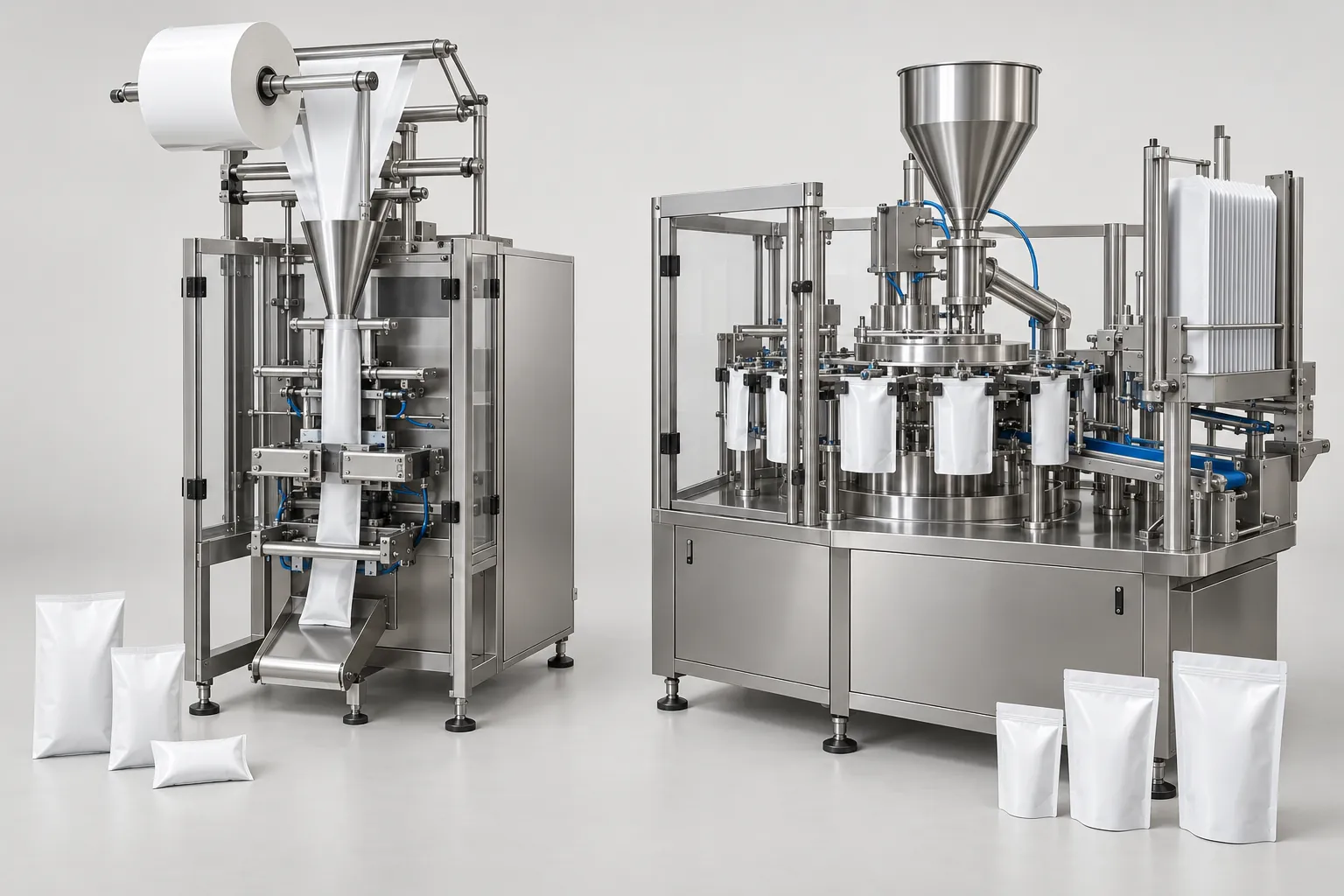
VFFS vs. Premade Pouch Machines: How to Choose
Compare VFFS and premade pouch machines by bag style, product, changeover, film or pouch supply, appearance, footprint and staffing, with questions for suppliers.
Read guide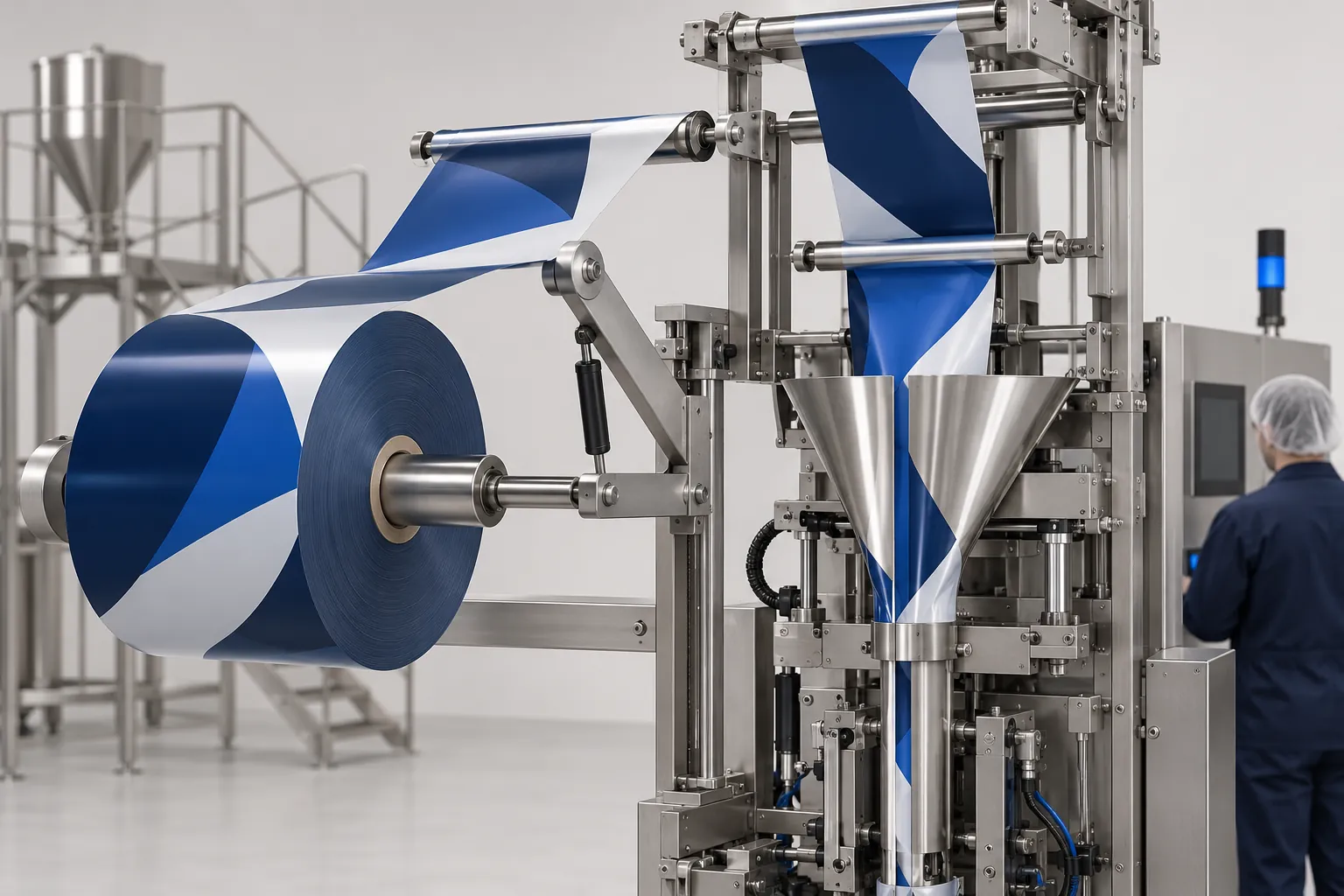
Packaging Film Compatibility: Questions Beyond Film Thickness
Follow the film path from reel to cut-off and list what to ask the film and machine suppliers about tension, friction, registration marks and sealing.
Read guide
Packaging Machine RFQ Checklist: Information Suppliers Need
A reusable blank RFQ template for packaging machines in nine sections, with the reason suppliers need each item and a list of commonly missed details.
Read guide