
Inside a Horizontal Flow Wrapper: Infeed, Film Path, Jaws and Cutoff
What each station of a horizontal flow wrapper does, from infeed and film path to fin seal, end-seal jaws, knife and discharge, and what it needs from the line.
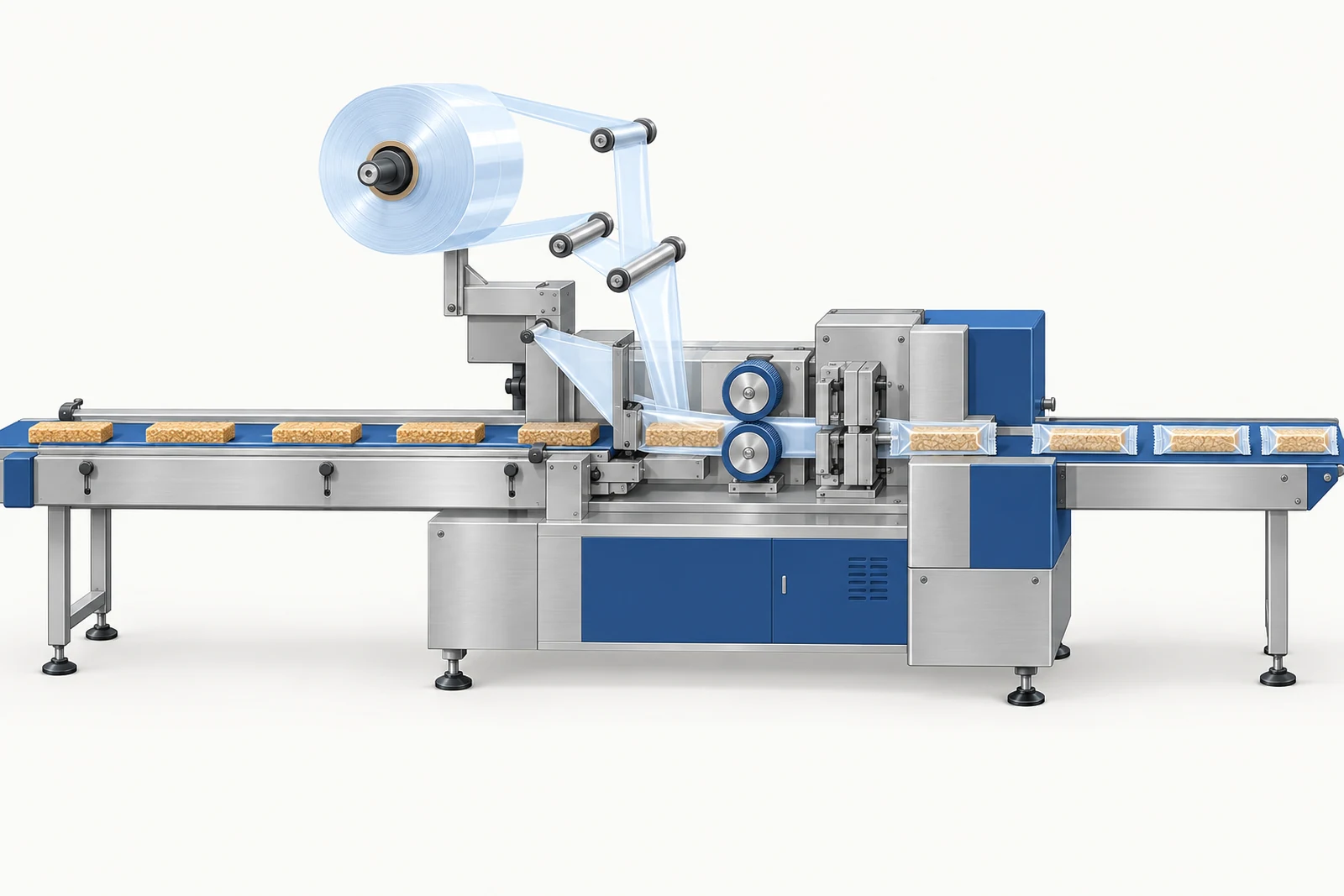
A horizontal flow wrapper, also called an HFFS machine, wraps line-fed products in film from a reel in five stations: infeed, film path, forming with the lengthwise fin seal, end sealing with cutoff, and discharge. Each station depends on a neighbor: product pitch from upstream, registration marks and splices from the film, and a downstream line that can take every pack, including rejects.
Applies to: Covers continuous-film horizontal flow wrappers with rotary or box-motion end sealing, fed with single products or groups. Does not cover choosing between flow wrap and other pack formats, film specifications, food suitability, machine prices or settings for a specific machine.
A flow wrapper has two paths that meet at the former: products travel along the infeed, through forming and sealing to discharge, while film runs from the reel through the splicer, tension control, registration sensor and coder. This guide divides the machine into five working areas and, for each, lists what it needs from the line and what it hands on. It is compiled from manufacturers’ public pages, cited in the sources section, and is not based on our own tests.
Key points:
- Pack rate is set by the cycle: at a given film speed, a longer film index means fewer packs per minute, and the infeed must deliver products at the matching pitch.
- The film path connects the wrapper to the film supplier and the coding system, through reel size, splices, registration marks and code triggers.
- Seal quality depends on temperature, pressure, dwell time and the film. Jaw type (rotary or box-motion) is a choice to confirm by trial.
- Rejects and downstream capacity have to be agreed between the wrapper, inspection devices and the cartoner or case packer.
- Published speeds are maximums with unstated conditions, so they cannot be compared across models.
What does a flow wrapper do in one pass?
A flow wrapper pulls film from a reel, forms it into a tube around products that arrive in a line, seals the tube lengthwise, then seals and cuts across the tube between products. Syntegon describes its Pack 103 as a horizontal form-fill-and-seal (HFFS) machine that wraps products in rollstock film and seals them on all sides, and calls the resulting pack style flow wrap.
The difference between flow wrapping and overwrapping, and when each format fits, is covered in our flow wrapping vs. overwrapping comparison. This guide assumes the format is already chosen and looks at the machine itself.
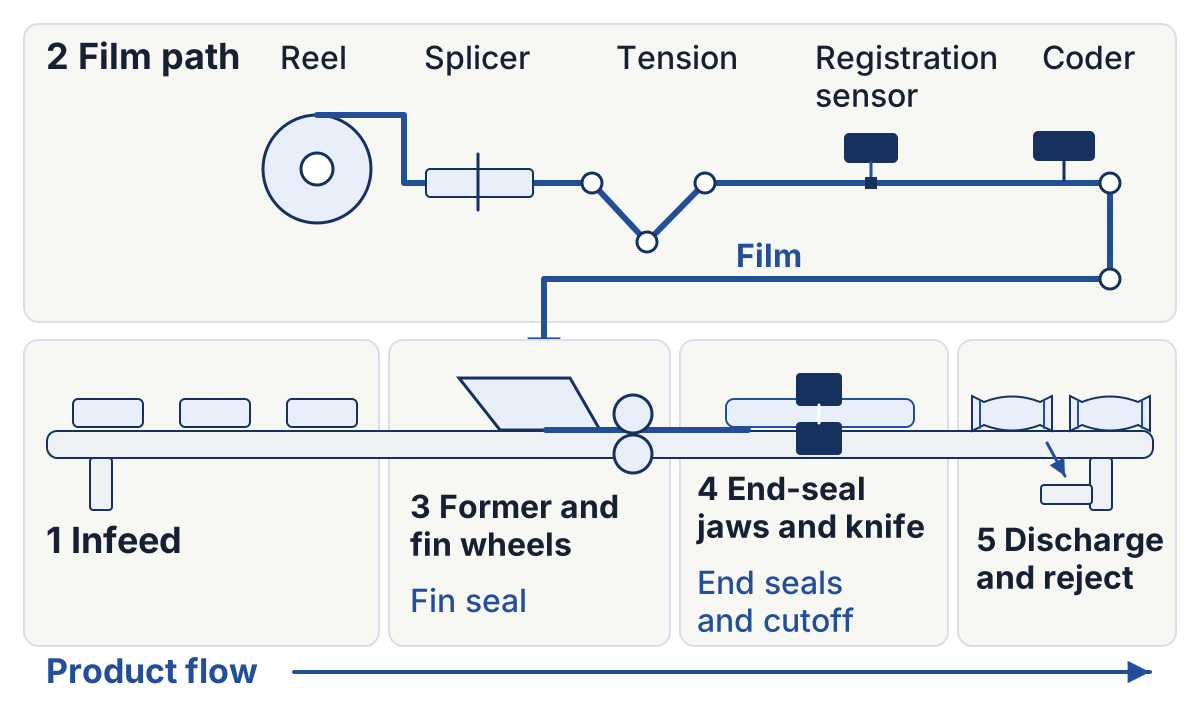
| Station | What happens there | Main parts |
|---|---|---|
| 1. Infeed | Products are spaced, timed and pushed into the film tube | Infeed conveyor, lugs or pushers, belt feeders, manual loading section or robot cell |
| 2. Film path | Film is unwound, kept under tension, positioned to the print and coded | Reel holder (backstand), splicer, rollers, tension control, registration sensor, coder |
| 3. Forming and fin seal | Film is folded into a tube and joined lengthwise | Former (forming box), fin wheels |
| 4. End seals and cutoff | The tube is sealed across, before and after each product, and cut | End-seal jaws (crimpers), knife |
| 5. Discharge | Finished packs leave the machine and faulty packs are removed | Discharge belt, reject device |
Infeed: where is the machine’s pace set?
The infeed sets the pace because the wrapper can only make a pack when a product is in the right place. Products must arrive one at a time or in fixed groups at a consistent spacing, called pitch, in the orientation the pack needs. If the upstream line cannot hold that pitch, the wrapper slows, stops or makes faulty packs.
A guide from flow wrapper builder Wolf-Packing (December 2025) defines packages per minute as the number of complete wrap cycles in 60 seconds, and pitch as the center-to-center distance between products on the infeed conveyor. It describes film index, the length of film advanced per cycle, as product length plus seal width plus clearance. At a given film speed, a longer film index takes longer to advance, so each cycle is longer and fewer packs are made per minute. The slowest operation in the cycle sets the maximum speed.
Infeeds range from a hand-loaded conveyor to robot cells. Two published examples show that range:
- Manual loading. For the entry-level Pack 103, Syntegon’s product page (checked October 7, 2026) lists infeed lengths matched to the number of operators: 1.5 m for one operator, 3 m for two, 4.5 m for three, 6 m for four and 7.5 m for five. Its page introduces these as three lengths but lists five, so confirm the current options with the supplier.
- Automated feeding. For the washdown Pack 403 HE, Syntegon lists robotic loading across one or several legs, distribution to several legs, grouping and stacking for multipacks, collating, buffering, gap closing and metering, product orientation and pre-turning, and cardstock feeders for product support.
Both machines are offered in left-to-right and right-to-left versions, so the direction of flow is a layout choice that has to be fixed early.
What the infeed needs from upstream:
- Product at the agreed pitch and orientation, or a feeder that creates them, such as gap closing, metering and turning.
- A buffer, or an agreed reaction, for when the upstream supply pauses, so the wrapper does not run empty.
- Agreement on what happens to a missing or misplaced product. Wolf-Packing describes features often called “no product, no bag” and misplaced product detection, which are meant to avoid empty packs and product caught in seals. Ask whether they are standard on the machine you are offered.
If the line has a pace problem rather than a wrapper problem, the bottleneck guide shows how to tell from machine state times which machine limits output.
Film path: what keeps the film running and in register?
The film path determines how often the machine stops for film and whether print, seals and cuts land in the right place. Its parts are the reel holder, an optional splicer, guide rollers, tension control, the registration sensor and often a coder. Each one connects to something outside the machine: the film supplier, the print layout or the coding system.
- Reel holder and splicer. Syntegon’s 2020 release for the Pack 202 lists a 450 mm dual backstand as standard and a 650 mm single backstand as an option, plus an optional automatic film splicer for changing reels without stopping the machine. Whether a reel change on your machine needs a stop depends on the splicer fitted, so confirm it. Also confirm how the splice passes through the seals and cutoff, and whether packs containing the splice are detected and rejected.
- Rollers and threading. The same release describes sequentially numbered film rollers that make threading repeatable at changeover. If threading is done from memory, film path errors become a changeover problem.
- Tension. Film must reach the former at a steady tension. Wolf-Packing describes dancer arms or load cells adjusting brake torque to hold tension across the speed range. Ask which method your machine uses and how it is set for each film.
- Registration sensor. On printed film, a sensor reads an eye-mark so the cut and the end seals fall at the right point in the print. Soontrue’s maintenance guidance (May 2026) notes that dust or film particles on photoelectric and eye-mark sensors can cause false stops or misalignment, and in the worst case the knife cuts into the product.
- Coder. Syntegon lists batch coding and expiration date printing among the Pack 103 options. Where the coder is mounted, how it is triggered and how code content reaches it are not described on public pages, so confirm them with both the wrapper and coder suppliers.
The film interface has its own checklist. The properties a film supplier must document, including friction, tension range, registration marks and sealing window, are covered in the film and machine compatibility guide. If code legibility or print register will be checked by a camera, the machine vision guide explains what a vision station can and cannot verify.
Forming and the fin seal: how is the lengthwise seal made?
The former folds the flat film into a tube around the product, and the fin wheels pull the two film edges together and seal them along the length of the pack. That lengthwise seal is the fin seal, and it usually sits on the underside of the finished pack. Fin wheels also help transport the film, so they affect film travel as well as seal quality.
In a February 2026 article on sealing and cutting, Syntegon describes fin wheels as giving precise film guidance and constant film transport at synchronized speed, which reduces slippage and wrinkles while forming an airtight fin seal. In its 2020 Pack 202 release, the same company describes fin modules that operators can tilt (cant) with a knob. On the Pack 403 HE, it lists finwheel pressure gauges among the visual controls.
Sealing depends on the film as much as on the machine. Syntegon states that reliable seals need the right combination of temperature, pressure, sealing time and film type. For the Pack 103, it lists cold-seal film for heat-sensitive products such as chocolate and heat-seal film where a hermetically sealed pack is needed. Which applies to your product is a film and pack decision, made before the machine settings.
End seals and cutoff: what do the jaws and the knife do?
The end-seal jaws, also called crimpers, seal across the film tube behind one product and in front of the next. A knife then cuts between the two seals. Each pack gets a trailing seal from one jaw closure and the next pack gets its leading seal from the same closure. Seal quality and pack length are both decided at this station.
Syntegon describes the jaws as delivering consistent temperature, uniform pressure and a defined dwell time. It places the knife after the sealing unit, cutting in coordination with the jaws so that pack length stays consistent and the film does not fray. Its 2020 Pack 202 release describes a double-spring kit on the cross-seal unit for more consistent seals, with finer crimper adjustment. Check the current configuration with the supplier.
Jaw motion is the main design split. Rotary jaws turn continuously. Box-motion jaws move in a rectangular, back-and-forth path, which Soontrue says gives a longer dwell time. The table summarizes how Soontrue describes the difference. These are a manufacturer’s descriptions, not test results, and the right choice for a given product is settled by a trial.
| Point | Rotary jaws | Box-motion jaws |
|---|---|---|
| Motion | Continuous rotation | Rectangular, back-and-forth movement with the film |
| Seal dwell time | Shorter than box-motion | Longer dwell time per cycle |
| Products described as suited | Uniform products in continuous, high-volume runs | Taller, delicate, irregular or multipack products |
| What to verify | Seal integrity on your film at target speed | Whether the extra dwell is needed for your film and pack, and at what speed |
Sealing technology also varies within a builder’s range. Syntegon, for example, lists rotary cold and hot sealing, its AHS hot sealing, rotary ultrasonic, and LongDwell hot or ultrasonic sealing as options to evaluate with the product. End seal styles also vary. Syntegon lists straight, zig-zag and serrated end seals, and notes that vertical seal serrations need a tailored jaw setup. Jaws and knives are wear parts, so put them on the spare parts list from the start.
When seals fail in production, the seal defect investigation checklist shows how to collect evidence before changing settings, so a film problem is not treated as a jaw problem.
Discharge and reject: what must the wrapper hand over?
The discharge belt takes finished packs away from the cutoff and passes them to inspection, collation or a cartoner. Faulty packs have to leave the line here or at the next inspection point. Before ordering, agree on which machine detects which fault, which device rejects it and how the reject is confirmed.
Syntegon’s 2020 Pack 202 release describes a one-meter reject belt and a detection function on the short discharge belt that ejects faulty packages with compressed air. For larger and heavier products, a two-meter discharge module with a reject plow is offered as an option. Your machine may differ, but the questions are the same. What does the wrapper detect itself? What does a downstream checkweigher, metal detector or camera detect? How does each reject get confirmed?
Downstream capacity matters as much as the reject. Wolf-Packing notes that downstream equipment has to clear packs faster than the wrapper makes them. Without accumulation, any downstream stop forces the wrapper to stop. Syntegon’s 2020 account of a cracker line shows the handover in one project: flow wraps go straight to a TTM 100 topload cartoner that the company says loads 30 to 150 packs into cartons per minute. That figure belongs to that machine and project. It shows that the cartoner’s range and the wrapper’s output have to be matched in the line design.
Inspection order and reject handling are covered in the checkweigher and metal detector guide. Loading into cartons and cases is covered in the cartoner and case packer comparison.
Station-by-station interface map
Every station on a flow wrapper either receives something from outside the machine or hands something over to it. The table lists those interfaces so you can assign each one to the wrapper supplier, a neighboring supplier or your own team, and decide how it will be verified. Use it alongside a general interface list such as the packaging line integration checklist, which covers electrical, signal, safety and utility interfaces in more depth.
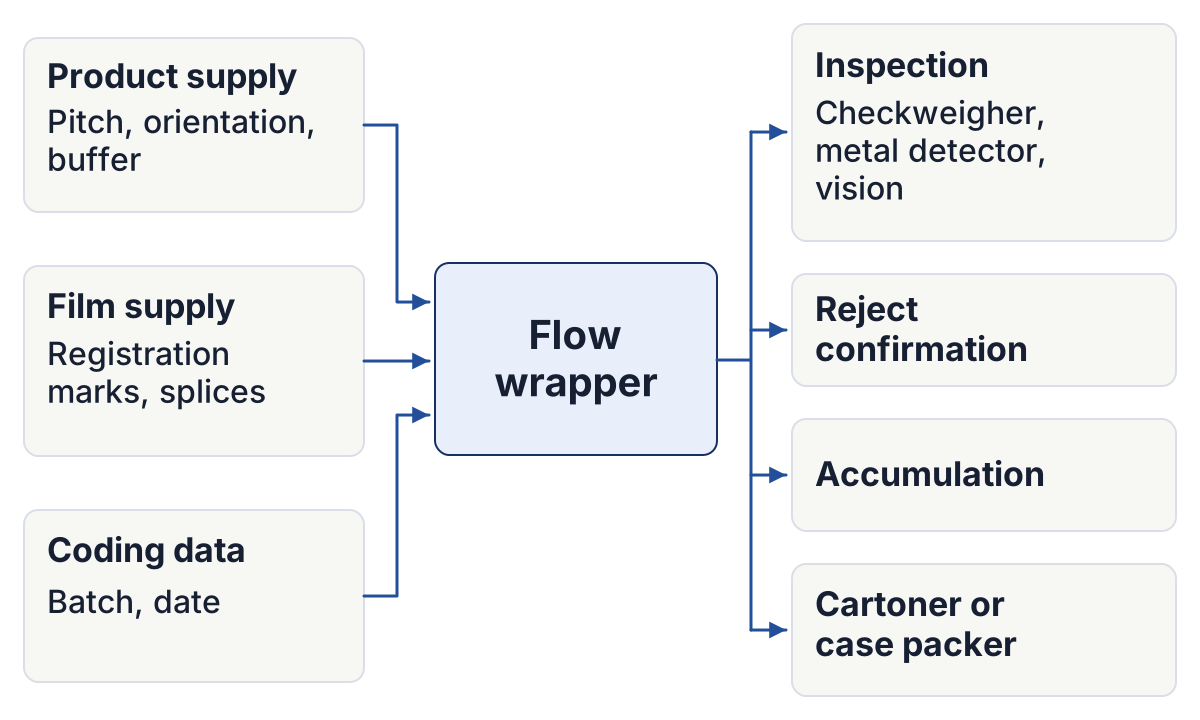
| Station | What it does | Needs from upstream or suppliers | Hands to the next step | Confirm before ordering |
|---|---|---|---|---|
| Infeed | Spaces and times products into the film tube | Product at agreed pitch and orientation; supply rate and pauses; group size for multipacks | Products in register with the film | Infeed type and length; flow direction; reaction to missing or misplaced product; buffer location |
| Film path | Unwinds film, holds tension and keeps print in register | Reel width, core and diameter range; splice method; registration mark position and contrast | Film in tension and in register | Backstand and splicer type; tension method; registration sensor type; threading guide |
| Coder (part of the film path) | Prints batch and date codes | Code content and trigger; coder mounting space | Coded film or pack | Who supplies the coder; how it is triggered; how a missing or bad code is detected |
| Forming and fin seal | Folds film into a tube and seals it lengthwise | Film with a documented sealing window; product height and width range | Sealed tube | Former range and change parts; fin seal type (heat or cold seal) |
| End seals and cutoff | Seals across the tube and cuts single packs | Pack length; seal style; film sealing window | Single packs of consistent length | Rotary or box-motion jaws; sealing technology; end seal style; jaw and knife spares |
| Discharge and reject | Carries packs away and removes faulty ones | Downstream rate and accumulation; inspection devices and their reject signals | Good packs to collation, cartoner or case packer | What the wrapper rejects itself; reject confirmation; discharge length and height; status signals to neighbors |
Integration problems and where they start
A problem can show up at one station but start at another, often at an interface. The table pairs symptoms described in the manufacturer sources cited here with the interface to check first. It is an author’s checklist, not a diagnosis of any particular machine.
| Symptom | Where it often starts | Check first |
|---|---|---|
| Empty packs or product caught in the end seal | Infeed pitch or a missing product upstream | Product spacing at the infeed; whether missing-product detection is active |
| Cut or seal lands in the wrong place on the print | Registration sensor or film print | Sensor cleanliness and setting; registration mark position and contrast on the film |
| Frequent stops at reel change | Film path | Whether a splicer is fitted; reel size against shift length |
| Wrinkled or open fin seal | Fin wheels or film | Fin wheel pressure and temperature or cold-seal setting; film within its documented sealing window |
| Leaking end seals at speed | End-seal jaws or film | Dwell and temperature against film data; jaw type for the product height |
| Wrapper stops when the cartoner stops | Discharge and downstream | Accumulation between machines; status signals between wrapper and cartoner |
| Rejects end up in the good stream | Reject device or confirmation | Reject confirmation sensor; which machine owns each reject |
| Long changeovers | Change parts and settings | Which parts change by format; whether settings are stored as recipes |
Two background points help with the last rows. Wolf-Packing describes wrappers in which the infeed, film feed and jaws are separate servo axes coordinated by a central motion controller, which is why format changes can be partly recipe-based. The servo and pneumatic actuation guide explains how that affects changeover. For the changeover itself, the format changeover checklist lists what to record so a change is repeatable.
What do the published speed figures tell you?
Published speeds are manufacturer maximums for a model. They do not tell you what a line will produce with your product, film and pack length. Use them to see which class of machine a supplier is offering, then ask for the conditions behind the number.
| Model | Published speed | Other published configuration | Source and date | Conditions stated |
|---|---|---|---|---|
| Syntegon Pack 103 | Up to 175 packages per minute | Manual or semi-automatic loading; five infeed lengths for one to five operators; left-to-right or right-to-left | Syntegon product page, checked 2026-10-07 | Product, film and pack length not stated |
| Syntegon Pack 202 | Not stated in the source; described as for low to medium speeds | 450 mm dual backstand standard, 650 mm single optional; optional automatic splicer; 1 m reject belt | Syntegon press release, August 14, 2020 | Configuration as launched; current options to confirm |
| Syntegon Pack 403 HE | Up to 600 packages per minute | Washdown design; belt or robotic infeed options; left-to-right or right-to-left | Syntegon product page, checked 2026-10-07 | Product, film and pack length not stated |
For context, Syntegon’s solutions page describes its range as running from 80 packages per minute at entry level to 1,500 for integrated systems, again without stated conditions.
The figures are not comparable across models or suppliers because the conditions behind them are not published. A quote is comparable only when it states the product, film, pack length and seal type behind its speed. The RFQ checklist shows how to ask for that.
Limits and on-site verification
This guide describes how flow wrappers are generally built and where they connect to a line. Your machine will differ, and these points can only be settled with the real product, film and equipment:
- Infeed behavior. Spacing, orientation and product damage at transfer points show up only in a trial with your product, ideally including the worst-case product.
- Sealing. Fin and end seal settings depend on film, temperature, pressure and dwell. The film supplier and machine builder give ranges, and a test on your film confirms them.
- Jaw choice. Rotary versus box-motion is described differently by different builders. Ask for a trial at your target speed rather than relying on general descriptions.
- Signals and reject handling. Status signals, reject confirmation and code checks must be written into the specification and tested at acceptance. The FAT and SAT guide covers how.
- Rated speed. Treat every published figure as a ceiling under unstated conditions until a trial shows otherwise.
Heated fin wheels and jaws, the knife and the infeed pushers are the main hazards on a flow wrapper. Clearing a jam at the jaws or threading film near the knife should only be done after isolating energy as the machine manual describes, with guards and interlocks kept in place. The risk assessment for the installation, for example under ISO 12100, and the applicable machine safety standard for the market (ANSI/PMMI B155.1 in the US, EN 415-10 in the EU) set the guarding requirements.
Frequently asked questions
How does a flow wrap machine work?
Products enter on the infeed at a fixed pitch. Film is formed into a tube around them and sealed lengthwise by fin wheels, then end-seal jaws seal across the tube and a knife cuts the packs apart. The interface map shows what each step needs from the line.
What are the different types of flow wrap machines?
This guide distinguishes machines first by end-seal motion: rotary jaws or box-motion jaws. Machines also differ by infeed (manual, automatic or robotic), by hygienic design (standard or washdown) and by sealing method (heat, cold or ultrasonic). Which combination fits depends on the product and the film.
Method and sources
This guide was compiled from manufacturers’ public product pages, press releases and technical articles about horizontal flow wrappers. Each claim is attributed to its source in the text. The figures are the manufacturers’ own and were not verified by testing. In a search of US desktop results for “what is flow wrap” on October 7, 2026, the top ten results were product pages, videos and social posts, with no page explaining the machine station by station. That gap is why this guide is organized around stations and interfaces. Models are named only as published examples of a design feature. The guide does not rank or recommend them.
Sources, all accessed October 7, 2026:
- Syntegon, “Pack 103 horizontal flow wrapper”, product page.
- Syntegon, “Pack 403 HE horizontal flow wrapper”, product page.
- Syntegon, “Horizontal flow wrapper”, solutions page.
- Syntegon, “Sealing and cutting for horizontal flow wrappers”, February 12, 2026.
- Syntegon, “New Syntegon Pack 202 Flow Wrapper”, press release, August 14, 2020.
- Syntegon, “The cracker packer”, July 22, 2020.
- Soontrue, “Top 10 Maintenance Tips to Extend the Life of Your Horizontal Flow Wrapper”, May 28, 2026.
- Soontrue, “Rotary Vs Box Motion Flow Packing Machine: What Is The Difference?”, July 5, 2024.
- Wolf-Packing Editorial Team, “Flow Wrapper Speed: Matching Production Line Efficiency”, December 4, 2025.
For where the flow wrapper sits in a complete line, see the overview of packaging machine types and the packaging equipment guides.
References
- ANSI/PMMI B155.1-2023 — Safety Requirements for Packaging and Processing Machinery — PMMI
- EN 415-10:2014 — Safety of packaging machines — Part 10: General requirements — CEN
- ISO 12100:2010 — Safety of machinery — General principles for design — Risk assessment and risk reduction — ISO
- 29 CFR 1910.147 — The control of hazardous energy (lockout/tagout) — U.S. Department of Labor, OSHA (eCFR)
Update history
- : First published.
Next steps
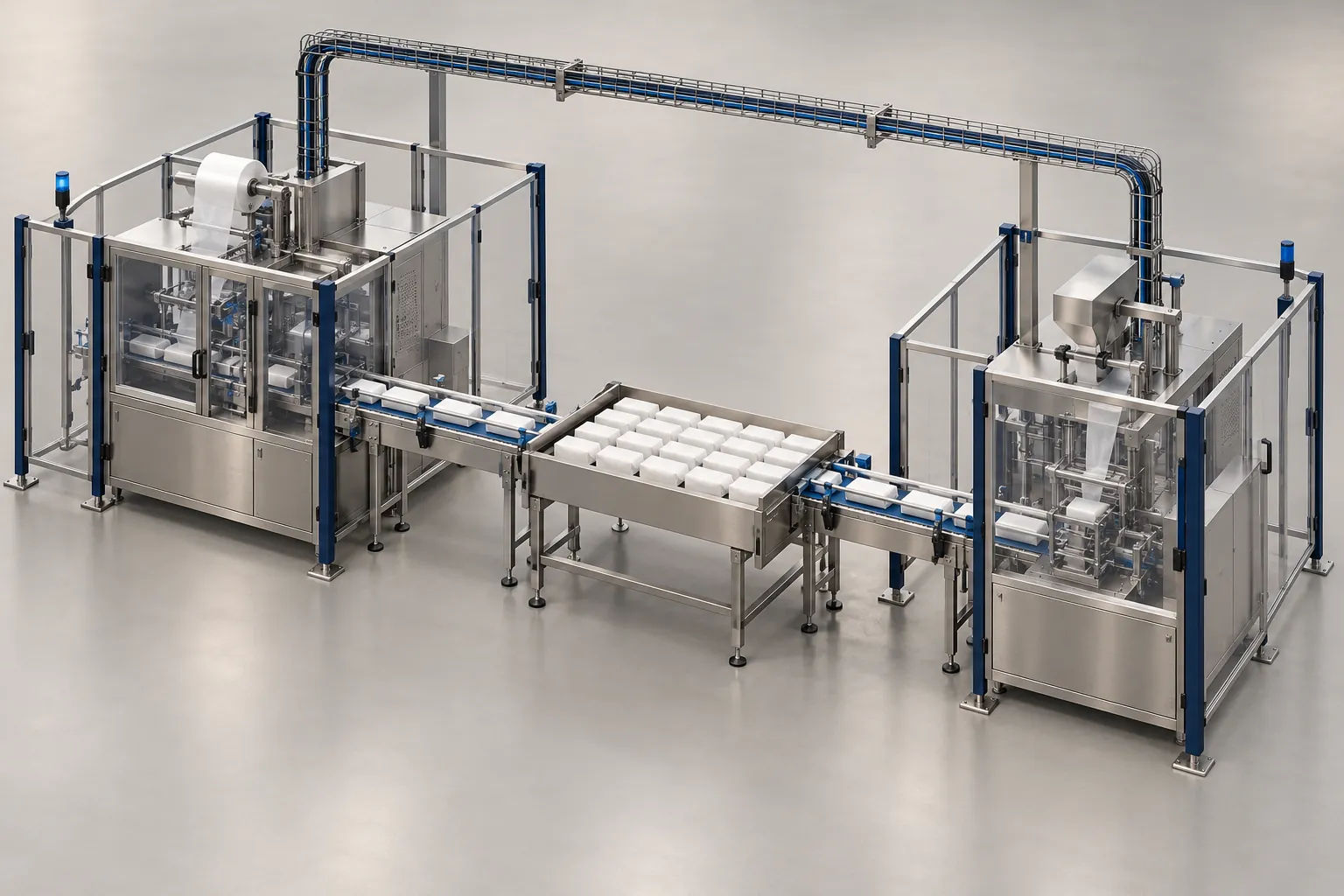
Packaging Line Integration Checklist: Interfaces to Confirm Before Ordering
Checklist of mechanical, electrical, signal, communication, safety and utility interfaces to settle before ordering a machine for a packaging line.
Read guide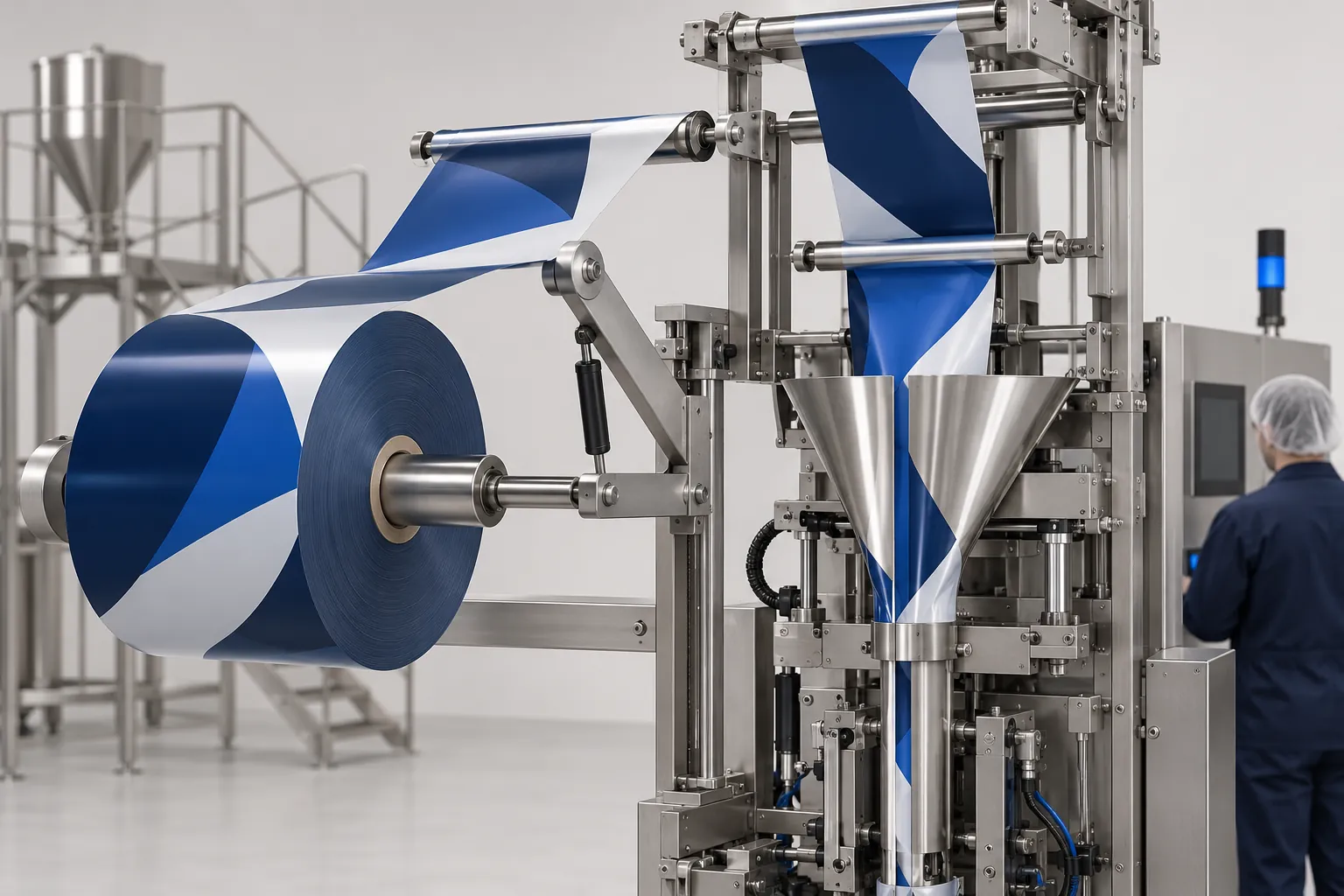
Packaging Film Compatibility: Questions Beyond Film Thickness
Follow the film path from reel to cut-off and list what to ask the film and machine suppliers about tension, friction, registration marks and sealing.
Read guide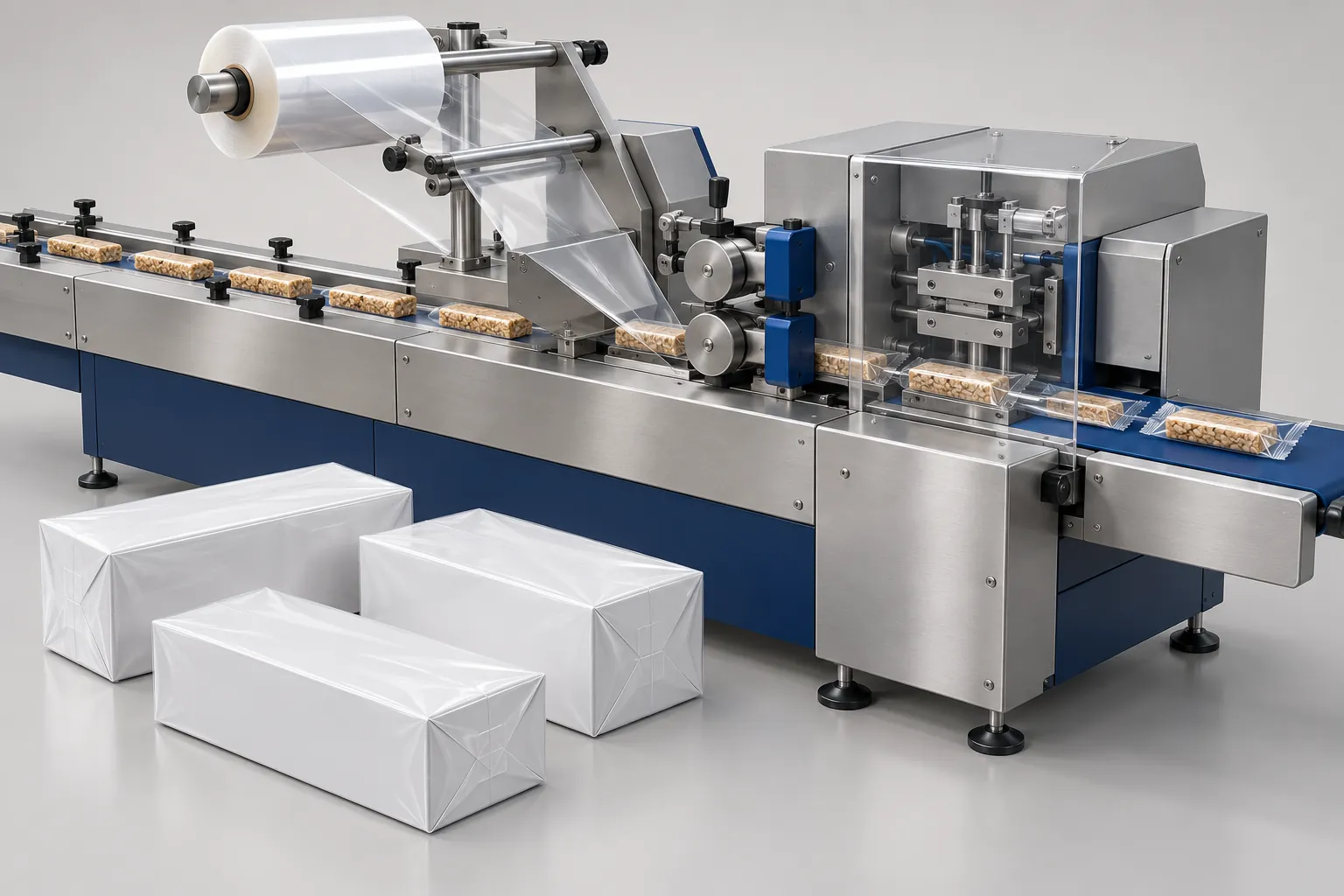
Flow Wrapping vs. Overwrapping: Formats, Materials and Applications
Compare flow wrap (pillow pack) and overwrap formats by seal structure, product shape, film, appearance, tamper evidence and machine questions for suppliers.
Read guide