
Flow Wrapper for Cookies: Arrangement and Feeding Trial Checklist
Before trialling a flow wrapper for cookies, fix the arrangement and the intake boundary, then record breakage, count, seal-area crumbs and rejects by stage.
Record the cookie count, orientation and tray support, and name where the wrapper intake begins, before the trial. Run your cookies and film, and log incoming damage, transfer damage, count errors, seal-area crumbs and rejects separately. The project team sets the limits.
Applies to: Horizontal flow wrapping of cookies, biscuits and crackers fed singly, in flat groups, in on-pile stacks or as on-edge slugs, with or without trays. Does not give speeds, breakage limits, film specifications or a recommended machine, feeder or supplier.
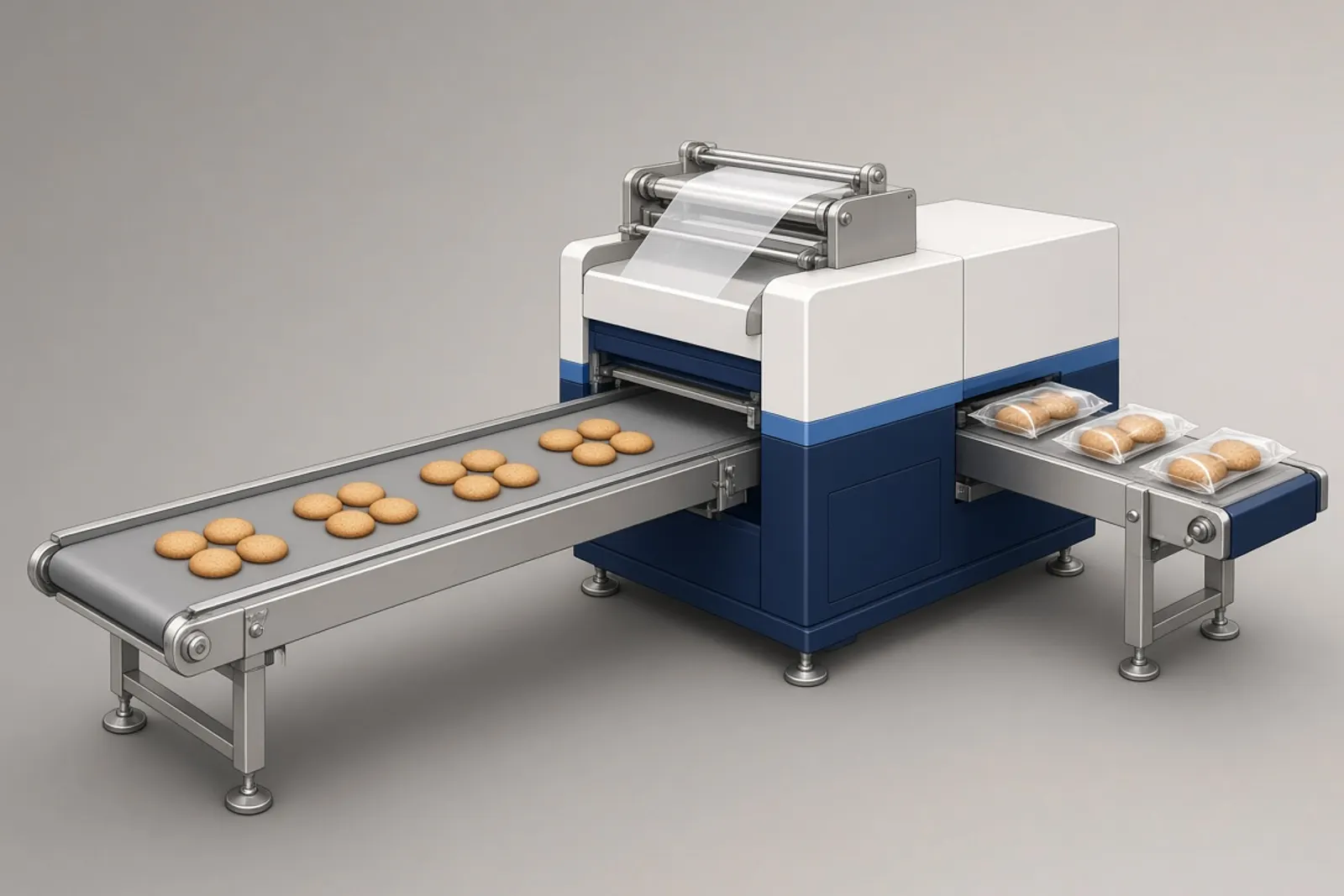
If a cracked cookie is first noticed in a finished pack, the wrapper can get the blame for damage that may have started on the cooling conveyor, at a grouping step or at the transfer onto the wrapper infeed. Define the arrangement and the wrapper’s intake boundary before the trial, then observe the cookies before each handoff so any damage can be assigned to a stage.
The request itself causes a second problem. “Stacked cookies” can mean a flat pile or a row standing on edge, and a supplier can quote the wrong one. This checklist helps you describe the arrangement field by field, agree where the wrapper’s scope begins and keep a trial record that separates damage, count, seal-area and reject observations. We report no trial of our own and set no numerical targets.
Describe the cookie arrangement in four separate fields
Write the arrangement as four answers: how many cookies go in one pack, how each cookie lies, what supports the group and how it reaches the wrapper. Everyday words mix these up. “Single” is a count and “flat” is an orientation, while “on-pile” combines both: a group of cookies stacked flat on top of one another.
Quick specs: inputs to fix before the trial
Swipe sideways to see the other columns. The first column stays visible.
| Input or item | Value or source | Why it matters |
|---|---|---|
| Count per pack | Your pack drawing | Sets whether the infeed presents one cookie at a time or a fixed group |
| Orientation | Pack drawing: flat, on-pile or on-edge slug | A flat pile and an on-edge slug are different packs to quote and trial |
| Support | Tray drawing and version, or “none” | Decides whether tray handling belongs in the trial |
| Intake boundary and transfer owners | Scope agreed with each supplier | Lets damage be assigned to a stage |
| Defect definitions | Quality team’s written crack and edge-chip definitions, with photographs | Fixes what counts as damage before anyone sees results |
| Trial materials | Representative cookie lots, production film and trays | The result applies only to what actually ran |
| Acceptance limits | Agreed by the project team; left blank here | This page sets no breakage, count or speed targets |
Manufacturers use the same vocabulary. Syntegon’s August 2026 article on cookie and cracker lines describes packing “flat or on-pile”. In its round-biscuit example it lists a flow wrapper for flat-stacked pile packs separately from one for on-edge slug packs, where the cookies stand upright in a row. Another of its examples puts pile and slug configurations either into trays or directly into flow wraps. Read together, those examples show that tray or no tray is a choice separate from how the cookies sit.
Swipe sideways to see the other columns. The first column stays visible.
| Field | Options | What to write down | Common mislabel |
|---|---|---|---|
| Count per pack | One cookie, or a fixed group | The number, or “to be agreed” | Calling a one-cookie pack “flat” without stating the count |
| Orientation | Lying flat; flat stack (on-pile); standing upright (on-edge slug) | Which face is down, if appearance depends on it | Writing “stacked” without saying pile or slug |
| Support | None; tray; another insert you specify | Tray drawing and version, or “none” | Treating a tray as a cookie orientation |
| Arrival at the wrapper | Hand-loaded; grouped by upstream equipment; grouped by the feed system being quoted | Who forms the group, and where | Assuming the wrapper supplier groups the product when the quote covers only the wrapper |
Fragility shapes the handling route, but not in one fixed way. Syntegon describes a line that brings very thin or brittle cookies, including gluten-free biscuits, flat on belts to the wrapper. It describes a separate robotic line that caps sandwich cookies and loads them flat into trays before flow wrapping. Those are one supplier’s examples of its own systems. They do not show that every fragile cookie needs belts, robots or trays, and they say nothing about the breakage your product will see.
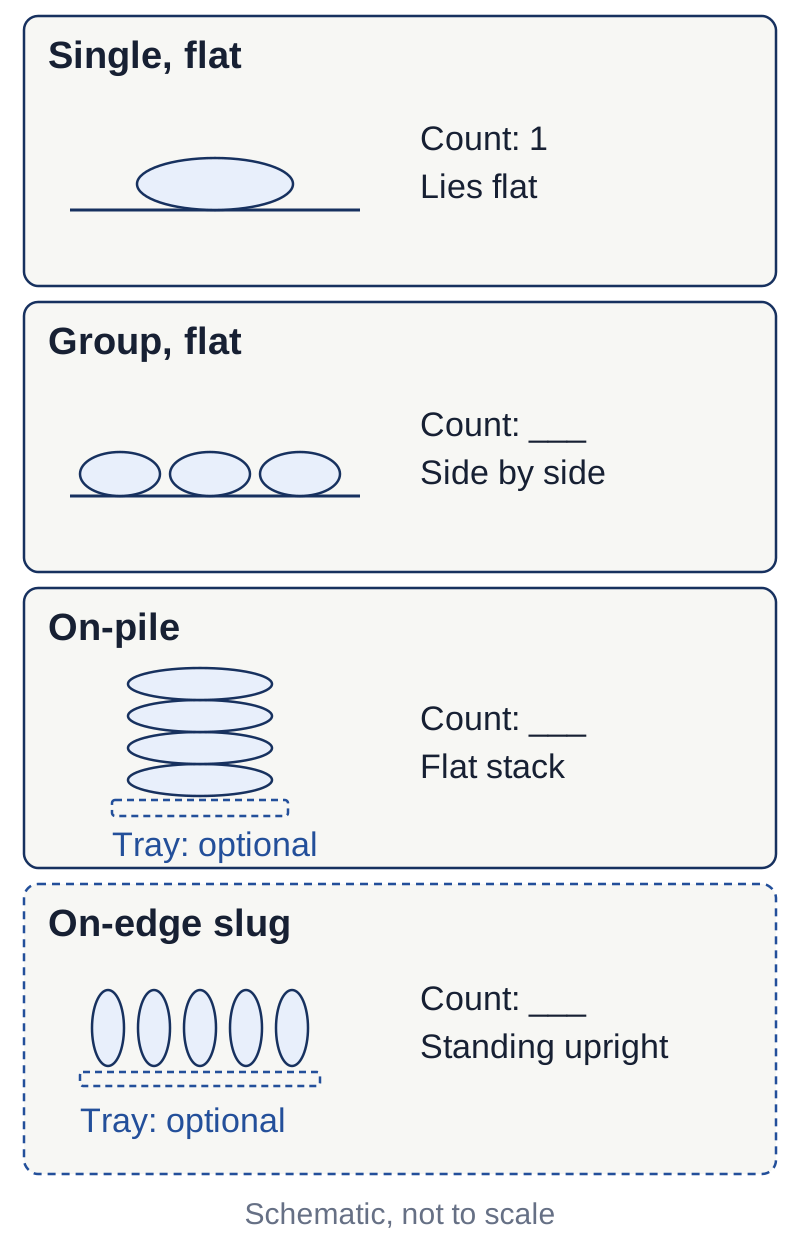
The flow wrapper anatomy guide explains how the infeed holds pitch for single products or groups, so this page concentrates on what the cookie arrangement adds. If you are still choosing between a pillow pack and a folded wrap, settle that first with the flow wrapping and overwrapping comparison. For the other machine choices on a cookie line, such as cartoning after the wrapper, the packaging equipment guides list the format comparisons by packaging task.
Takeaway: When count, orientation, support and arrival are stated separately, every supplier quotes and trials the same pack.
Agree where the wrapper’s intake starts
Before the trial, name the point where the wrapper supplier’s scope begins and the person who owns each transfer up to it. Breakage found later can be assigned to a stage only if both sides agreed that boundary in advance.
Soontrue’s September 2026 article on fragile products says damage can occur “from initial feeding to final sealing”. It names unstable movement, sudden acceleration and inconsistent spacing as conditions that raise the risk for brittle products, and it says feeding design depends on product size, shape, texture and production speed. Each handoff between pieces of equipment is a place where those conditions can change, so the worksheet below lists them one by one. Leave each name blank until the contract assigns it.
Swipe sideways to see the other columns. The first column stays visible.
| Handoff | Who prepares the product before it | Who owns the transfer | What the trial should show |
|---|---|---|---|
| Upstream conveyor to grouping or feed | ________ | ________ | Cookies arrive at the agreed intake in the condition sampled there |
| Grouping or orientation step, if any | ________ | ________ | Intended count and orientation formed, with new defects recorded |
| Feed to wrapper infeed | ________ | ________ | Group arrives positioned as the wrapper needs, with new defects recorded |
| Wrapper discharge to the next machine | ________ | ________ | Packs and rejects handed on, and stop behavior as agreed |
Grouping can happen upstream, in a feed system quoted with the wrapper, or by hand. Write which. A quote that starts at the wrapper infeed leaves the grouping step, and any breakage there, outside that supplier’s trial. The packaging line integration checklist holds the general interface matrix for heights, signals and guarding; use it for the transfer drawings and keep this worksheet for product condition. If hand loading is still one of the options, the automation system guide helps fix that scope before quotes arrive.
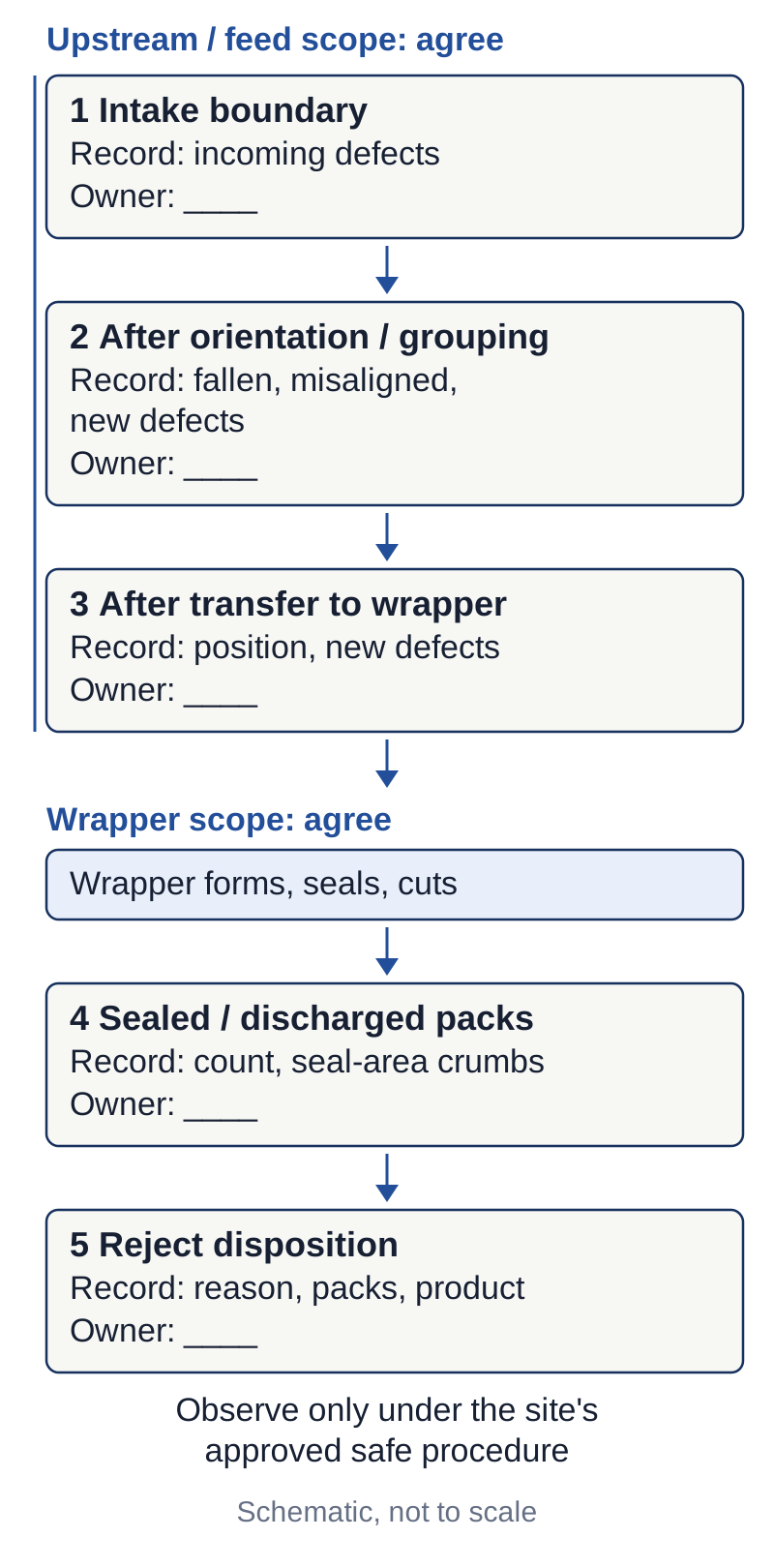
Agree with the responsible team how observers take samples at each boundary under the site’s approved safe procedure. Nobody should reach into running equipment or open a guard to collect cookies for the record. If finished packs go on to cartoning, the cartoner and case packer guide covers that next handoff.
Takeaway: Fill the owner column before the trial date. A blank owner is a finding in its own right.
Prepare samples and defect definitions before the trial
A trial tells you something about your cookies only if it runs your cookies, your film and a written definition of a defect. Agree these with the quality team and the supplier before the run:
- Representative cookie lots, covering the size and thickness variation you see in production, plus any inclusions, coatings or thin edges that tend to break first.
- The count per pack and the intended pack drawing, with film and any tray at the drawing version you plan to buy.
- Written definitions of a crack and an edge chip, with photographs of borderline cases. Soontrue names small cracks and edge damage as appearance concerns for biscuits and cookies; your own definition decides what counts as a defect.
- A sampling plan stating how many cookies or packs are inspected at each boundary, how they are identified, and which population each sample represents.
- An intake condition describing an acceptable incoming cookie, so that damage arriving from upstream is not later charged to the wrapper.
Common mistake: Trialling with hand-picked, best-looking cookies. The run then shows how the line treats your strongest pieces, not the thin or uneven ones that break first in production.
The RFQ checklist lists the general product and pack information suppliers need. Film behavior on the machine is its own question, covered in the film and machine compatibility guide. When several suppliers run the same samples, the supplier evaluation guide helps keep the requests comparable.
Takeaway: Write the defect definition before the run, or the team will argue over the results instead of using them.
Copyable cookie feeding trial record
Fill the header with the conditions that actually ran, then give each kind of observation its own row, unit and denominator. A blank speed field marks the speed as a trial input. It is not a capacity anyone has promised.
Trial header
Swipe sideways to see the other columns. The first column stays visible.
| Field | Entry |
|---|---|
| Date and run ID | ________ |
| Cookie product and lot; condition when sampled | ________ |
| Machine and feed configuration actually run | ________ |
| Arrangement: count, orientation, support | ________ |
| Film lot, tray lot and pack drawing version | ________ |
| Agreed intake boundary | ________ |
| Operating condition as run | ________ |
| Duration or sample plan | ________ |
| Starts, stops and restarts during the run | ________ |
| Upstream and downstream availability | ________ |
| Observers and their responsibilities | ________ |
| Inspection and reject equipment in scope, if installed | ________ |
Observation rows
Swipe sideways to see the other columns. The first column stays visible.
| Category | What to record | Unit and denominator | Attribution limit |
|---|---|---|---|
| Incoming damage | Cracks and edge chips already present at the intake; sample and photo IDs; time | Damaged cookies / cookies inspected at intake | Describes that sample, not the whole lot |
| Grouping and transfer damage | Fallen, misaligned or touching cookies, and defects first seen after each named handoff | Cookies with new defects / cookies inspected at that boundary | A defect first found at discharge has an unknown origin |
| Count errors | Intended count, actual count, missing, extra or displaced cookies | Packs with a wrong count / packs inspected | Pack weight alone does not prove the cookie count |
| Seal-area crumbs | Crumb location in the seal area, pack and film IDs, any related seal observation | Packs with seal-area crumbs / packs inspected | A visible crumb is an observation, not a leak result |
| Wrapper and inspection rejects | Reject reason as shown, packs attempted, inspected, accepted and rejected, product recovered or lost | Rejected packs / packs attempted | Keep empty-pack alarms, upstream exclusions and real rejects apart; do not assume reject hardware |
| Target, limit, method, sign-off | Left blank here | ________ | Agreed by product, quality and engineering with the supplier |
Keep raw counts beside every rate, and write down which population each denominator describes. One cookie can carry both a crack and an edge chip, and one pack can have a count error as well as seal-area crumbs. Tag each observation, and avoid adding them up as if they were separate rejects.
Common mistake: Reporting one overall breakage percentage for the trial. It merges incoming, transfer and wrapper damage into a figure that no handoff owner can act on.
Weight and count are different checks. The checkweigher and metal detector guide explains what a checkweigher measures, and the machine vision guide covers what a camera can confirm if the line has one. If the trial runs more than one arrangement, record each setup change with the fields in the format changeover checklist.
Takeaway: One observation type per row, one unit per row, and the raw count next to any percentage.
Read the observations without blaming the wrong station
Compare two stages only when the samples and counting method make the comparison fair, and leave the cause as unknown when a defect was first seen at discharge. The record supports narrower conclusions than people often draw from it.
- When many cookies are already damaged at the intake, the trial says little about the feed or the wrapper until the upstream condition is fixed or sampled on its own.
- New defects between two boundaries point to that handoff if both samples came from the same tracked cookies. Samples drawn from different populations cannot be subtracted to show what the transfer caused.
- Count errors that coincide with fallen or misaligned groups at the infeed are a question for the supplier about how the group is formed and held. Repeat the run with that step observed.
- Crumbs in the seal area belong in the record, and packs of concern go through a seal test the team has agreed. Soontrue links inconsistent spacing or alignment to uneven wrapping or sealing issues, which justifies looking at positioning but does not prove that a given crumb caused a leak. The seal defect investigation checklist separates material, machine, product and method causes.
- Record stops caused by an empty or blocked neighbor as availability events. The bottleneck guide shows how to read them from machine states.
Once the project team has agreed limits, carry them and the measurement method into the factory and site acceptance tests, so the same record is used at FAT and again on the installed line.
Takeaway: An unknown origin recorded honestly is more useful than a cause assigned from a discharge count.
When this does not apply
This page gives no speed, breakage rate, transfer gap, count accuracy, seal strength or shelf-life figure. Supplier articles quote throughput for their own systems under conditions they choose. We do not reuse those numbers, and they cannot be compared between suppliers or transferred to your cookie.
The page also recommends no feeder, robot, tray or wrapper. Whether a tray or robotic loading suits your product is a question for the trial, and neither is better by default. Food-contact, machinery-safety and labeling requirements depend on your market and product and sit outside this checklist.
Takeaway: Treat every number and machine choice as a trial question for your own cookie.
Frequently asked questions
How to individually wrap a cookie?
On a flow wrapper, an individually wrapped cookie is a pack with a count of one; state whether it lies flat or sits in another orientation. The infeed has to present one cookie at a time at a consistent spacing, and the trial should show whether single cookies reach the wrapper without new cracks or chips. Record it with the same arrangement fields and trial rows as a group pack. Wrapping cookies by hand at home is outside this guide.
How does a flow wrapper work?
A horizontal flow wrapper forms film from a reel into a tube around products fed along the infeed, seals the tube lengthwise, then seals and cuts each pack at its ends. The anatomy guide explains each station and what it needs from the line.
What is the best way to package cookies?
No single format is best for every cookie. On a production line, decide the pack you sell first: the count, whether the cookies lie flat, sit on-pile or stand on edge, and whether a tray supports them. Then run the trial with your own cookies and film. Syntegon’s examples include flat and on-pile flow wraps, with and without trays, as alternatives on its own lines. Retail presentation, shelf life and home packaging are outside this checklist.
What do you call the packaging of biscuits?
A biscuit or cookie pack made on a horizontal flow wrapper is called a flow wrap, the term Syntegon uses for its cookie and cracker packs. Because the film is sealed as a tube, the same format is also known as a pillow pack, as our flow wrap and overwrap comparison explains. Syntegon names the arrangement inside it as well: flat, on-pile for a flat stack and on-edge slug for an upright row. Use the arrangement name in a request, because “flow wrap” alone does not say how the cookies sit.
How are cookies packed?
In the automated lines Syntegon describes, cookies are distributed, formed into the count and orientation of the pack, fed to a flow wrapper and sealed in film. Its robotic example runs through distribution, tray loading, flow wrapping, cartoning and case packing, while its flat-belt example brings delicate cookies flat on belts to the wrapper. Which steps your line needs depends on the arrangement and on whether a tray is used.
How much does a packing machine cost?
This page gives no prices, and supplier quotes are only comparable when they cover the same scope. A quote for the wrapper alone leaves out any grouping, feeding or tray handling that another supplier may include. Write the arrangement fields and the intake boundary into the request first, using the RFQ checklist, then compare what each quote covers before comparing price.
Method and sources
We wrote this checklist on October 11, 2026 from two manufacturer articles, read from copies retrieved earlier in October:
- Syntegon, Flexible flat and on-pile packaging for cookies and crackers, published August 31, 2026, retrieved October 6, 2026. We used it for the flat, on-pile and on-edge vocabulary and for its examples of tray and direct flow-wrap configurations.
- Soontrue, Flow Wrapping Solutions for Fragile Product Packaging, published September 28, 2026, retrieved October 8, 2026. We used it for its account of where fragile products can be damaged and the handling factors it names.
Both are supplier publications about their own equipment. We treat their statements as supplier claims and did not verify any performance figure. The arrangement fields, observation boundaries and trial record are our editorial tools; neither source supplies them, and no row in them holds a test result. The FAQ questions are real search questions from US Google results. The first two are People Also Ask questions for “flow wrapper for cookies”, captured October 7, 2026. On October 11, 2026, “What is the best way to package cookies?” and “How much does a packing machine cost?” appeared as People Also Ask for “cookie packaging machine”, “What do you call the packaging of biscuits?” for “biscuit packaging line”, and “how cookies are packed” as an autocomplete suggestion for “how are cookies packaged”. The other results we read on that page were supplier product and category pages, used for comparison only. One trade-directory result returned an access error and was not used.
Related guides and questions to bring to the trial
Put these questions to each supplier before the trial date:
- Which of the arrangement fields in our request can the quoted equipment handle, and which need a separate feed or grouping system?
- Where does your scope start, and which handoffs will the trial include?
- Will the trial run our cookie lots, film and trays, and who records each observation?
- How does the machine respond to a missing, fallen or misaligned cookie, and is that response standard or an option?
- How are rejects counted and confirmed during the trial?
For the request itself, use the RFQ checklist. For acceptance, read the FAT and SAT guide. For station-by-station background, start with inside a horizontal flow wrapper.
Takeaway: Send the same questions to every supplier, and compare the answers before the trial date.
References
Update history
- : First published.
Next steps
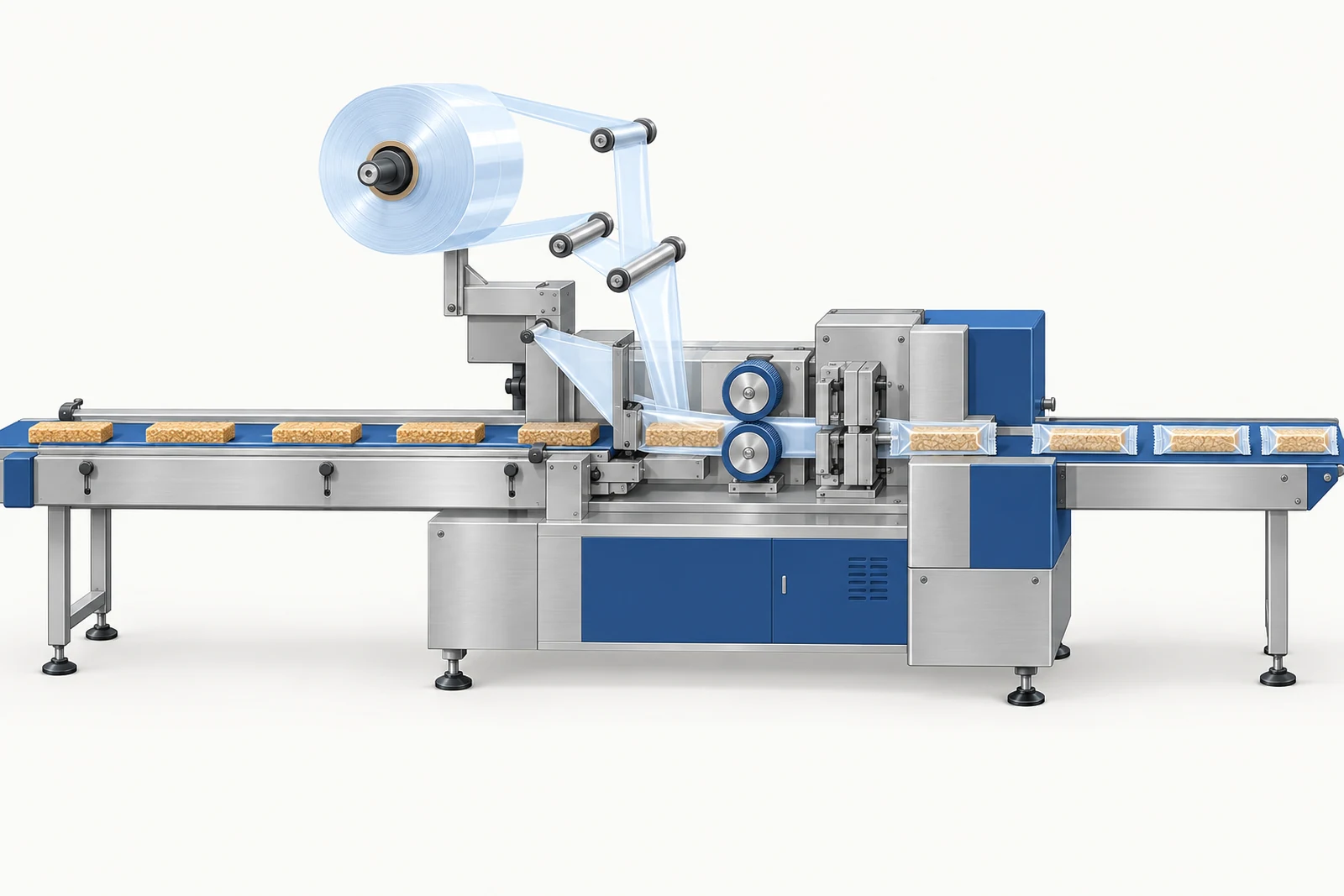
Inside a Horizontal Flow Wrapper: Infeed, Film Path, Jaws and Cutoff
What each station of a horizontal flow wrapper does, from infeed and film path to fin seal, end-seal jaws, knife and discharge, and what it needs from the line.
Read guide
FAT vs. SAT for Packaging Equipment: Defining Acceptance Criteria
Compare factory and site acceptance tests for packaging machines, and learn how to write acceptance criteria that both buyer and supplier can verify.
Read guide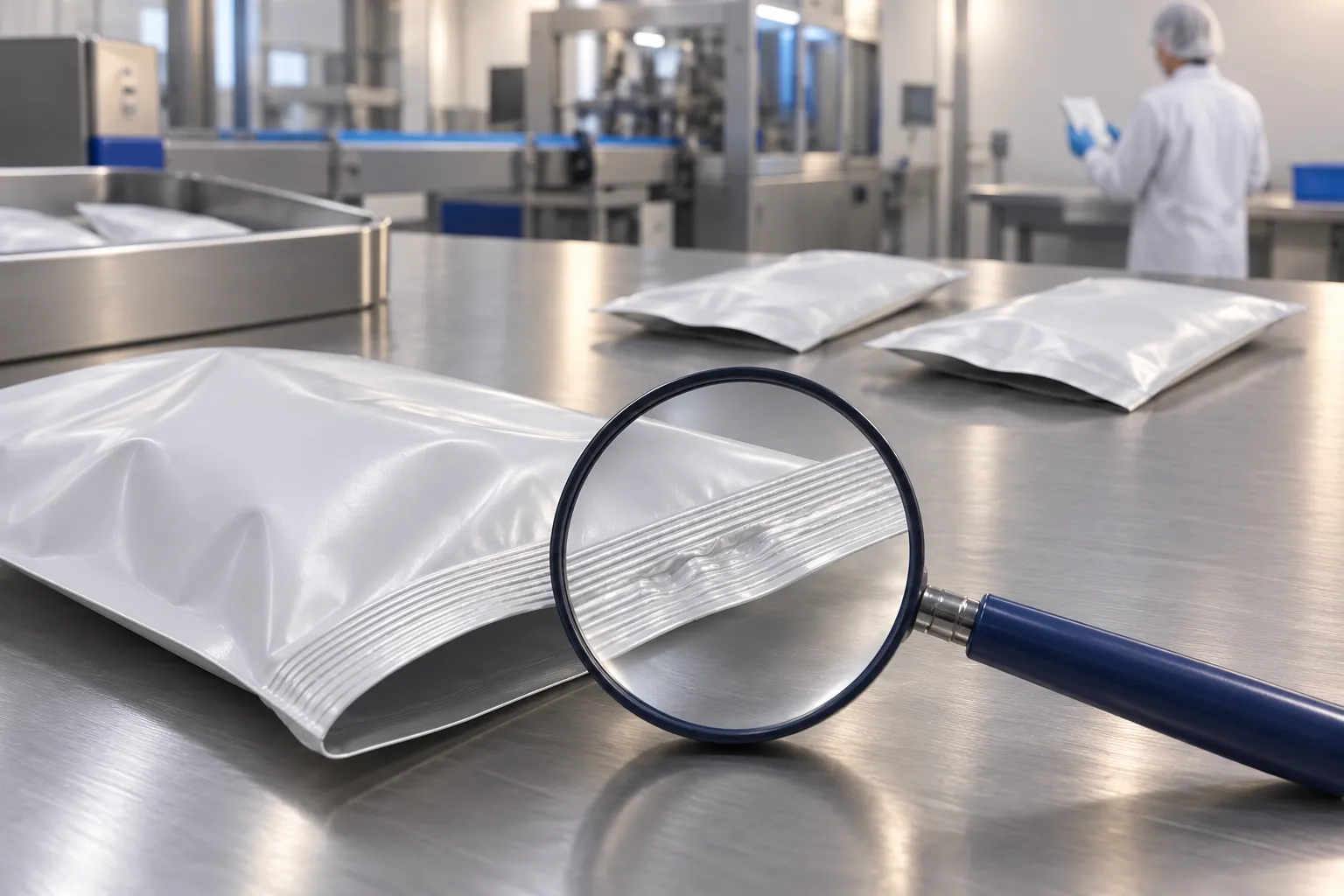
Packaging Seal Defects: An Evidence-Based Investigation Checklist
Investigate packaging seal defects by containing suspect product, collecting evidence, testing with agreed methods and changing one variable at a time.
Read guide