
Preventive vs Predictive Maintenance
Preventive maintenance replaces wear consumables on fixed schedules; predictive maintenance monitors critical packaging drives in service before failure.
Preventive maintenance replaces or services packaging machine parts on fixed calendar, run-hour, or cycle schedules before failure, whereas predictive maintenance tracks live equipment condition through ultrasonic, vibration, motor-current, oil, or infrared measurements to schedule work only when degradation begins. Use preventive intervals for low-cost wear consumables and predictive monitoring for critical rotating drives.
Applies to: Plant managers, reliability engineers, and maintenance leads deciding which packaging-line components belong on fixed-interval preventive schedules, condition-based predictive monitoring, corrective run-to-failure, or proactive redesign.
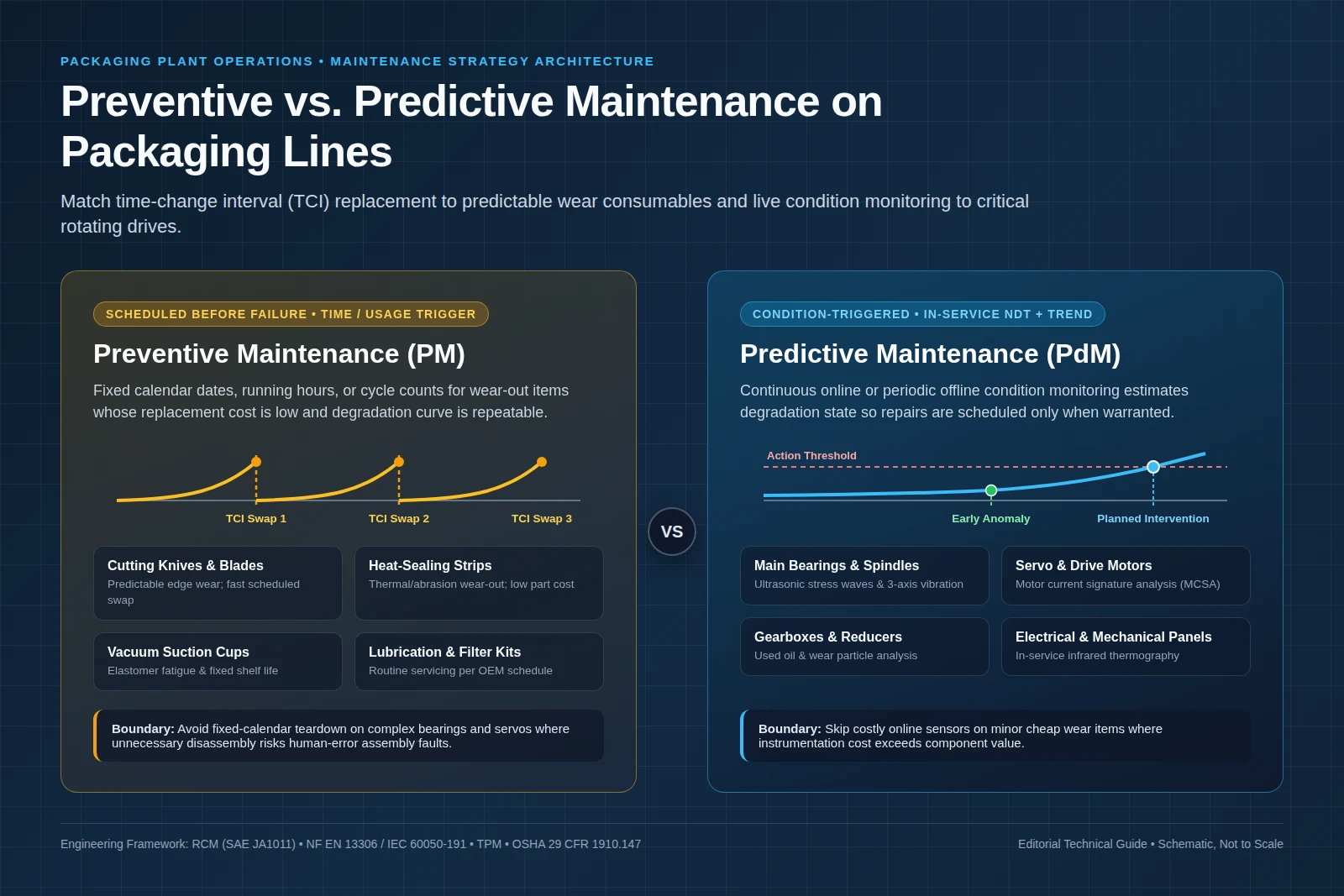
In preventive vs predictive maintenance on a packaging line, preventive maintenance performs scheduled servicing or parts replacement on fixed calendar dates, running hours, or cycle counts before a fault occurs, whereas predictive maintenance evaluates live in-service equipment condition through nondestructive measurements to estimate degradation and schedule intervention only when warranted.
Assigning every machine on a packaging floor to a single strategy wastes either labor or sensor capital. Mounting costly online instrumentation on low-value wear consumables spends more on monitoring hardware than the parts are worth, while tearing down critical main bearings or servo drives on fixed calendar intervals risks introducing assembly errors without preventing random mid-life failures. Teams building a full operational program across plant operations pair these allocation rules with a machine-specific preventive maintenance checklist and shift-level packaging line OEE calculation and bottleneck analysis.
| Comparison dimension | Preventive maintenance (PM) | Predictive maintenance (PdM) |
|---|---|---|
| Primary trigger | Calendar date, equipment running hours, or cycle/distance count before failure | Measured degradation state and trend approaching an action threshold |
| Information basis | Average or expected life statistics, fixed shelf life, and OEM service schedules | Current measured equipment condition via offline routes or online sensors |
| Equipment state during check | Usually requires scheduled downtime and energy isolation when guards open | Most predictive inspections run while equipment remains in service |
| Best-fit failure pattern | Repeatable age- or cycle-related wear-out (time-change interval items) | Random onset faults with measurable physical warning before breakdown |
| Typical packaging line targets | Cutting knives, heat-sealing strips, vacuum suction cups, filters, lubrication | Main drive bearings, rotary spindles, gearboxes, servo motors, electrical panels |
| Primary operational drawback | Labor-intensive servicing of healthy parts; misses faults between intervals | High initial sensor cost, added sensor upkeep, and analytical skill requirements |
What is the difference between preventive and predictive maintenance on a packaging line?
Preventive maintenance acts before failure using preplanned date, operating-hour, or cycle schedules based on average life expectations, whereas predictive maintenance evaluates the current condition of in-service equipment with nondestructive measurements to forecast when intervention is actually needed and convert unplanned breakdowns into shorter, fewer planned stops.
Both strategies belong to maintenance performed before a fault occurs, distinguishing them from corrective repair carried out after breakdown. In industrial packaging machine maintenance, the practical difference lies in what triggers the work order. Planned preventive maintenance aims to keep equipment running cleanly from one scheduled service window to the next by preventing faults caused by normal wear, fatigue, neglect, or seasonal temperature swings through cleaning, lubrication, adjustments, inspections, and fixed-interval replacements. Its three core goals are extending capital equipment productive life, reducing critical breakdowns, and minimizing production losses.
Predictive maintenance differs from preventive maintenance because it measures current asset health instead of relying on average or expected life statistics. By applying statistical process control and machine learning methods to trend live condition readings, maintenance teams can stage spare parts and technicians ahead of time. Unplanned stops turn into fewer and shorter planned interventions, improving plant availability, safety, spare-parts handling, and equipment service life.
Why failure patterns separate wear-out consumables from random-failure drives
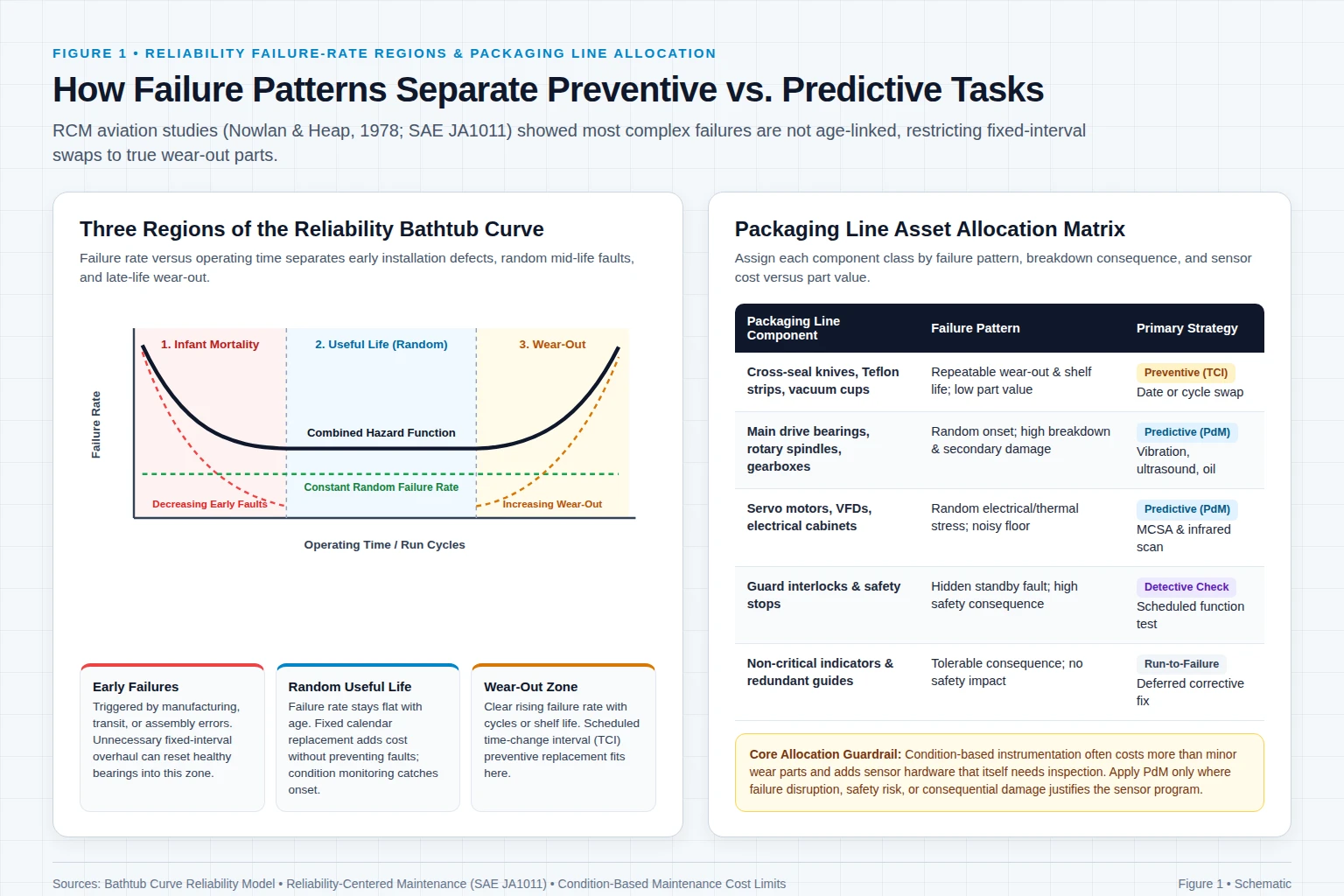
Reliability engineering models failure rate over operating life with the three-region bathtub curve: an initial infant mortality phase with a decreasing failure rate as manufacturing, transit, or installation defects appear; a middle useful-life phase with a constant random failure rate; and a late wear-out phase where failure rate rises with accumulated use. Fixed-interval replacement only reduces breakdown risk when a component actually enters a clear wear-out region.
In-service aviation engineering studies led by Stanley Nowlan and Howard Heap at United Airlines and published with U.S. Department of Defense support in 1978 overturned the older belief that every complex machine assembly has a fixed reliable lifetime requiring calendar overhaul. Those studies, later codified in the Reliability-Centered Maintenance (RCM) standard SAE JA1011, established that the vast majority of failures in complex equipment are not linked to asset age. For assets operating in a random failure regime, scheduled disassembly replaces healthy components prematurely and exposes the machine to human error during reassembly, potentially pushing a stable bearing or drive back into infant mortality. Condition-based monitoring lowers the number of intrusive interventions, directly reducing human-error influences.
Packaging line allocation rules: consumables vs critical rotating assets
On a coupled packaging line—linking fillers, sealers, labelers, checkweighers, and case packers—the failure pattern and downtime consequence decide whether a component belongs under preventive replacement or predictive monitoring:
- Time-change interval (TCI) wear consumables belong on preventive maintenance. Parts with predictable wear-out or fixed shelf life—such as cross-seal cutting knives, heat-sealing release strips, elastomeric vacuum suction cups, pneumatic seals, and routine lubrication points—are inexpensive relative to line downtime and quick to swap on a run-hour or cycle count. Instrumenting minor wear parts with continuous sensors often costs more than the components themselves.
- High-consequence rotating and electrical assemblies belong on predictive maintenance. Critical main drive bearings, rotary filler spindles, enclosed gearboxes, servo motors, and power cabinets sit on the line’s pacing path. Failure triggers extended repair downtime and consequential damage to adjacent hardware, justifying non-intrusive condition monitoring while the line keeps running.
- Line bottleneck status sharpens the priority. Before deploying sensors across every conveyor frame, teams should identify the true throughput constraint using finding packaging line bottlenecks with basic production data so predictive monitoring protects the pacing machine first.
Is condition-based maintenance the same as predictive maintenance?
Condition-based maintenance (CBM) and predictive maintenance are closely related but not identical: condition-based maintenance is the older practice of performing service when real-time indicators show deteriorating performance or impending failure, whereas predictive maintenance builds on CBM by estimating an item’s degradation trajectory with statistical process control or machine learning to forecast when failure will cross a threshold.
In plant practice, condition-based maintenance acts as one core discipline inside the broader predictive maintenance field, and many engineers now use the abbreviation CBM to describe condition-based monitoring itself. Both approaches abandon equipment age as the primary trigger. Observing asset state—through vibration, temperature, pressure, acoustic emissions, or fluid samples—allows maintenance teams to intervene only when evidence warrants action rather than servicing healthy machinery on a calendar date.
Three practical constraints govern how far a packaging plant should push CBM and predictive monitoring:
- Instrumentation cost versus asset value. Installing permanent sensors on existing machinery carries substantial upfront expense; for minor components, installation cost frequently exceeds the value of the part itself. Wireless sensor networks reduce wiring expense, yet cost-effectiveness still restricts CBM to high-criticality or safety-sensitive assemblies.
- Added sensor upkeep and uneven maintenance cadence. Every monitoring instrument adds extra hardware components that themselves require periodic inspection and maintenance. Because condition-triggered repairs occur as faults emerge rather than on fixed dates, maintenance spend and labor can cluster unevenly across quarters.
- Turning raw data into actionable decisions. Measuring basic parameters such as vibration displacement, velocity, acceleration, temperature, or pressure is straightforward compared with interpreting those trends reliably and adapting the maintenance organization to act on them before failure. Guidance from the U.S. Department of Energy Federal Energy Management Program (FEMP) warns that monitoring programs stall under lack of training, insufficient analytical skills, or data-driven information overload, while NIST Prognostics, Health Management, and Control (PHMC) research emphasizes capturing the right diagnostic (what happened) and prognostic (when failure will happen) data at the right time rather than indiscriminate big-data collection.
What are the core elements of a preventive vs predictive maintenance plan?
A preventive maintenance plan defines fixed calendar or usage intervals, time-change interval parts lists, servicing tasks, and hazardous-energy isolation rules, whereas a predictive maintenance plan integrates five connected stages—data collection and preprocessing, early fault detection, fault diagnosis, time-to-failure prediction, and CMMS-linked work-order scheduling—supported by nondestructive sensing matched to each machine fault mode.
Comparing predictive vs preventive maintenance at the planning level highlights why the two programs require different workflows, skill sets, and safety controls even when both operate on the same packaging machine.
Core elements of a preventive maintenance plan and OSHA energy isolation
An effective preventive maintenance plan builds on the OEM manual, plant failure history, critical spares, and site risk assessment (detailed column by column in the preventive maintenance checklist). Planned tasks specify whether each trigger is date-based, running-hour-based, or cycle-based, distinguish time-change interval consumables from routine lubrication and inspection steps, and define pass/fail acceptance checks.
Because preventive work frequently opens guards for cleaning, lubrication, blade replacement, or drive belt tensioning, energy control is inseparable from the schedule. Under OSHA 29 CFR 1910.147, lockout/tagout governs servicing and maintenance across electrical, mechanical, hydraulic, pneumatic, chemical, and thermal energy sources whenever an employee removes or bypasses a guard or places any body part into a point of operation or danger zone. Mechanical energy isolating devices—such as circuit breakers, disconnect switches, line valves, or physical blocks—must isolate energy; push buttons, selector switches, and control-circuit devices do not qualify as energy isolating devices. Routine, repetitive, integral minor tool changes and adjustments during normal production fall outside full lockout only when performed with alternative measures that provide effective protection.
Five building blocks of a predictive maintenance plan and CMMS handoff
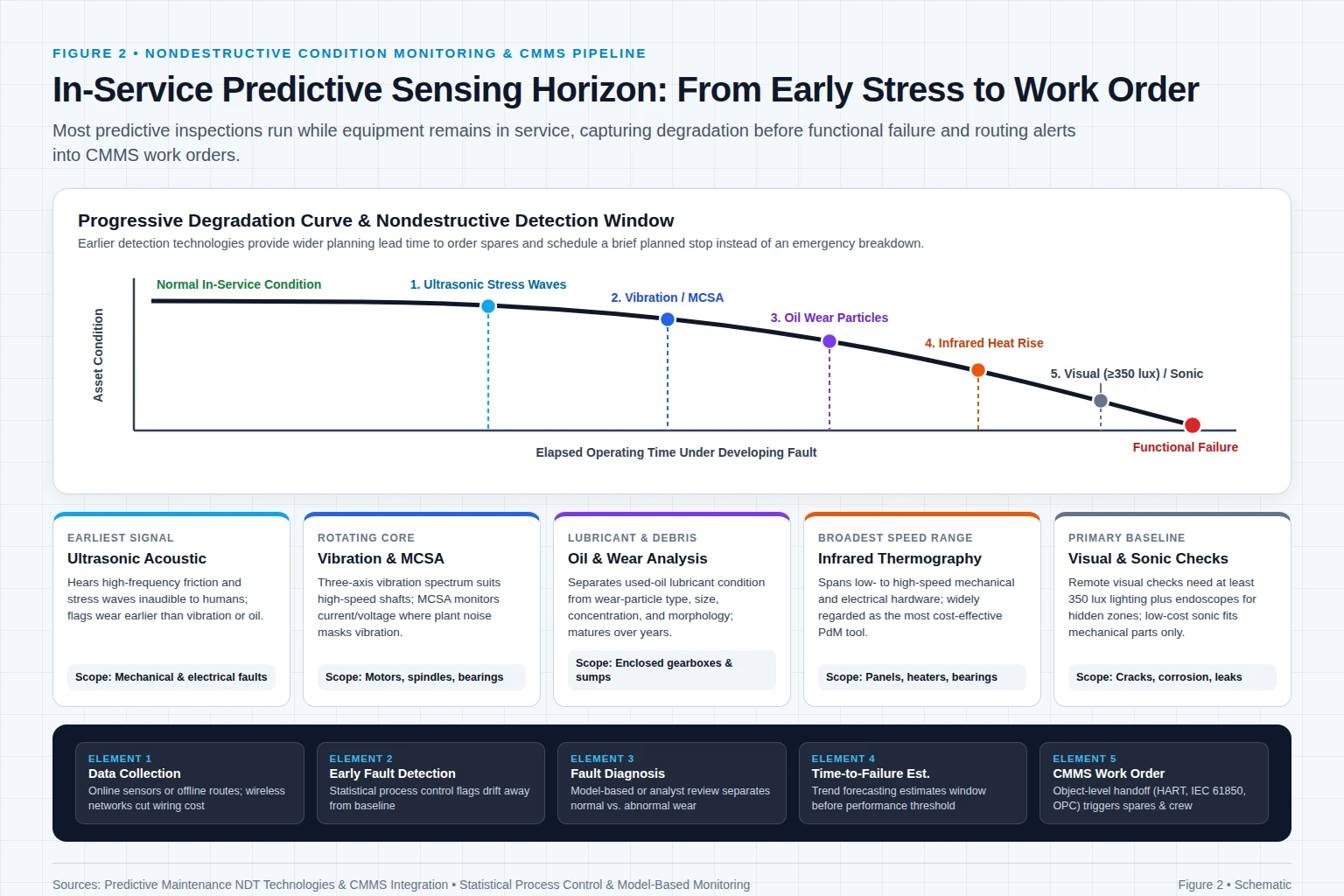
Implementing a predictive program requires five sequential capabilities working together rather than isolated handheld checks:
- Data collection and preprocessing. Gather periodic offline route readings or continuous online sensor streams (often over wireless sensor networks to cut cabling cost) and clean noise before trending.
- Early fault detection. Compare live equipment condition and process-performance signals against baseline statistical process control limits to spot subtle departures from normal behavior.
- Fault detection and diagnosis. Distinguish normal wear from abnormal mechanical, lubrication, or electrical degradation using analyst expertise or model-based condition monitoring.
- Time-to-failure prediction. Project degradation trends forward to estimate when performance will cross an operational threshold so repairs happen before breakdown.
- Maintenance scheduling and CMMS resource optimization. Transfer condition alerts directly to the right equipment object inside a computerized maintenance management system (CMMS) via industrial protocols such as HART, IEC 61850, or OPC to trigger planning, spare-parts staging, work orders, and reporting. Without CMMS object-level integration, predictive monitoring delivers limited value across large equipment fleets. Plants configuring machine telemetry can align these data feeds during packaging line integration.
Selecting nondestructive testing methods for packaging machinery
Because most predictive inspections take place while machines remain in service, selecting the right nondestructive testing (NDT) technology determines how much warning lead time the maintenance team gains and whether guards can stay closed:
| NDT condition monitoring method | What it detects | Packaging line fit | Key strength and operational limit |
|---|---|---|---|
| Ultrasonic acoustic analysis | High-frequency friction and stress waves inaudible to humans; mechanical and electrical faults | High-speed rotary bearings, lubrication deficiency, compressed-air leaks, electrical corona/discharge | Detects deteriorating friction and stress much earlier than vibration or oil analysis; covers both mechanical and electrical assets |
| Sonic acoustic monitoring | Audible-range mechanical sound level shifts | Basic mechanical drivetrains on lower-budget screening routes | Lower equipment cost than ultrasonic tools, but limited strictly to mechanical equipment |
| Vibration analysis (three-axis spectrum) | Imbalance, misalignment, looseness, bearing and gear mesh faults | High-speed rotating fillers, cappers, fans, pumps, and main drive shafts | Most productive on high-speed rotating assets, yet can be the most expensive PdM component to launch; vulnerable to background noise and dependent on analyst fundamentals |
| Motor current signature analysis (MCSA) and model-based monitoring | Spectral anomalies in motor current and voltage signals against a learned model | Servo drives, conveyor drive motors, and induction motors in noisy plant zones | Non-intrusive electrical and mechanical fault detection where competing floor noise masks vibration sensors; model-based spectral tracking originated on NASA's space shuttle main engine |
| Infrared thermography | Abnormal surface heat buildup across low- to high-speed assets | Control cabinets, drive panels, heat-sealing heaters, motor housings, and bearing blocks | Widest speed range across mechanical and electrical equipment; widely regarded as the most cost-effective PdM technology |
| Oil analysis (used oil and wear particle) | Lubricant quality/suitability plus wear particle type, size, concentration, distribution, and morphology | Enclosed high-load gearboxes, hydraulic power packs, and centralized oil sumps | Can eventually become the most predictive method where lubricated sumps exist, but requires years for a plant program to reach full maturity |
| Remote visual inspection | Surface cracks, folds, breaks, corrosion, and external irregularities | Guards, structural frames, conveyor guides, and enclosed cavities via endoscope | Cost-efficient primary nondestructive screening; requires at least 350 lux lighting and endoscopes for inaccessible components |
Actuation architecture also shapes the sensor mix. As detailed in servo versus pneumatic actuation in packaging equipment, servo-driven axes concentrate wear in bearings, gearboxes, belts, and drives (suited to MCSA, vibration, and infrared checks), whereas pneumatic axes concentrate wear in seals, valves, and air leaks (suited to scheduled seal PM and ultrasonic leak detection).
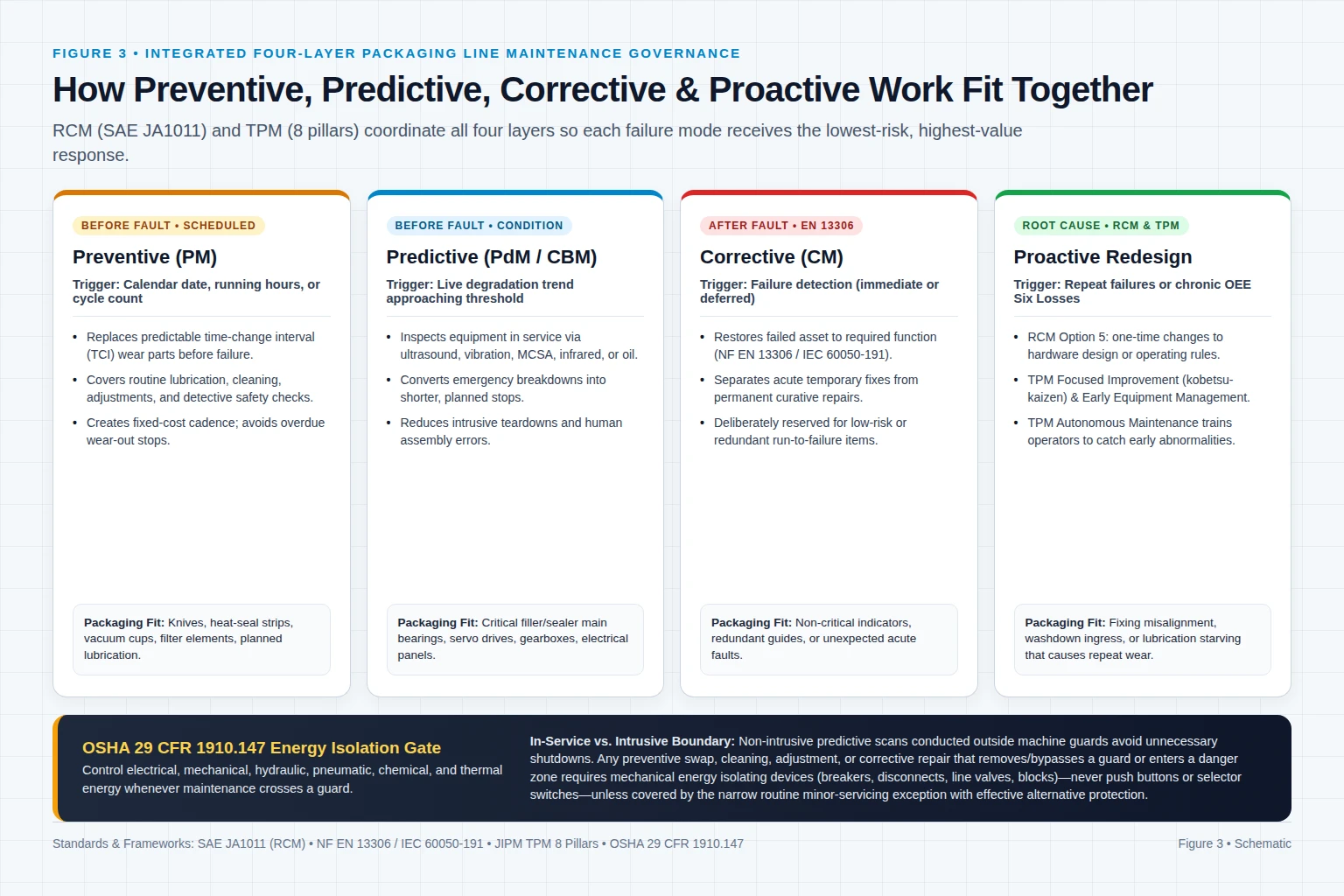
How do preventive, predictive, and corrective maintenance split tasks on a line?
Across an industrial packaging line, Reliability-Centered Maintenance (SAE JA1011) splits equipment tasks by failure consequence and detectability: predictive maintenance protects critical assets with random failure onset, preventive maintenance handles predictable wear-out consumables, detective checks verify hidden safety devices, and corrective maintenance (defined in NF EN 13306 / IEC 60050-191) restores low-criticality run-to-failure items or unexpected faults.
Under French and European terminology standard NF EN 13306 (a subset of IEC 60050-191), corrective maintenance is maintenance carried out after failure detection to restore an asset to a condition where it can perform its intended function. The standard subdivides corrective work into immediate corrective maintenance (started right after failure) and deferred corrective maintenance (delayed in conformance with maintenance rules). Practice also separates temporary acute fixes that replace a failed component from broader curative maintenance that permanently resolves the underlying mechanism defect.
Leaving critical bottleneck machinery on reactive breakdown maintenance is often the most expensive choice because a failed bearing or jammed mechanism can cause consequential damage to adjacent shafts and housings while halting line output during extended overhaul. However, deliberate corrective run-to-failure remains sound when an asset is non-critical, redundant, or presents trivial safety and operational consequences.
SAE JA1011 establishes seven sequential RCM questions—backed by Failure Mode Effects and Criticality Analysis (FMECA)—to assign each failure mode objectively:
- What is the item supposed to do and its associated performance standards?
- In what ways can it fail to provide the required functions?
- What are the events that cause each failure?
- What happens when each failure occurs?
- In what way does each failure matter (safety, environment, operations, or maintenance budget)?
- What systematic proactive task can prevent or diminish the failure’s consequences to a satisfactory degree?
- What must be done if a suitable proactive task cannot be found?
Answering those seven questions routes every packaging-line component into one of five RCM risk-management options, directly shaping capital and labor budgets evaluated in packaging machine total cost of ownership:
| RCM maintenance strategy | Trigger and timing | When it wins on a packaging line | Packaging equipment examples |
|---|---|---|---|
| Preventive restoration or replacement | Before failure; fixed date, run hours, or cycle count | Clear wear-out curve or fixed shelf life; low replacement cost | Rotary cutting blades, heat-seal PTFE strips, vacuum cups, filter elements |
| Predictive (condition-based) | Before failure; measured degradation trend | Random failure onset with measurable NDT warning; high downtime or safety cost | Main filler/wrapper bearings, servo motors, gearboxes, electrical panels |
| Detective (failure-finding) | Scheduled functional test | Hidden failures on standby or protective devices invisible during normal runs | Safety guard interlocks, emergency stops, redundant standby pumps |
| Corrective / Run-to-failure | After failure detection (immediate or deferred) | Non-critical or redundant item with no safety risk and low downtime impact | Non-essential indicator lamps, minor guide hardware, low-cost redundant fixtures |
| One-time system change | Engineering modification project | Safety or high operational risk cannot be reduced to tolerable levels by routine tasks | Guarding upgrades, washdown enclosure sealing, lubrication redesign, alignment fixtures |
Where does proactive root-cause work sit beside preventive and predictive maintenance?
Proactive root-cause work sits upstream of both preventive and predictive maintenance: rather than accepting recurring wear cycles or repeatedly catching incipient faults, proactive engineering eliminates the underlying causes of accelerated deterioration through RCM one-time system modifications and Total Productive Maintenance (TPM) focused improvement, quality maintenance, and early equipment management.
Preventive maintenance slows wear-out breakdowns and predictive maintenance forecasts random failures, yet neither strategy alone fixes a chronic design flaw, poor alignment, washdown moisture ingress, or lubrication starvation that forces the same bearing or seal jaw to degrade prematurely. RCM explicitly accounts for this gap through its fifth risk-management option: one-time changes to hardware design, operating procedures, or training whenever routine maintenance cannot bring risk to a tolerable level.
Total Productive Maintenance (TPM)—developed by Seiichi Nakajima in Japan between 1950 and 1970, first applied at Nippondenso in 1971, and expanded by the Japanese Institute of Plant Maintenance (JIPM) into eight activities—institutionalizes proactive reliability across the whole plant. TPM’s main objective is raising Overall Equipment Effectiveness (OEE = Performance multiplied by Availability multiplied by Quality) by eliminating the six losses: breakdowns, waiting and changeovers, reduced speed, minor stops, startup rejects, and running rejects.
A practical total productive maintenance checklist connects frontline operators and maintenance engineers across TPM’s core technical pillars:
- Autonomous maintenance (jishu-hozen): Line operators use their senses during routine cleaning, inspection, and basic care to catch early abnormalities—leaks, loose guards, unusual noise, or film-dust buildup—before they escalate into breakdowns.
- Planned maintenance: Trained mechanics and engineers execute scheduled preventive intervals and condition-based predictive routes coordinated through the CMMS.
- Focused improvement (kobetsu-kaizen): Cross-functional teams apply structured problem solving to eliminate repeat failure modes and chronic micro-stops.
- Quality maintenance (hinshitsu-hozen) and early equipment management: Engineers trace product defects back to machine variance and apply design lessons during new equipment commissioning so new packaging machines run defect-free with less accelerated wear.
What are the main types of preventive maintenance with plant examples?
Preventive maintenance splits into four main operational types on a manufacturing floor: calendar (time-based) maintenance, usage (running-hour or cycle-based) maintenance, condition-based or predictive maintenance, and detective failure-finding inspections for hidden protective functions.
Understanding all four categories prevents maintenance teams from equating preventive maintenance exclusively with rigid monthly calendars. Each category uses a distinct trigger tailored to how the packaging component degrades or fails:
| Preventive maintenance type | Trigger mechanism | How it works | Packaging plant examples |
|---|---|---|---|
| Calendar / time-based maintenance | Fixed elapsed date interval | Preplanned service visit on calendar dates regardless of shift utilization; fits corrosion, shelf-life, or statutory cycles | Scheduled washdown corrosion checks, elastomer shelf-life replacements, periodic panel cleaning |
| Usage / operation-count maintenance | Equipment running hours, pack cycles, or distance travelled | Replaces time-change interval (TCI) wear parts based on actual operating load rather than idle calendar time | Cross-seal knife swaps by cycle count, heat-seal strip replacement by run hours, vacuum cup and belt swaps |
| Condition-based / predictive maintenance | Live or route-based NDT condition indicators and degradation trends | Monitors in-service equipment via ultrasonic, vibration, MCSA, infrared, or oil readings and schedules work only when warranted | Triaxial vibration trends on rotary filler spindles, infrared scans on electrical cabinets, gearbox oil sampling |
| Detective (failure-finding) maintenance | Scheduled functional verification test | Tests standby or protective systems whose failure remains hidden until an emergency demand occurs | Functional checks on guard interlocks, emergency-stop circuits, pressure relief valves, and backup sensors |
On a real packaging line, these four preventive types work alongside deliberate run-to-failure on non-critical parts and TPM proactive root-cause elimination. Reviewing failure history periodically ensures that time-based tasks showing premature breakdown move to shorter usage intervals, predictive sensing, or root-cause redesign, while tasks showing zero degradation over repeated teardowns stop wasting labor and risking assembly errors.
Frequently asked questions
Does predictive maintenance replace preventive maintenance on a packaging line?
No; predictive maintenance complements preventive maintenance rather than replacing it. Low-cost wear consumables with predictable wear-out or shelf life (such as cutting knives, sealing strips, and vacuum cups) remain more economical on fixed-interval preventive replacement because condition-monitoring instrumentation often costs more than minor parts and adds extra sensors to maintain.
How does oil analysis fit into a packaging-line predictive maintenance plan?
Oil analysis separates into used oil analysis, which checks lubricant condition and suitability for continued use, and wear particle analysis, which evaluates solid particle type, size, concentration, distribution, and morphology inside lubricated gearboxes. Where lubricated sumps are present, oil analysis can eventually become highly predictive, though a plant program can take years to reach full maturity.
Why can fixed-interval overhauls increase failures on critical bearings and drives?
Reliability studies behind Reliability-Centered Maintenance (Nowlan and Heap, 1978; SAE JA1011) proved that the vast majority of complex component failures are not linked to asset age. Unnecessarily disassembling healthy bearings or servo assemblies on a calendar schedule increases intrusive maintenance operations and human-error exposure, which can re-introduce infant-mortality defects.
Which predictive sensing method works best when packaging floor noise masks vibration sensors?
Motor current signature analysis (MCSA) provides a non-intrusive alternative when strong background noise from adjacent machinery masks vibration signals, monitoring both electrical and mechanical anomalies through motor current and voltage spectra. Infrared thermography also operates across low- to high-speed mechanical and electrical equipment without contact.
When does maintenance work on a packaging machine require OSHA lockout/tagout?
Under OSHA 29 CFR 1910.147, hazardous energy control applies during servicing and maintenance whenever an employee removes or bypasses a guard or places any part of the body into a point of operation or danger zone. Isolation requires mechanical energy isolating devices—not push buttons or selector switches—unless work qualifies under the narrow routine minor-servicing exception with effective alternative protection.
Sources
- U.S. Department of Energy (FEMP) — Operations and Maintenance Challenges and Solutions (Reactive, Preventive, Predictive, and Reliability-Centered Maintenance)
- NIST — Prognostics, Health Management, and Control (PHMC) for Smart Manufacturing
- eCFR — OSHA 29 CFR 1910.147 (Control of Hazardous Energy / Lockout-Tagout)
- OSHA — Control of Hazardous Energy (Lockout/Tagout Overview)
- CCOHS — Hazardous Energy Control Programs
- Wikipedia — Predictive maintenance (in-service monitoring, NDT technologies, CMMS integration)
- Wikipedia — Reliability-centered maintenance (Nowlan and Heap 1978, SAE JA1011 seven questions, five risk-management strategies)
Update history
- : First published.
Next steps
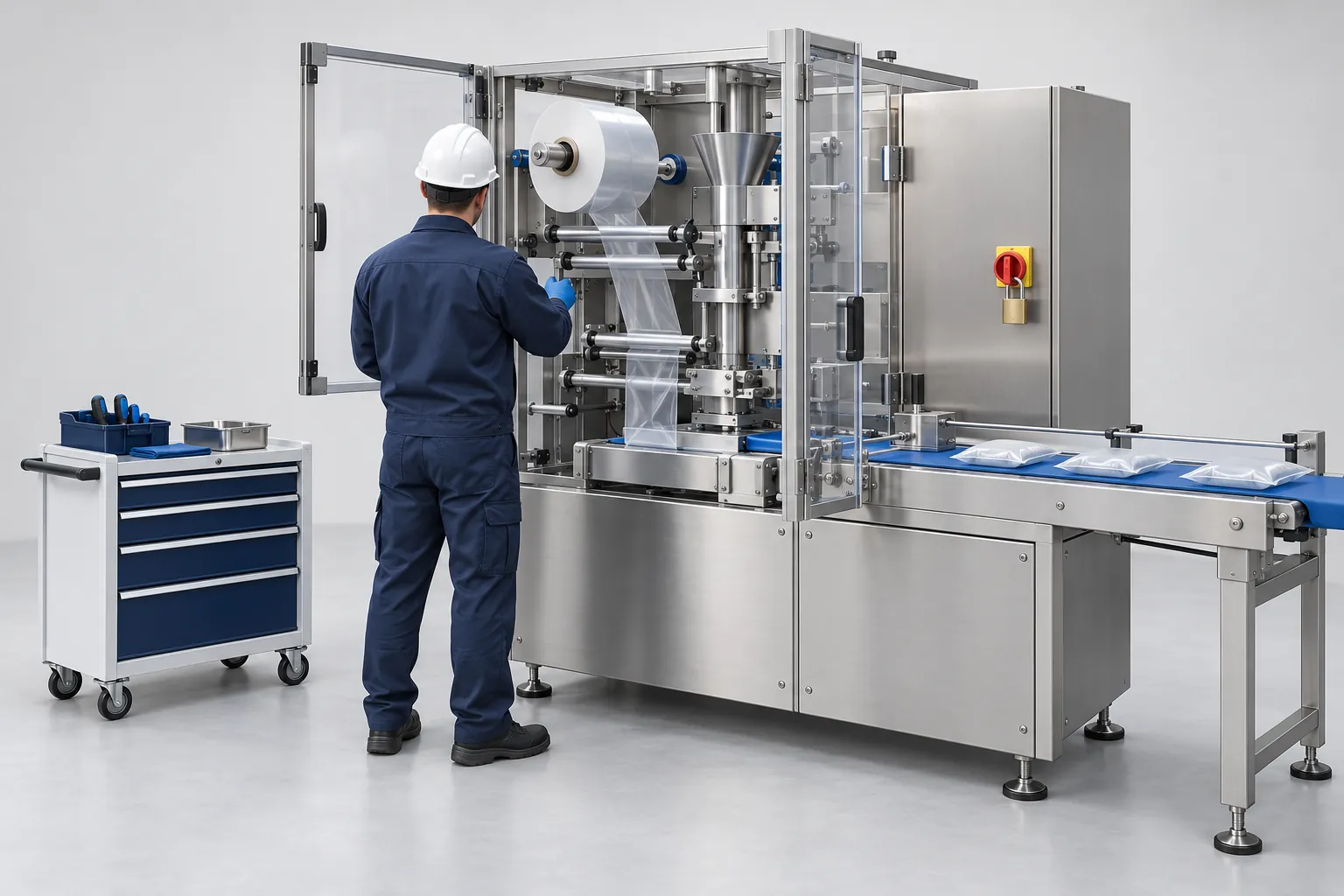
Packaging Machine Preventive Maintenance: Building a Site-Specific Checklist
Build a preventive maintenance checklist for packaging machines from OEM manuals, failure history, risk assessment and critical spares, with a task list.
Read guide
Packaging Line OEE Calculation and Bottleneck Analysis: PackML States, V-Curve Speeds and SMED
Run a packaging line OEE calculation that separates Availability, Performance and Quality, maps PackML Starved and Blocked timers, and sizes V-curve buffers.
Read guide Finding Packaging Line Bottlenecks with Basic Production Data
Identify candidate packaging-line constraints using four analysis groups, measured good-pack counts and running rates, with a worked example and copyable shift log.
Read guide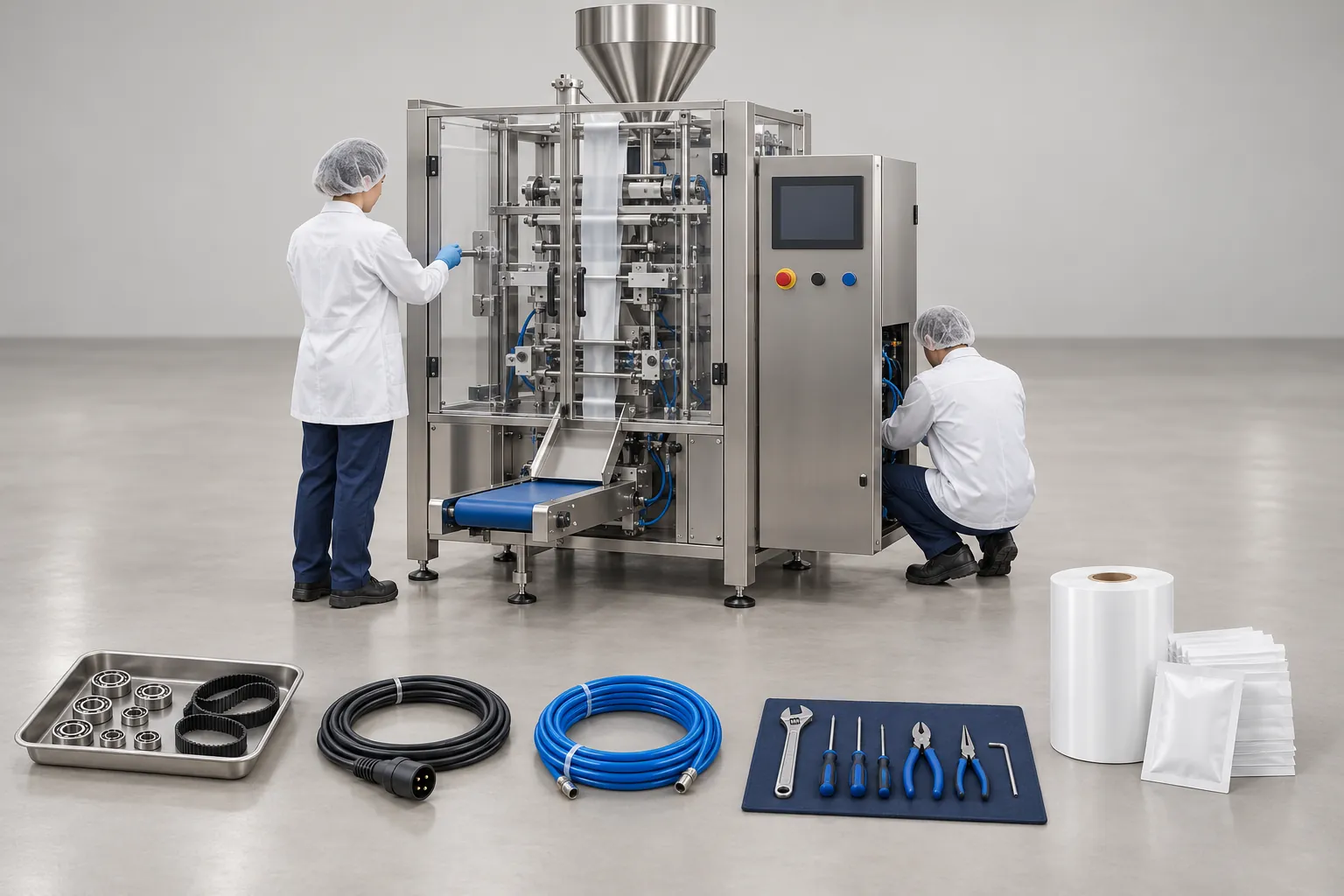
Packaging Machine Total Cost of Ownership: A Comparison Framework
Compare packaging machine offers by total cost of ownership: cost components, a fill-in table, an example with invented numbers and a sensitivity check.
Read guide