
Wrap-Around vs RSC Case Packer Selection
A wrap-around case packer folds a flat folder blank around grouped packs; an RSC case packer erects, fills, and closes a slotted 0201 shipping box.
Choose a wrap-around case packer when grouped packs form a stable block that a one-piece folder-type blank (such as FEFCO 0406, marked A for usually automated erection) can fold around and close inside one machine path. Choose a Regular Slotted Container (RSC, FEFCO 0201) top-load or side-load case packer when packs enter a pre-erected slotted box, when the shipping case carries compressive load without internal product support, or when erecting, loading, and sealing run as separate stations.
Applies to: Packaging engineers, plant managers, and equipment buyers comparing wrap-around folder-blank case packers against Regular Slotted Container (RSC, FEFCO 0201) top-load and side-load case packers for tertiary corrugated shipping cases.

A wrap around case packer collates packs into a defined group, folds a flat folder-type corrugated blank around that group, and closes the joint inside one integrated frame, whereas an RSC carton (Regular Slotted Container) top load case packer or side-load case packer sets up a knocked-down slotted box, loads packs into the open cavity, and closes the flaps for shipment. Selecting between the two architectures starts with four physical checks: blank construction and automation mark, whether the primary packs share vertical stacking load, how rising warehouse humidity affects corrugated walls, and how operators guard and adjust the closing and forming zones.
This comparison covers tertiary corrugated shipping cases at the end of a packaging line. If your project still needs to separate secondary folding-paperboard cartons from tertiary corrugated shipping boxes, start with cartoners versus case packers or review the broader packaging equipment guides.
| Selection axis | Wrap-around case packer (folder-type blank) | RSC top-load or side-load case packer (slotted box) |
|---|---|---|
| Corrugated blank construction | One-piece folder-type board hinged from the bottom panel to form two or all side walls and the cover | One-piece slotted-type box shipped flat with a pre-joined manufacturer's joint and equal-length top and bottom flaps |
| Representative FEFCO styles and marks | FEFCO 0406 (marked A for usually automated erection) or FEFCO 0410 (marked M/A). FEFCO 0409 is marked M for usually manual erection | FEFCO 0201 Regular Slotted Container (marked M/A for manual or automated erection) |
| Machine station sequence | Group packs, feed flat blank, wrap walls and cover around the group, and close flaps in one frame | Set up knocked-down box, load grouped packs from the top or side, and close flaps at an integrated or downstream sealer |
| Product presentation requirement | Grouped containers or cartons maintain stable geometry while board panels fold tightly around the array | Open box cavity receives rigid, semi-rigid, or non-supporting packs lowered by gripper, drop packer, or horizontal pusher |
| Available closure methods | Cold or hot gluing, taping, interlocking, or stitching, applied singly or in combination | Cold or hot gluing, taping, interlocking, or stitching on flaps, paired with a glued, stitched, or taped manufacturer's joint |
How do wrap-around and RSC case packers form and load a shipping case?
An RSC case-packing system opens a pre-joined slotted tube before any product enters the container, while a wrap-around case packer places the collated product group on a flat folder blank and forms the box walls around that group.
Under the FEFCO and ESBO International Fibreboard Case Code, slotted-type boxes consist basically of one piece of fibreboard with a glued, stitched, or taped manufacturer’s joint plus top and bottom flaps, shipped flat, ready to use, and closed using the provided flaps. As summarized in the Regular Slotted Container design reference, the Regular Slotted Container (RSC) is the most common box style, coded 0201 in the 4-digit FEFCO system; all flaps have the same length from score to edge, and typically the major flaps meet in the middle while the minor flaps do not unless box width equals box length. On an RSC, the manufacturer’s joint is most often joined with adhesive, though it may also be taped or stitched, and the knocked-down flat box goes to the packager who sets up the box, fills it, and closes it for shipment.
On the plant floor, an RSC line runs that set-up, fill, and close sequence. A top load case packer places the grouped packs into the open top of the erected 0201 case. A side-load case packer places the grouped packs through an open side of the erected case, then closes the flaps.
By contrast, folder-type boxes and trays in the FEFCO and ESBO classification usually consist of only one piece of board in which the bottom of the box is hinged to form two or all side walls and the cover, with locking tabs, handles, or display panels incorporated in some designs. A wrap around case packer places the collated group on that one-piece folder blank and folds the hinged side walls and cover around the group until the joint is closed. The folder blank is formed around the load; it is not the pre-joined slotted tube that an RSC line sets up, fills, and closes.

| Forming stage | Slotted RSC path (FEFCO 0201) | Wrap-around folder path (such as FEFCO 0406) |
|---|---|---|
| Incoming corrugated supply | Knocked-down flat slotted blank with a manufacturer's joint already glued, stitched, or taped by the box converter | Flat unjoined die-cut or scored one-piece folder blank stacked in the machine magazine |
| Case setup step | The packager sets up the knocked-down box before product enters | The flat folder blank is formed around the group, with no pre-joined tube to set up first |
| Product loading action | Grouped packs are placed into the open RSC from the top or from the side | The grouped packs sit on the bottom panel while the hinged side walls and cover fold around them |
| Final closing action | Top and bottom flaps close by cold or hot gluing, taping, interlocking, or stitching, singly or in combination | The cover and side walls close by cold or hot gluing, taping, interlocking, or stitching, singly or in combination |
What do FEFCO 0201, 0406, 0409, and 0410 erection marks mean for automation?
FEFCO and ESBO pair every 4-digit box design number with an erection symbol (M for usually manual erection, A for usually automated erection, or M/A when erection can be either manual or automated). Match that published mark to the line before the machine specification is locked: a folder style marked M is the manual-erection design, and an automated wrap-around path uses a style marked A or M/A.
Developed by FEFCO and ESBO (cited here from the 2007 11th Edition), the International Fibreboard Case Code substitutes long, complicated verbal descriptions of fibreboard case and packaging constructions with simple international symbols. In the code’s style schedule, the erection indications split slotted and folder blanks along clear operational lines:
| FEFCO style code | Construction group | Published erection mark | Equipment specification implication |
|---|---|---|---|
| 0201 | Slotted-type box (Regular Slotted Container) | M/A (can be either manual or automated) | Manual or automated erection, including an RSC top-load or side-load case packer |
| 0406 | Folder-type box | A (usually automated erection) | Usually automated erection, the folder style to specify for an automatic wrap-around case packer |
| 0409 | Folder-type box | M (usually manual erection) | Usually manual erection, so keep it off an automatic wrap-around case packer specification |
| 0410 | Folder-type box | M/A (can be either manual or automated) | Manual or automated erection when the line can use either |
Blank drawings also have to obey strict dimensioning and unit rules so the corrugated converter and the case packer builder work from identical crease geometry. Under the FEFCO and ESBO specification, unless otherwise specified, all case dimensions are expressed as internal dimensions in mm written as Length (L) x Breadth (B) x Height (H), where L is the longer dimension at the opening, B is the shorter dimension at the opening, and H is the dimension from the top of the opening to the base. Dimensions should be measured under standard climatic conditions on the flat blank from the centre of the crease, bearing the thickness of the board material in mind. When a case design uses overlapping outer flaps, as seen on folder-type wrap-around blanks and overlapping slotted containers, the length of the area of overlapping (o) should be given as a fourth measurement after an oblique stroke, illustrated by the code’s dimension-writing example 355 x 205 x 120/40 mm for (L) (B) (H) (o).
When North American and European teams share box specifications, ASTM D5118/D5118M-25 covers the fabrication of new fiberboard boxes, liners, and sleeves and points out the manufacturing factors and components that must be controlled in corrugated and solid fiberboard box manufacture. Under ASTM D5118/D5118M-25, values stated in inch-pound units and values stated in SI units are regarded separately as standard; because the two unit systems are not exact equivalents, each system must be used independently, and combining values from the two systems may result in non-conformance with the standard. Lock one unit system, the FEFCO 4-digit code, internal L x B x H crease-center dimensions, board thickness, and outer-flap overlap o in the packaging machine RFQ checklist before requesting vendor quotes.
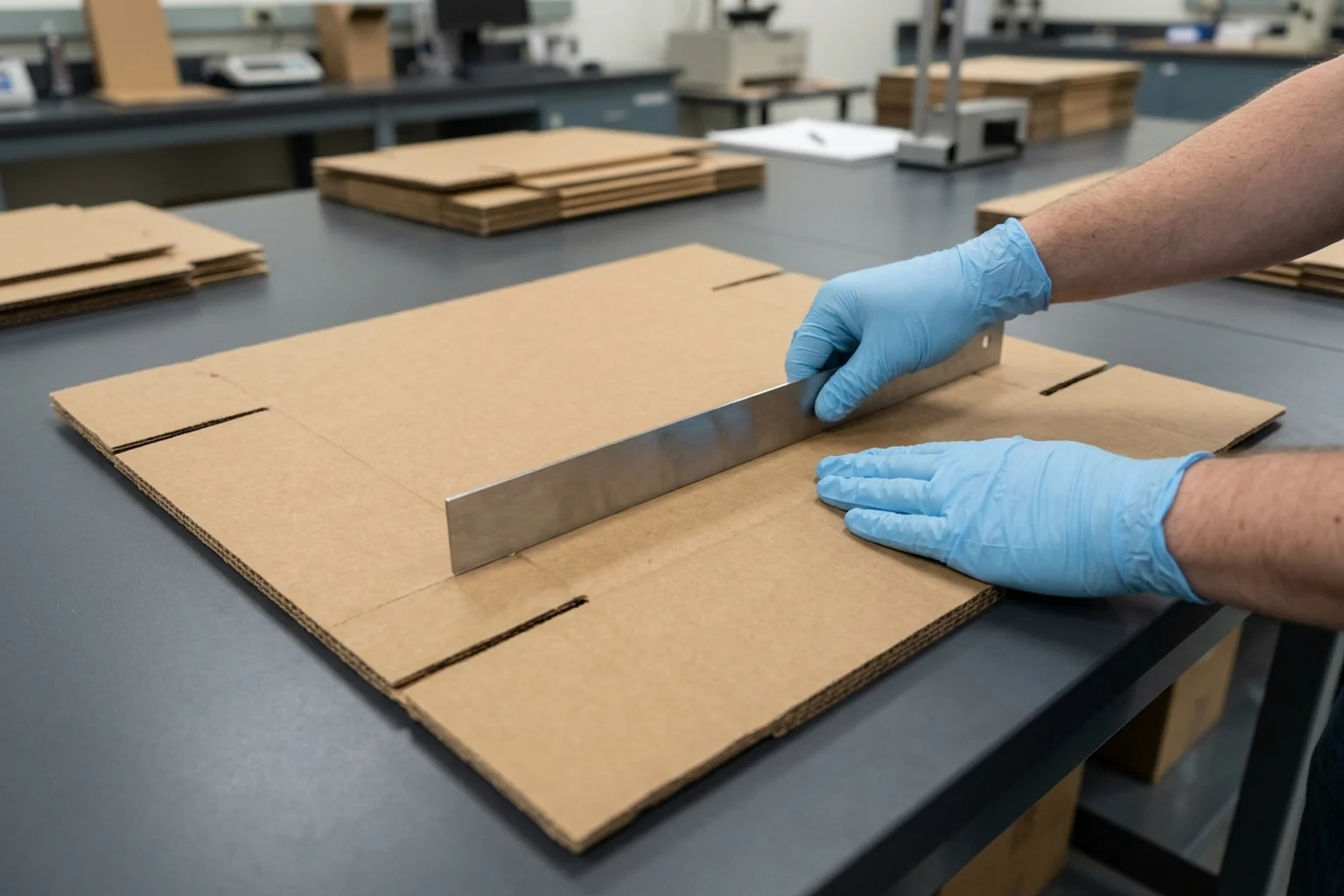
Top-load RSC vs wrap-around case packer: how do load-sharing and humidity affect compression?
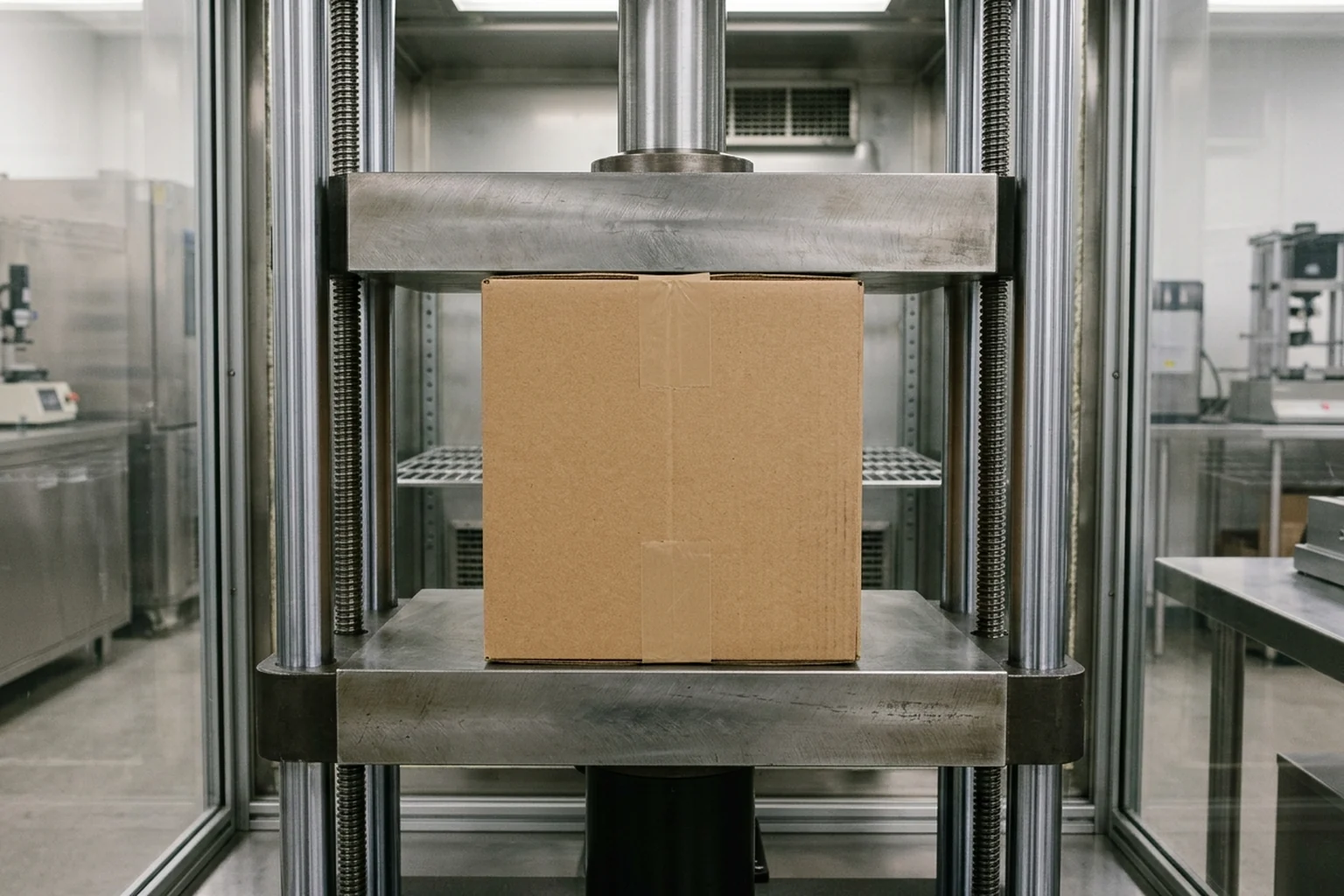
Case selection turns on whether the packed container or the primary packs carry vertical stacking load, and on how rising humidity is tied to fiberboard box collapse in shipping. ASTM D5118/D5118M-25 covers fabrication of new fiberboard boxes, liners, and sleeves, and it includes references for assessing container adequacy under atmosphere, handling, shipping, and storage. Use a compression test for that load-sharing check and a distribution-cycle plan for the shipping hazards.
Under the ASTM shipping-container compression test method, compression tests apply external loads to container faces, diagonally opposite edges, or corners across individual shipping containers (such as boxes and drums), components, multiple containers, or unit loads, tested with or without contents, using inch-pound units as standard (with parenthetical SI conversions provided for information only). That compression test method is related to TAPPI T 804 and fulfills the requirements of ISO Test Method 12048. The ISO standards may not meet the requirements of this test method. The load-application procedure may be used to compare containers that differ in construction, including a slotted shipping box and a folder-type wrap-around case, and the test may be conducted with the container loaded with contents and interior packaging when the contents share the load.
Rigid load-sharing primary packs
When the primary packs share the vertical compressive load, run the ASTM compression method with the contents and interior packaging installed. A wrap around case packer then folds the folder-type blank around that load-sharing group.
Non-load-bearing or compressible primary packs
When the primary packs do not share the vertical load, test the shipping container without treating the contents as the compression member, and place those packs into an erected RSC carton with a top load case packer. The slotted case carries the stack.
Warehouse and transit humidity changes that structural choice. Research published by the USDA Forest Products Laboratory notes that collapse of fiberboard packaging boxes in the shipping industry due to rising humidity conditions is common. In that study, a 2 in. by 2 in. corrugated panel is subjected to steady-state moisture flow from a rise in relative humidity from 50% to 90%. Liner and medium stress-strain curves are generated from experimental data at 50% and 90% RH, and the fiberboard is subjected to transient moisture analysis coupled with edgewise-compressive loading. The short-column model in the creep analysis is a 2 in. by 2 in. corrugated fiberboard, while the experimental fiberboard is 2 in. wide and 1.5 in. high, which the paper calls a standard Edge Crush Test specimen, with deflection adjusted for the height difference. Across the 38% to 86% RH interval in that creep model, constant C4 is affected by relative humidity and maximum deformation occurs at 86% RH.
Pair a loaded compression test, when the contents share the load, or a test of the container on its own, when the case carries the load, with ASTM D4169. That practice provides a uniform laboratory basis for evaluating whether shipping units withstand the distribution environment through a test plan of anticipated hazard elements in distribution cycles. This practice is not intended to supplant material specifications or existing preshipment test procedures. For packages in single parcel shipments, consider Practice D7386. Once the case dimensions are set, carry the outer case into downstream pallet stacking patterns.
| Engineering selection check | What to verify before locking the machine class | Impact on wrap-around vs RSC selection |
|---|---|---|
| Product load-sharing | Test whether primary packs and interior dividers share vertical compression load or require clearance inside the box | Load-bearing rigid packs suit tight wrap-around folding; compressible pouches and fragile packs suit top-load RSC placement |
| FEFCO erection mark | Confirm the exact 4-digit FEFCO style and whether its schedule mark is A, M/A, or M | Specify A (such as 0406) or M/A (such as 0201 or 0410) for automated lines; keep M-marked blanks (such as 0409) on manual erection |
| Case closure method | Name the closure method: cold or hot gluing, taping, interlocking, or stitching, used singly or in combination | Either style closes by cold or hot gluing, taping, interlocking, or stitching, singly or in combination; the RSC also has a glued, stitched, or taped manufacturer's joint |
| Humidity and distribution cycle | Check the USDA FPL moisture-flow case (50% to 90% RH) and the creep model (C4 affected from 38% to 86% RH, maximum deformation at 86% RH), then the distribution-cycle plan | When humidity rises and the contents do not share the load, verify container compression with the case carrying the stack |
How do closure methods, guarding, and changeover rules differ on the plant floor?
Closure method, point-of-operation guarding, and hazardous-energy isolation decide how the line is run. In the FEFCO and ESBO code, closure is possible either singly or in combination by gluing (cold or hot), by taping, by interlocking, or by stitching.
On a wrap-around case packer, the folder walls and cover close in the same path that folds them around the group. On an RSC line, the packager sets up the box, fills it, and closes the flaps. When comparing blank supply, adhesive or tape consumables, spare parts, and the rest of the station chain, use the packaging machine total cost guide.
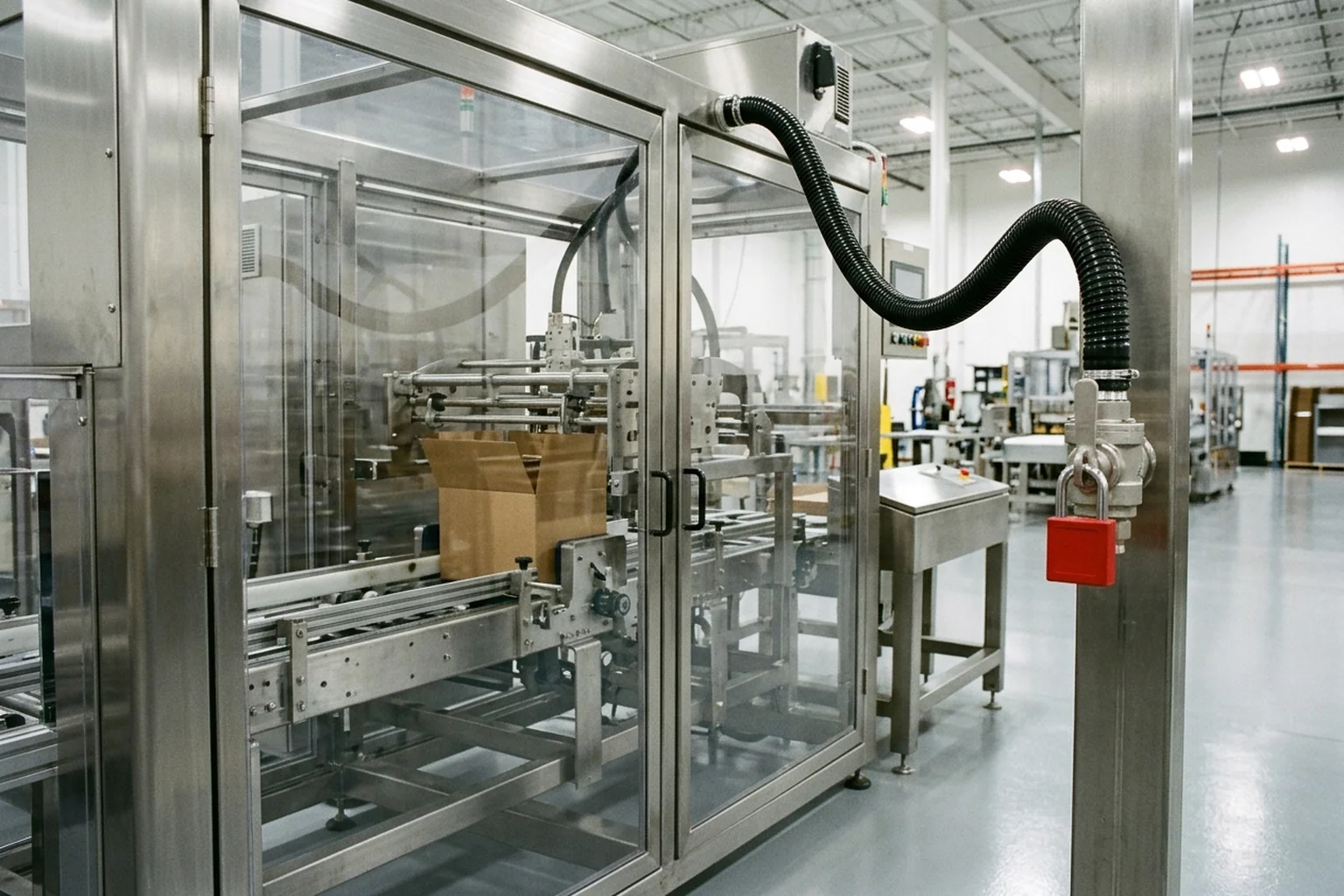
Both machine families present point-of-operation, nip-point, and rotating-part hazards where the blank is formed and the case is closed. Under OSHA 29 CFR 1910.212, one or more methods of machine guarding (such as barrier guards, two-hand tripping devices, or electronic safety devices) shall be provided to protect the operator and other employees in the machine area from hazards created by the point of operation, ingoing nip points, rotating parts, flying chips, and sparks. Guards shall be affixed to the machine where possible (and secured elsewhere if machine attachment is not possible) without offering an accident hazard in themselves. Because the point of operation is the area on a machine where work is actually performed upon the material being processed, OSHA 29 CFR 1910.212 requires that any point of operation exposing an employee to injury shall be guarded so the operator cannot have any part of the body in the danger zone during the operating cycle, and specifies that special hand tools for placing and removing material only supplement required guarding rather than substituting for it.
Format changes and servicing fall under the same hazardous-energy rules when a guard comes off or a hand enters the danger zone. Under OSHA 29 CFR 1910.147, lockout/tagout establishes minimum performance requirements for controlling hazardous energy during servicing and maintenance in which unexpected energization, start up, or release of stored energy could injure employees. While normal production operations are not covered by 1910.147, servicing or maintenance during normal production falls under lockout/tagout whenever an employee is required to remove or bypass a guard or other safety device, or place any part of the body into a point of operation or associated danger zone during a machine operating cycle. Minor tool changes, adjustments, and other minor servicing activities during normal production operations are outside 1910.147 only if they are routine, repetitive, and integral to the use of the equipment for production, provided the work uses alternative measures that provide effective protection.
OSHA 29 CFR 1910.147 defines an energy source as any source of electrical, mechanical, hydraulic, pneumatic, chemical, thermal, or other energy. Isolating the electrical and pneumatic supplies still leaves mechanical and thermal energy to be controlled, including thermal energy at a hot-melt glue unit. Record which adjustments stay on alternative protection and which require full lockout on the format changeover checklist.
Wrap-around vs RSC case packer selection table
Use this end-of-page engineering matrix to match your blank style, primary pack stability, closure method, humidity exposure, and line architecture to either a wrap-around case packer or an RSC top-load or side-load case packer before issuing supplier bids.
| Decision factor | Choose a wrap-around case packer | Choose an RSC top-load or side-load case packer | Verification record to include in RFQ |
|---|---|---|---|
| FEFCO case family and code | One-piece folder-type blank such as FEFCO 0406 (marked A) or FEFCO 0410 (marked M/A), where the bottom hinges to form side walls and cover | One-piece slotted-type Regular Slotted Container coded FEFCO 0201 (marked M/A), with equal-length flaps and a pre-joined manufacturer's joint | 4-digit FEFCO style code, published erection mark (A or M/A), and flat-blank crease-center drawing |
| Flat-blank dimension notation | Internal L x B x H dimensions in mm measured from crease centers under standard climatic conditions, plus fourth overlap measurement `/o` where outer flaps overlap | Internal L x B x H dimensions in mm measured on the flat slotted blank from crease centers, bearing board thickness in mind | Crease-center blank drawing stating internal L x B x H in mm, board thickness, and overlap length `o` |
| Box fabrication and unit systems | New fiberboard folder blanks fabricated under ASTM D5118/D5118M-25, with inch-pound and SI values kept in one unit system | New fiberboard slotted boxes fabricated under ASTM D5118/D5118M-25, with inch-pound and SI values kept in one unit system | ASTM D5118/D5118M-25 fabrication specification using one independent unit system |
| Primary pack load-sharing | Primary packs that share vertical compressive load, tested with contents and interior packaging installed, and a folder blank folded around that group | Primary packs that do not share the load, placed into an erected slotted box from the top or the side so the case carries the stack | Compression test plan: loaded container when contents share the load; container on its own when the case carries the load |
| Case closure method (glue, tape, interlock, stitch) | Cold or hot gluing, taping, interlocking, or stitching, singly or in combination, on the folder walls and cover | The same closure methods on the flaps, plus a glued, stitched, or taped manufacturer's joint | Named closure method: gluing (cold or hot), taping, interlocking, or stitching |
| Warehouse humidity and transit hazards | Loaded compression when contents share the load, plus the USDA FPL creep check (maximum deformation at 86% RH; C4 affected from 38% to 86% RH) | Container compression when the slotted case carries the load, plus the 50% to 90% RH moisture-flow case and the 38% to 86% RH creep interval | ASTM D4169 distribution-cycle test plan; consider Practice D7386 for single parcel shipments |
| Line modularity and manual fallback | One path groups the packs, folds an A or M/A folder blank around them, and closes it | Set-up, fill, and close of an M/A 0201 box, which can also be erected manually | Whether set-up, loading, and closing are one path or separate stations, and whether manual erection is required |
| Point-of-operation machine guarding | Barrier guards, two-hand tripping devices, or electronic safety devices affixed at the point of operation, nip points, and rotating parts | The same guarding methods at the point of operation, nip points, and rotating parts on the erector, loader, and flap closer | OSHA 29 CFR 1910.212 guarding layout confirming hand tools only supplement required machine guards |
| Changeover and hazardous-energy lockout | Routine, repetitive, integral adjustments stay on alternative protection; bypassing a guard or reaching into the danger zone requires lockout of every energy source in use, including thermal energy at a hot-melt unit | The same split: alternative protection only for minor servicing that meets 1910.147, and lockout of electrical, pneumatic, mechanical, and thermal energy when a guard is bypassed or a hand enters the danger zone | OSHA 29 CFR 1910.147 energy-isolation map covering electrical, mechanical, hydraulic, pneumatic, chemical, and thermal sources |
FAQ
When does a wrap-around case packer fit better than an RSC top-load case packer?
A wrap-around machine fits when the primary packs share the vertical compressive load and a one-piece folder-type blank (such as FEFCO 0406, marked A) can fold around that group and close in the same path. An RSC top-load packer fits when the packs do not share that load and go into an already erected FEFCO 0201 box whose walls carry the stack.
Why is FEFCO 0409 unsuitable for an automated wrap-around case packer?
In the FEFCO and ESBO style schedule, folder style 0409 carries the erection mark M, which means usually manual erection. An automated wrap-around path specifies a style marked A for usually automated erection (such as 0406) or M/A for manual or automated erection (such as 0410), and the flat-blank drawing carries that 4-digit code and erection mark.
Does buying corrugated cases to ASTM D5118 guarantee stacking strength in humid warehouses?
No. ASTM D5118/D5118M-25 covers fabrication of new fiberboard boxes, liners, and sleeves, and it includes references for assessing adequacy under atmosphere, handling, shipping, and storage. Stacking performance where rising humidity is tied to fiberboard box collapse is checked by compression testing and by a distribution-cycle test plan.
When do case packer format adjustments require full lockout/tagout under 29 CFR 1910.147?
Under OSHA 29 CFR 1910.147, lockout/tagout applies during production whenever an operator or technician removes or bypasses a guard or safety device, or places any part of the body into a point of operation or associated danger zone. Adjustments stay outside 1910.147 only when they are routine, repetitive, and integral to production and use alternative measures that provide effective protection. Servicing that removes a guard or puts a hand in the danger zone is covered by lockout of the electrical, pneumatic, mechanical, and thermal energy sources.
Sources
- ASTM Standard Test Method for Determining Compressive Resistance of Shipping Containers, Components, and Unit Loads
- ASTM D5118/D5118M-25: Standard Practice for Fabrication of Fiberboard Shipping Boxes
- ASTM D4169: Standard Practice for Performance Testing of Shipping Containers and Systems
- FEFCO and ESBO: International Fibreboard Case Code (2007, 11th Edition)
- eCFR: 29 CFR 1910.212, General Requirements for All Machines (Machinery and Machine Guarding)
- eCFR: 29 CFR 1910.147, The Control of Hazardous Energy (Lockout/Tagout)
- USDA Forest Products Laboratory: Moisture Flow and Creep Analysis of Corrugated Fiberboard Packaging Boxes
- Wikipedia: Corrugated Box Design (Regular Slotted Container and FEFCO 0201 Reference)
Update history
- : First published.
Next steps
Cartoners vs. Case Packers: Where Each Fits in a Packaging Line
Compare cartoners and case packers by packaging level, loading style, product orientation, counting and end-of-line interfaces, with questions for suppliers.
Read guide
Pallet Stacking Patterns: Column, Brick, Pinwheel and Split-Row Compared
Compare column, brick, split-row and pinwheel pallet patterns by layer interlock, box compression, stability, how a palletizer forms each layer and containment.
Read guide
Packaging Machine Total Cost of Ownership: A Comparison Framework
Compare packaging machine offers by total cost of ownership: cost components, a fill-in table, an example with invented numbers and a sensitivity check.
Read guide
Packaging Machine RFQ Checklist: Information Suppliers Need
A reusable blank RFQ template for packaging machines in nine sections, with the reason suppliers need each item and a list of commonly missed details.
Read guide