
VFFS for Fresh Produce: Compare Hand Loading and Automatic Dosing with a Product Trial
Name the vegetable, cut, portion and feed, then record drops, damage, missed doses and operator tasks before comparing hand loading with automatic dosing.
A bruised slice or a missed handful wastes the pack before a bagger rate is worth comparing. Hand loading and automatic dosing put a named fresh vegetable into a vertical bag on different paths. Write the vegetable, the cut, the portion and the feed on one sheet, then record the drops, the damage, the missed doses and the operator tasks for the path you actually run.
Applies to: Fresh vegetables and salads placed by hand or released by a dosing device into a vertical bagger. Does not set a film oxygen value, a gas recipe, a shelf life, a food-safety result, or a line speed. Frozen-food pages are not used as fresh-produce evidence.
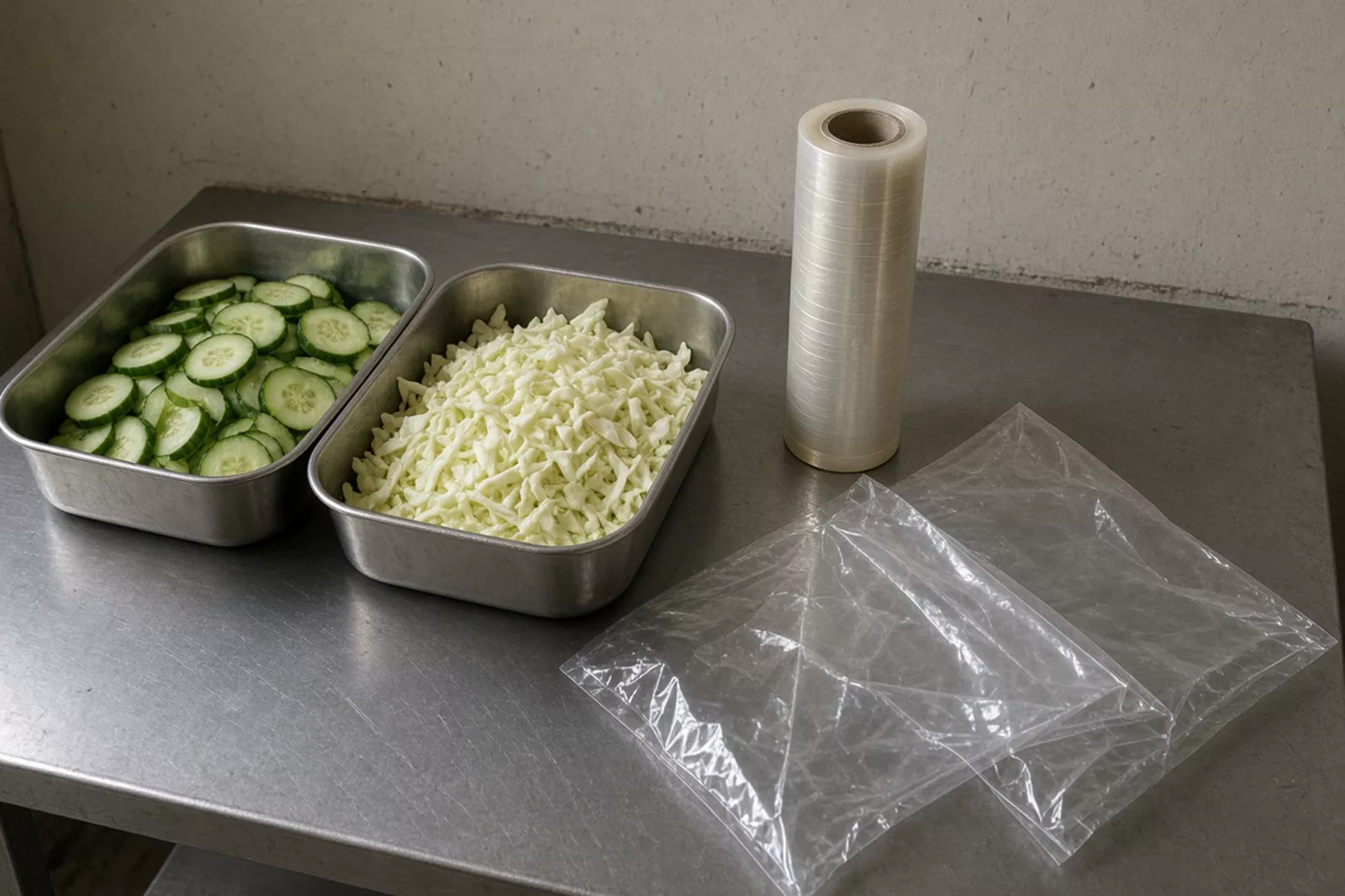
A bruised slice or a missed handful wastes the pack before a bagger rate is worth comparing. Hand loading and automatic dosing put a named fresh vegetable into a vertical bag on different paths. Write the vegetable, the cut, the portion and the feed on one sheet before you treat those paths as the same job.
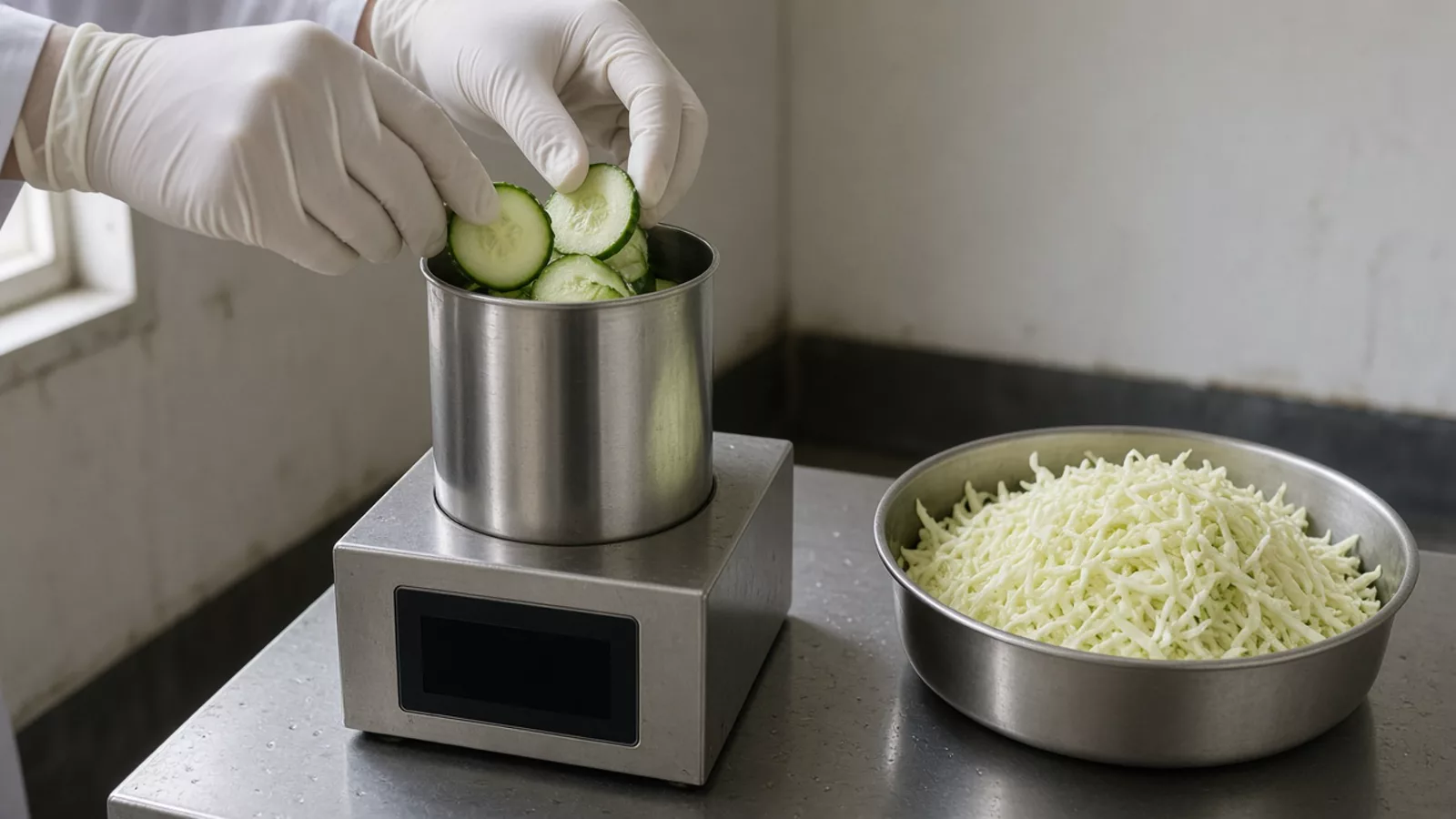
The photograph shows that placement. It is not a named bagger and not a completed trial. Public pages already show a hand-loaded produce demo and, separately, baggers that weigh and form a bag. They do not share one record of the vegetable, the portion, the drops, the damage and the people. This page is that record. It does not pick a faster machine.
If the package is already a premade pouch rather than a bag formed on the machine, use the VFFS and premade pouch comparison for the package route, and keep this sheet for how the vegetable gets into the bag.
Swipe sideways to see the other columns. The first column stays visible.
| Input | What to write down | What the note is for |
|---|---|---|
| Named vegetable and cut | The plant name and the piece: slice, shred, leaf, stick, or whole | So both routes are about the same product |
| Physical condition | Wet, dry, sticky, limp, or firm, in words from this lot | So a later run is not compared with a different lot |
| Portion | The target quantity and the unit the specification uses | So a handful and a machine dose are not mixed |
| Feed method | Hand loading, or the dosing device that is actually fitted | So the column you fill matches the machine in the room |
| Drop and transfer points | Each place the piece changes hands or falls | So damage and misses have a location |
| Damage, misses, operator tasks | What you see on the piece, what never lands in the bag, and who does which task | So a rate is not standing in for those observations |
What each public route actually describes
The two routes below come from different manufacturers. A sentence on one page is not a test of the other page’s machine. Where a page prints a number, the number stays attached to that page.
People placing the vegetable
WeighPack’s page of 30 July 2025 describes a VersaPak tabletop vertical bagger. Two operators work as a team and hand-load sliced cucumbers and cole slaw into the machine. The page calls the package a form-and-seal pouch. It says the bagger supports paper film, and it says the machine is for fresh produce and small batch runs. The same page also lists snacks, treats, candies, hardware and other count-based products. Those names are the manufacturer’s list. They are not a trial of your cut.
The page prints a rate of up to 15-20 bags per minute. It does not print a bag length, a bag width, a portion weight, or a timing method, and it does not say that the 15-20 figure was counted on the cucumber and the cole slaw. Leave that figure in the source note. Do not type it into the trial sheet as the rate your line should hit.
The page’s technology line includes weighing and dispensing. The demo sentence is hand loading by two people. Those are different statements. A weighing tag on the post is not evidence that this demo weighed the slices. The post also carries a VFFS hashtag. The machine name on the page is a tabletop vertical bagger, and the action described is hand loading. Do not relabel that demo as a fully automatic line.
Operator work is the part you can copy into the sheet as a question, not as a headcount you must match. The page says two people. Your room may have one person or three. Write the tasks: who picks the vegetable up, who holds or presents the bag, who starts the seal, and who takes the bag away. A task with no name is an empty cell.
A device releasing the vegetable
IAPACK’s ZL780 page, parameter table read on 14 October 2026, describes one machine that feeds, weighs, forms a bag from film, and seals it. The page says it is for packaging white radish, cucumber, lettuce and cabbage into a plastic bag. The application paragraph adds vegetable salad, fruit salad, potatoes, onions, tomatoes, cherry tomatoes, and other vegetables and fruits. It says finished bags leave on a conveyor, so people do not collect them by hand. That conveyor sentence is about taking the closed bag away. It is not a description of how the vegetable was portioned.
The same page prints these bag figures for model ZL780: pillow bag or gusseted bag; bag length 150-480 mm, with the length able to go longer when a second film pull is used; bag width 120-375 mm, stated as side width plus front width; film width up to 780 mm; bag forming speed 5-15 bags per minute. The page does not name the vegetable, the cut, or the target weight that sat behind that speed. A forming speed without a portion is not a produce rate. Copy the figures into the source note if you are reading that model. Leave the trial sheet’s speed cell blank until your run has a count, a product and a clock.
IAPACK says the machine uses a load cell, that it can pause when no product is present, and that feeder amplitude can be adjusted independently, which the page says can make feeding more uniform. Those are the manufacturer’s feature sentences. On the sheet they become observations: did a charge fail to leave, did an empty bag still form, and did the vegetable sit in one lane of the feeder while another lane ran light. The page also says parts that touch the product are stainless steel 304. That is a material sentence about that model. It is not a hygiene certificate.
Rovema’s BVC guide, published 11 August 2026, describes a different machine family. Each machine forms a bag from a flat film web, fills it, and seals it. Upstream, the guide says the bagger integrates with multi-head weighers, volumetric dosing systems, auger dosing systems, or liquid filling systems, depending on the product. Liquid filling is on that list. It is not a route for cut vegetables on this page. The guide says product moves down the forming tube by gravity. It names hygienic and washdown variants, including the BVC 310 Fresh, for operations with food-safety and cleaning requirements. That is the manufacturer’s description of a variant. It is not a washdown test, and it is not a result for cucumber or cabbage.
The same Rovema guide reports capacity and residual-oxygen figures for a coffee roaster. Those figures are coffee results. They are not repeated here and they are not fresh-produce evidence.
If the dosing device in your room is a weigher or a screw, the auger filler and multihead weigher comparison is the place to separate weighing pieces from transporting a powder. If the device is a gravity cup or a screw metering a volume, the auger and volumetric cup filler trial keeps that comparison on flow and density. Neither of those pages chooses a produce bagger. They stop you from writing “automatic” in the feed cell when you still do not know which device releases the portion.
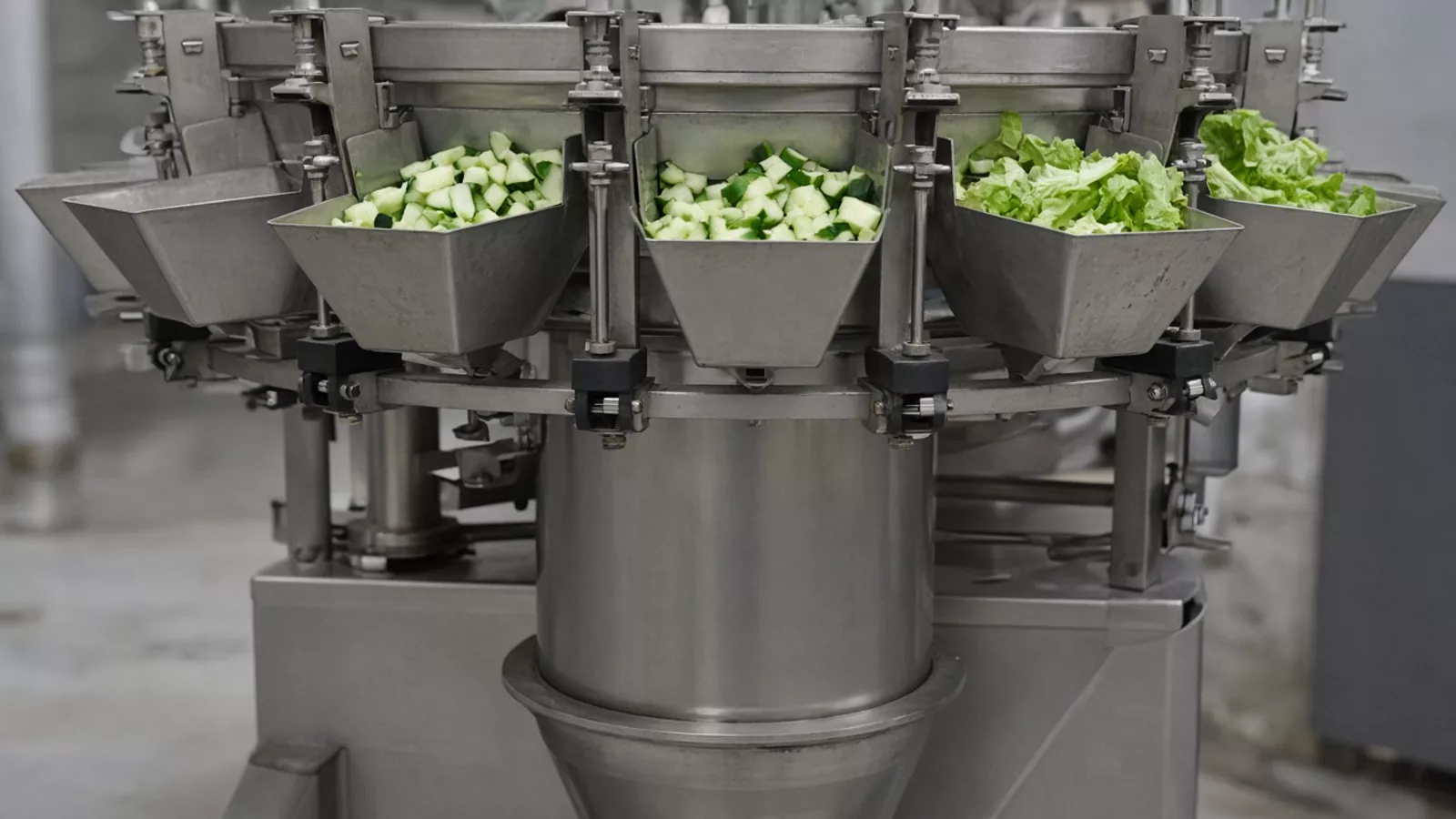
The photograph shows buckets and a cone. It is not the ZL780, not a BVC, and not a record of a drop. Use it to see the kind of transfer an automatic column has to name: the piece sits in a bucket, then it leaves, then it falls. Your machine may not look like this. Draw the transfers you have.
Takeaway: Keep each manufacturer’s rate, bag size and model name in the source note. The trial sheet starts blank.
Choose the column from the feed you can point at
Use the matrix as a screen. A row tells you which column to fill and which observation to make. It does not award the route.
Swipe sideways to see the other columns. The first column stays visible.
| What you can already point at | Hand-load column | Automatic-dosing column | Sheet field |
|---|---|---|---|
| A person places this cut into the bag or the tube | Who places it, and whether a second person presents the bag or starts the seal | Leave blank until a device, not a person, releases the portion | Feed method; operator tasks |
| A device releases a portion and the piece falls | Leave blank until someone is placing the vegetable by hand | The device name, and each fall after the release | Feed method; drop and transfer points |
| The specification names a weight or a count | The amount a person is supposed to place, in that unit | The amount the device is supposed to release, in that same unit | Portion |
| The lot is wet, sticky, limp, or firm | The words for this lot, next to the hand-loaded pieces | The same words, next to the pieces that went through the device | Physical condition |
| You can watch where pieces fail to arrive | Pieces that miss the bag, and pieces left in a hand or a pan | Empty releases, double releases, pieces left in a bucket or a chute | Missed doses |
| You can look at the pieces afterward | Marks, breaks, juice, or folds on the hand-loaded pieces | The same, on the pieces that dropped | Damage |
A Paxiom page dated 17 August 2026 describes a weighing and vertical bagging system for powders, granules, seasonings, baking mixes and dry ingredients. Its industry line includes fruit, vegetable and produce among other foods, and it names models V5 and Vertek 800. A dry-ingredient page that mentions produce in a list is not a fresh-cut loading trial. Those model names are not produce specifications on this sheet.
The outlines below have no labels and no measurements. They only separate a side opening from a ring of buckets over a tube, which is the distinction the two columns are for.
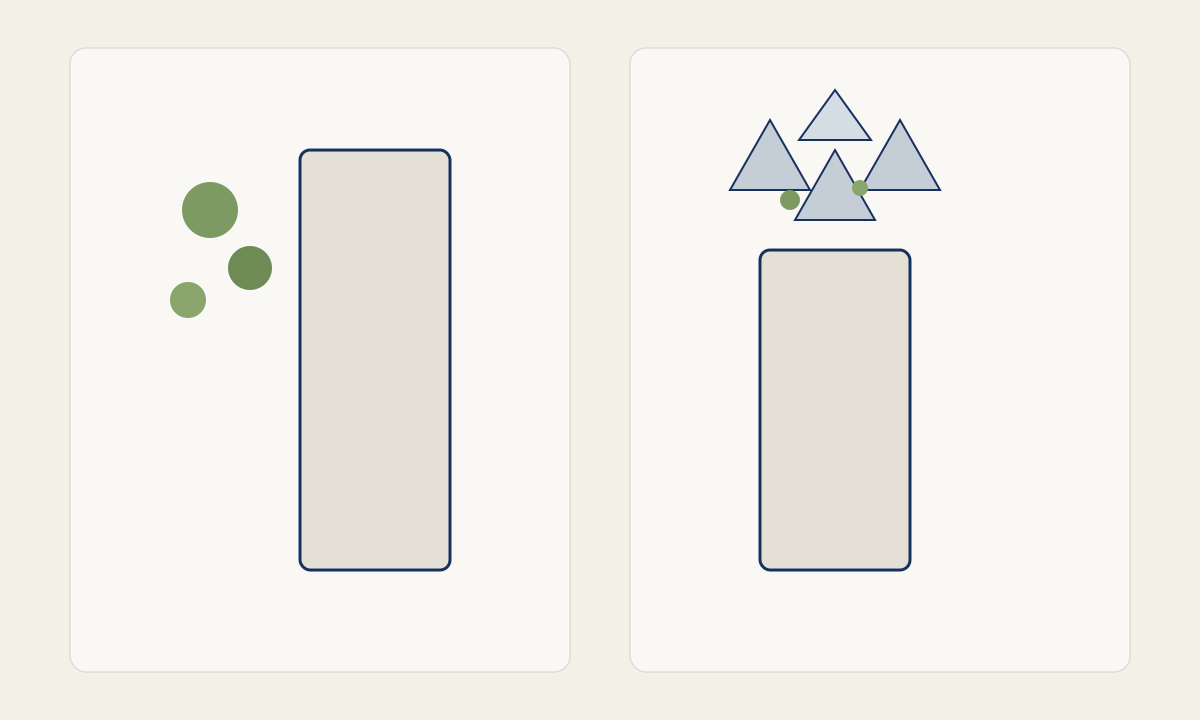
Takeaway: If you cannot point at the person or the device, the feed cell is still blank and the columns are not comparable.
Fill one sheet for the path you run
Run the route that is actually in the plant. If only hand loading is there, fill that column and leave the automatic column blank. If only a dosing device is there, do the reverse. A single demo with no sheet is not a comparison. Copy the table into the trial file. This page has no acceptance numbers. The project team sets any limit later, in its own file.
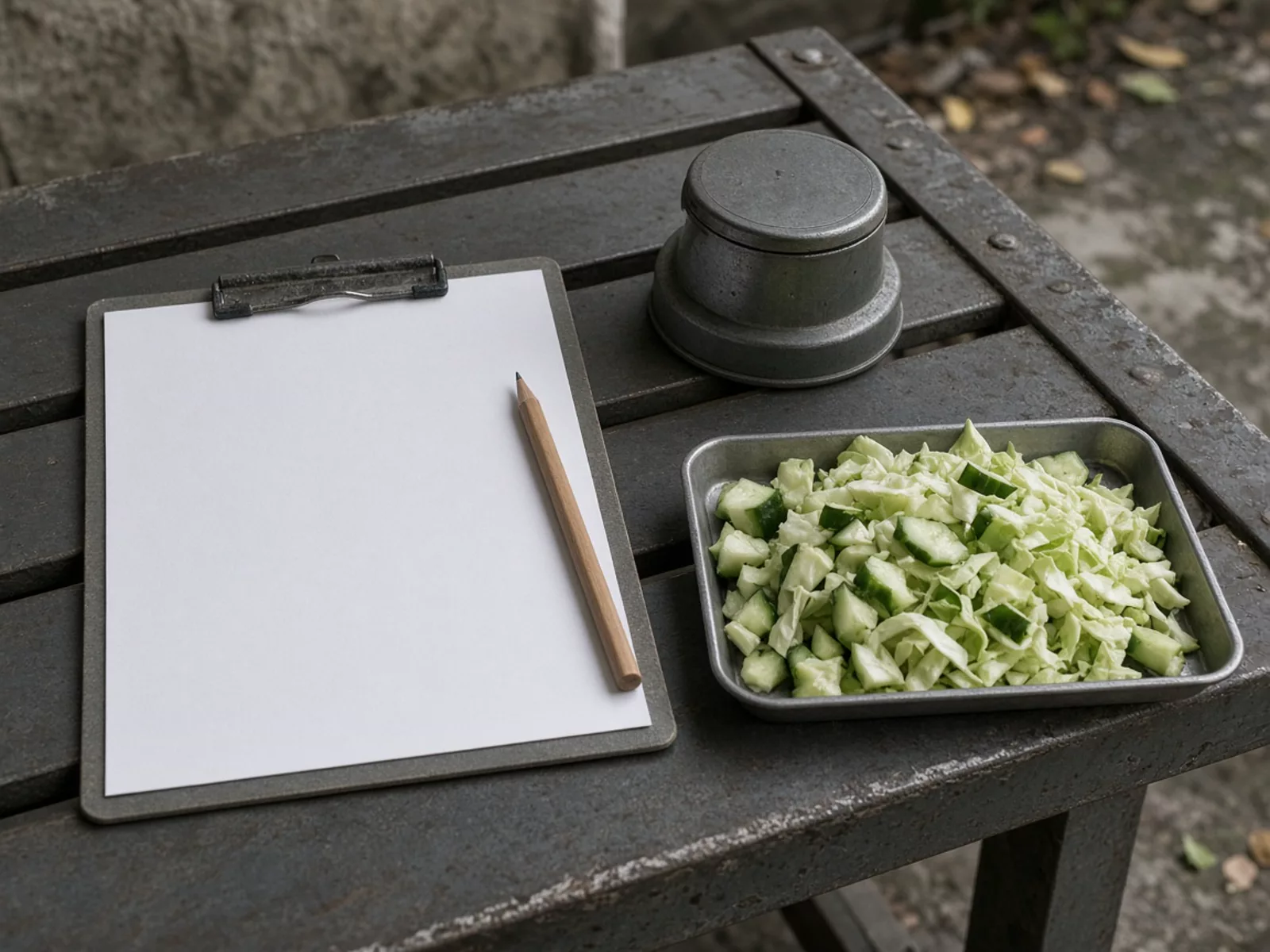
Swipe sideways to see the other columns. The first column stays visible.
| Field | Hand loading | Automatic dosing |
|---|---|---|
| Named vegetable and cut | ________ | ________ |
| Physical condition of this lot | ________ | ________ |
| Portion target and unit | ________ | ________ |
| Feed method and the device or tools fitted | ________ | ________ |
| Drop and transfer points, in order | ________ | ________ |
| Damage seen, and where along the path | ________ | ________ |
| Missed doses: what failed to arrive, and where it stayed | ________ | ________ |
| Operator tasks, and how many people did them | ________ | ________ |
| Bag on the machine, if you measured length, width and style | ________ | ________ |
| Who watched, and what is still unresolved | ________ | ________ |
How to fill the portion, the drops and the damage
Write the portion in the unit the specification uses. If the specification is a count of slices, write the count. If it is a weight, write the weight and the unit. Do not convert a count into a weight on this page. No piece weight is established here. If the specification is silent, leave the target blank and write “specification silent” in the unresolved cell rather than inventing a pack weight.
Drops are a list, not a score. For hand loading, name the pan, the hand, and the mouth of the bag or tube. For a dosing device, name the feeder, the bucket or cup, the chute, and the forming tube if there is one. Rovema’s guide ties the fall after the release to gravity down a forming tube. That is one description of one family. If your machine has a different path, write the path you see. A piece that hits a jaw, a piece that sticks in a bucket, and a piece that never leaves the pan are three different locations. Put the location in the cell.
Damage is what you can see on the pieces from this run: a bruise, a break, free juice, a fold, a smear. The source pages do not publish a bruise count for cucumber, cabbage, radish or lettuce. Do not borrow one. Keep the marked pieces with the column they came from. A mark that was already on the piece in the pan is not a mark from the drop. Look before the piece is placed or released, and look again after it is in the bag.
Missed doses are pieces or charges that did not make the bag. On a hand-load run that is a handful that missed, or a bag that closed light because the person was late. On a device run it is an empty release, a double release, or product left in a bucket or a chute. IAPACK’s pause-when-empty sentence is a feature claim for the ZL780, not a result from your trial. Write whether an empty charge still produced a bag on the machine you watched.
Operator tasks and the bag you measured
Operator tasks are the work, not a slogan about labor. WeighPack’s demo uses two people to hand-load sliced cucumbers and cole slaw. IAPACK’s page says people do not have to collect the finished bag because a conveyor takes it away. Those sentences describe two different jobs on two different pages. Your sheet should say which jobs existed on this run: placing, presenting, sealing, collecting, clearing a jam, or none of these. ISO 12100 is a reference for risk assessment of machinery. Hands, sealing jaws and moving buckets can trap or pinch. Watch the trial under the site’s isolation rules. Do not bypass a guard to see a drop.
The bag row stays blank until someone measures the bag that was actually made. IAPACK’s 150-480 mm length, 120-375 mm side-plus-front width, and 780 mm film width belong to the ZL780 page. They are not a default bag for every vegetable, and the length note on that page already says a second film pull can make the bag longer. WeighPack’s produce page does not print a bag size. If you did not measure, leave the cell blank.
Takeaway: One route in the plant fills one column. The other column stays blank until that route is in the room.
What to do with the sheet afterward
File the sheet with the vegetable name, the lot words, and the device or hand tools that were fitted. A printed rate stays in the source file. WeighPack’s up to 15-20 bags per minute and IAPACK’s 5-15 bags per minute are not substitutes for a count you made, and they are not comparable with each other: the pages do not share a product, a portion, or a timing method.
Place the bagger on the line with the packaging machine types overview. The sheet does not decide whether the bag should be formed from roll film. That question stays with the premade-pouch comparison if the plant is choosing the package route.
Cleaning access is a question for the machine in the room. EHEDG Guideline 8 is a reference for hygienic design principles such as cleanability and accessibility. It is not a certificate for the BVC 310 Fresh, for the ZL780, or for the VersaPak. Ask which product-contact parts come off, and how a person reaches a bucket, a tube, or a seal jaw. Rovema’s washdown sentence and IAPACK’s stainless-steel sentence are the manufacturers’ descriptions. Confirm them on the quoted machine.
Factory and site acceptance are a later gate. Use the factory and site acceptance guide to decide who signs which test. Carry this sheet in as the loading record. The sheet is not itself an acceptance protocol, and it does not set a speed.
Takeaway: The sheet is ready for a trial file when the vegetable, the feed and the blank cells are honest. It is not a speed claim.
Limits
This page compares hand loading with automatic dosing for a named fresh vegetable, and it stops there. It does not set a film oxygen transmission value, a modified-atmosphere recipe, a shelf life, or a food-safety validation. It does not use frozen-food pages as evidence for fresh produce. The coffee figures in the Rovema guide are out of scope for the same reason: they are a different product.
No bag rate, bag size, piece weight, or headcount is stated here as a property of vertical baggers in general. The figures that do appear are copied from the named page, with the conditions that page actually prints. Where the page is silent, the cell stays blank.
The mechanism sources are manufacturer pages. They are not independent trials of your vegetable. A cucumber on one list can share a name with your cucumber and still behave differently once it is wet, warm, or cut thinner. The blank sheet is an editorial worksheet. Filling it in does not create a test report from this site. We did not run product, and we do not supply the machines.
Related decisions
The machine types overview places a vertical bagger among the other primary machines. When the open question is the dosing device rather than the bag, go to the auger and multihead comparison or the cup and auger trial. When the open question is roll film versus a pouch that already exists, use the VFFS and premade pouch comparison.
Method and sources
Read from archived library copies, plus the IAPACK parameter table read on the live page on 14 October 2026. Manufacturer text supports only the descriptions cited. Compiled from those public pages. This site did not run a produce trial.
- WeighPack, Vertical Bagging Fresh Produce with VersaPak, 30 July 2025, library copy fetched 7 October 2026. Two operators hand-loading sliced cucumbers and cole slaw on a tabletop vertical bagger; form-and-seal pouch; paper film; a printed rate of up to 15-20 bags per minute with no bag size, portion weight, or timing method. The weighing-and-dispensing technology line is not treated as proof that the hand-load demo weighed the slices.
- IAPACK, Automatic fresh salad weighing filling packaging machine, model ZL780. Library publish date 1 December 2025; parameter table read 14 October 2026. Vegetables named on the page, automatic feeding and weighing, pillow and gusseted bags, bag length 150-480 mm with a longer bag possible on a second film pull, bag width 120-375 mm as side plus front, film width up to 780 mm, bag forming speed 5-15 bags per minute. The page also prints air consumption 0.8 MPa and 0.45 m³/min, reel diameter 400 mm, core 75 mm, power 6 kW at 380 V ±10% and 50 Hz, machine size 1650 × 1500 × 1750 mm, and machine weight 650 kg. Those machine figures are not copied into the trial sheet because the page does not tie them to a named portion.
- Rovema North America, BVC Series VFFS guide, published 11 August 2026, library copy fetched 8 October 2026. Flat-film forming, upstream multi-head, volumetric, auger, or liquid dosing, gravity down the forming tube, and the BVC 310 Fresh name. Coffee-roaster capacity and oxygen figures in that guide are not used.
- Paxiom, Food Ingredient Weighing and Vertical Bagging System, 17 August 2026, library body read 14 October 2026. Used only as a boundary: dry ingredients, with produce named inside a longer industry list. Not a fresh-cut trial.
ISO 12100 and EHEDG Guideline 8 are scope references for machinery risk assessment and hygienic design principles. They are not results from a produce loading trial.
References
- Vertical Bagging Fresh Produce with VersaPak — WeighPack Systems
- Automatic fresh salad weighing filling packaging machine — IAPACK
- BVC Series VFFS Machines: The Complete Guide to High-Performance Vertical Form-Fill-Seal Technology — Rovema North America
- Food Ingredient Weighing & Vertical Bagging System — Paxiom
- ISO 12100:2010 — Safety of machinery — General principles for design — Risk assessment and risk reduction — ISO
- EHEDG Guideline 8 — Hygienic Design Principles (Fourth Edition) — EHEDG
Update history
- : First published.
Next steps
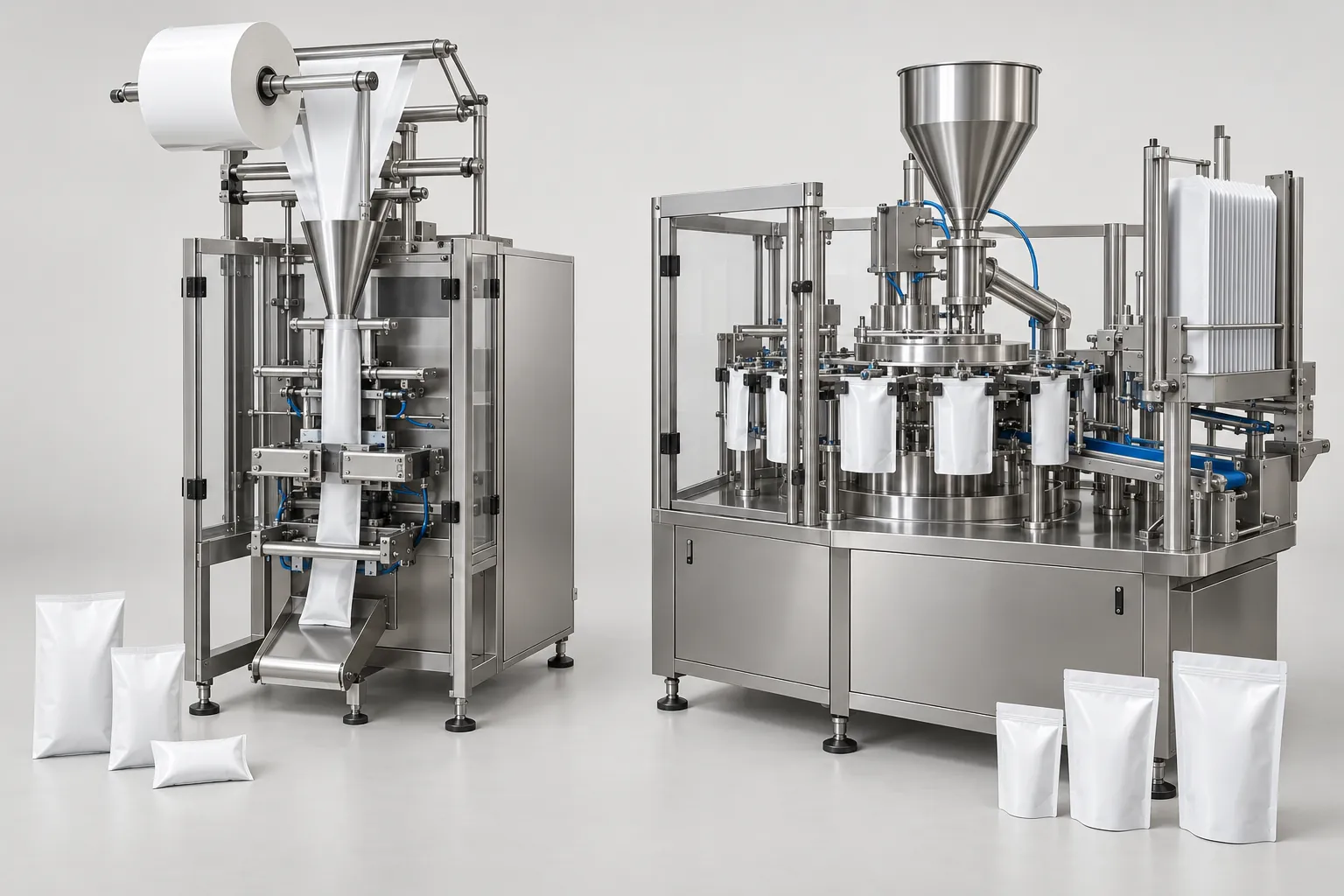
VFFS vs. Premade Pouch Machines: How to Choose
Compare VFFS and premade pouch machines by bag style, product, changeover, film or pouch supply, appearance, footprint and staffing, with questions for suppliers.
Read guide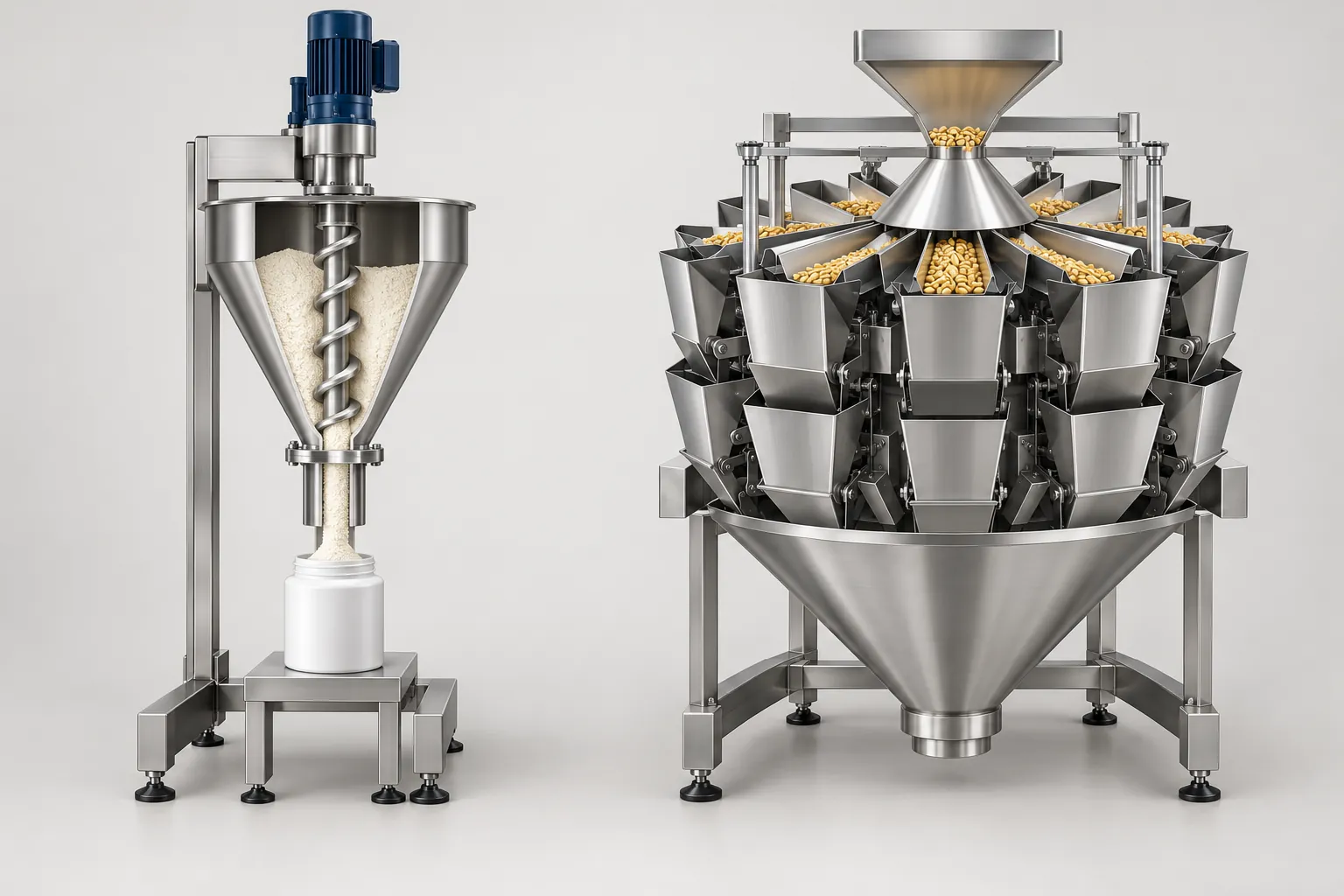
Auger Fillers vs. Multihead Weighers: Matching the Dosing System to the Product
Compare auger fillers and multihead weighers by dosing principle, product flow, fragility, dust, cleaning and mixes, with supplier questions and trial guidance.
Read guide
FAT vs. SAT for Packaging Equipment: Defining Acceptance Criteria
Compare factory and site acceptance tests for packaging machines, and learn how to write acceptance criteria that both buyer and supplier can verify.
Read guide