
TI HI Pallet Formula & Stack Height
Calculate TI-HI pallet configurations with zero overhang, check bottom-tier corrugated box compression, and verify container door height and pallet load limits.
A TI-HI pallet specification multiplies cartons per horizontal layer (TI) by layers stacked vertically (HI) to give total cases per pallet. Size TI from external carton dimensions inside a zero-overhang deck boundary, then cap HI at the lowest ceiling set by derated bottom-tier box compression, door or rack vertical clearance minus pallet height, and pallet working load.
Applies to: Packaging engineers, logistics planners, and automation leads sizing TI-HI counts, zero-overhang layer layouts, gross pallet weights, and stack-height ceilings for rectangular corrugated shipping cases.
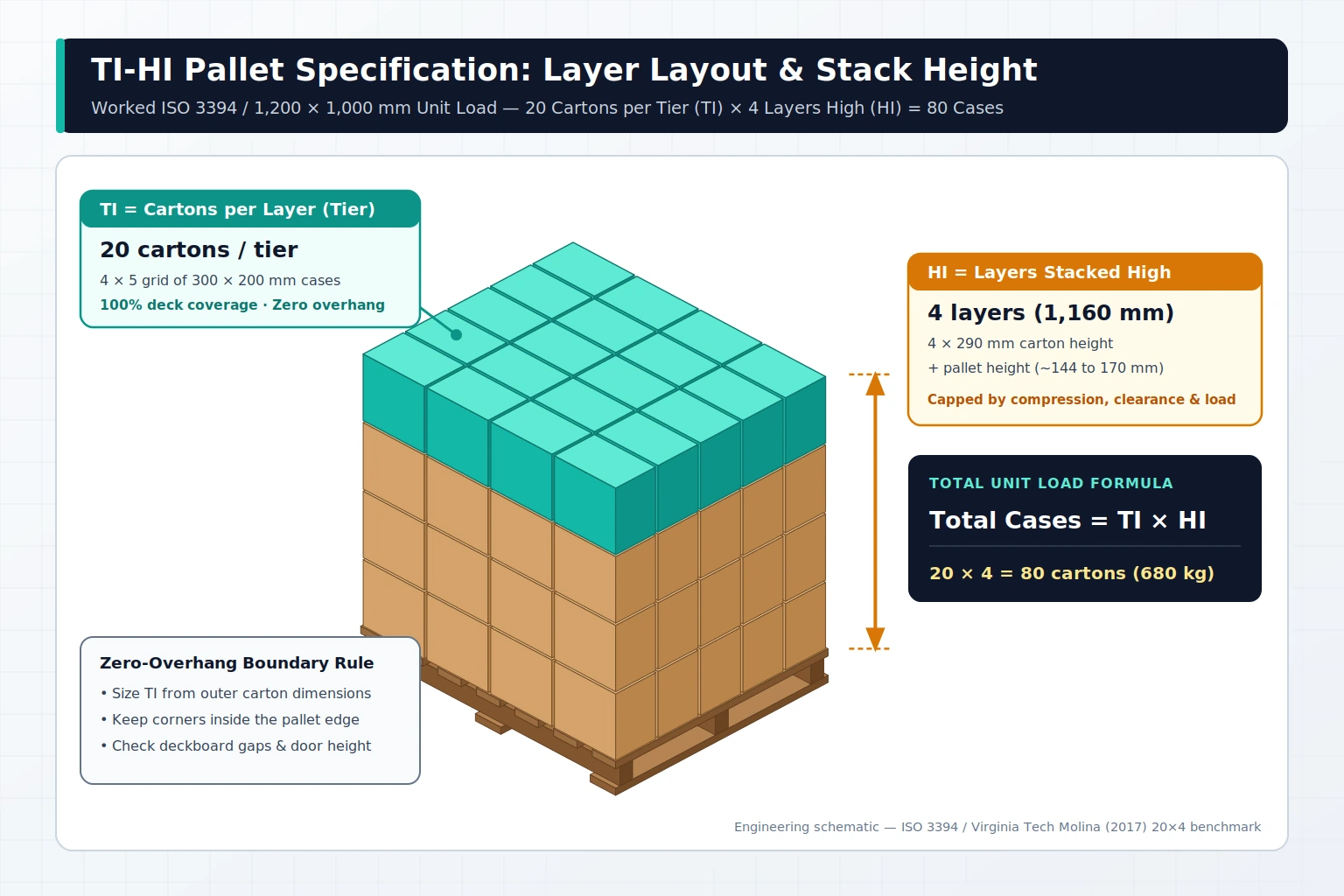
A ti hi pallet specification defines the number of cartons on one horizontal layer (TI, or tier) and the number of layers stacked vertically on the pallet (HI, or high), so total cases equal TI multiplied by HI. Keeping cartons flush inside the deck caps TI, while bottom-layer box compression, clearance, and load ratings cap HI.
Treating palletization as a pure geometry exercise leads directly to crushed bottom cartons, rejected warehouse deliveries, and unstable loads in transit. Shipping goods unitized on a pallet can reduce product damage by as much as 80% compared with loose break-bulk handling, which explains why roughly 80% of freight transported in the United States moves as palletized unit loads even though standardized ISO pallets leave up to 30% of available cargo volume unused. Getting those efficiencies on an automated packaging line requires aligning TI-HI arithmetic with upstream case sizing in wrap-around vs. RSC case packer selection, buffer space in packaging line layout and accumulation, and end-of-line packaging automation recipes.
| Parameter | Definition | Engineering check or relationship | Primary governing limit |
|---|---|---|---|
| TI (Tier) | Boxes or cartons placed on one horizontal layer | Calculated from external carton length and width inside pallet deck | Pallet deck footprint at zero overhang and deckboard gap support |
| HI (High) | Number of horizontal layers stacked vertically on the pallet | Lowest integer satisfying compression, clearance, and load ceilings | Bottom-tier box compression, door or rack height, and working load |
| Total Cases per Pallet | Complete carton count on a uniform unit load | TI multiplied by HI (for uniform standard layers) | Non-standard mixed layers require an explicit layer-by-layer map |
| Unit Load Height | Combined vertical height of pallet plus stacked cartons | Pallet height (144 mm to 170 mm typical) plus HI times carton height | Container door aperture height or warehouse rack beam clearance |
| Gross Pallet Weight | Product payload plus empty pallet tare mass | Total cases times case mass plus empty pallet tare weight | Pallet working load under racking, forklift, or floor support |
What is TI and HI in a pallet specification?
In logistics, TI refers to the number of boxes or cartons stored on one horizontal layer (tier) of a pallet, and HI refers to the number of layers stacked high. The term TI-HI (also Ti-High, Tie-High, or Ti by Hi) also describes the stacking pattern used to build a relatively stable stack.
According to standard logistics usage documented on Wikipedia’s TI-HI reference, warehouse operators and freight planners routinely request TI-HI immediately after the cube (cubic feet) of a master carton. Knowing both carton cube and TI-HI lets receiving docks, racking planners, and robotic palletizer programmers confirm how many pallets an order occupies without recalculating from raw box drawings.
Why external carton dimensions govern TI rather than internal box orders
One frequent source of layer-sizing errors sits in how corrugated boxes are ordered. Under the FEFCO corrugated box coding standard, Regular Slotted Containers (coded FEFCO 0201 in Europe) are usually specified and ordered by their internal dimensions to fit the primary product, whereas external dimensions govern handling machinery and palletizing.
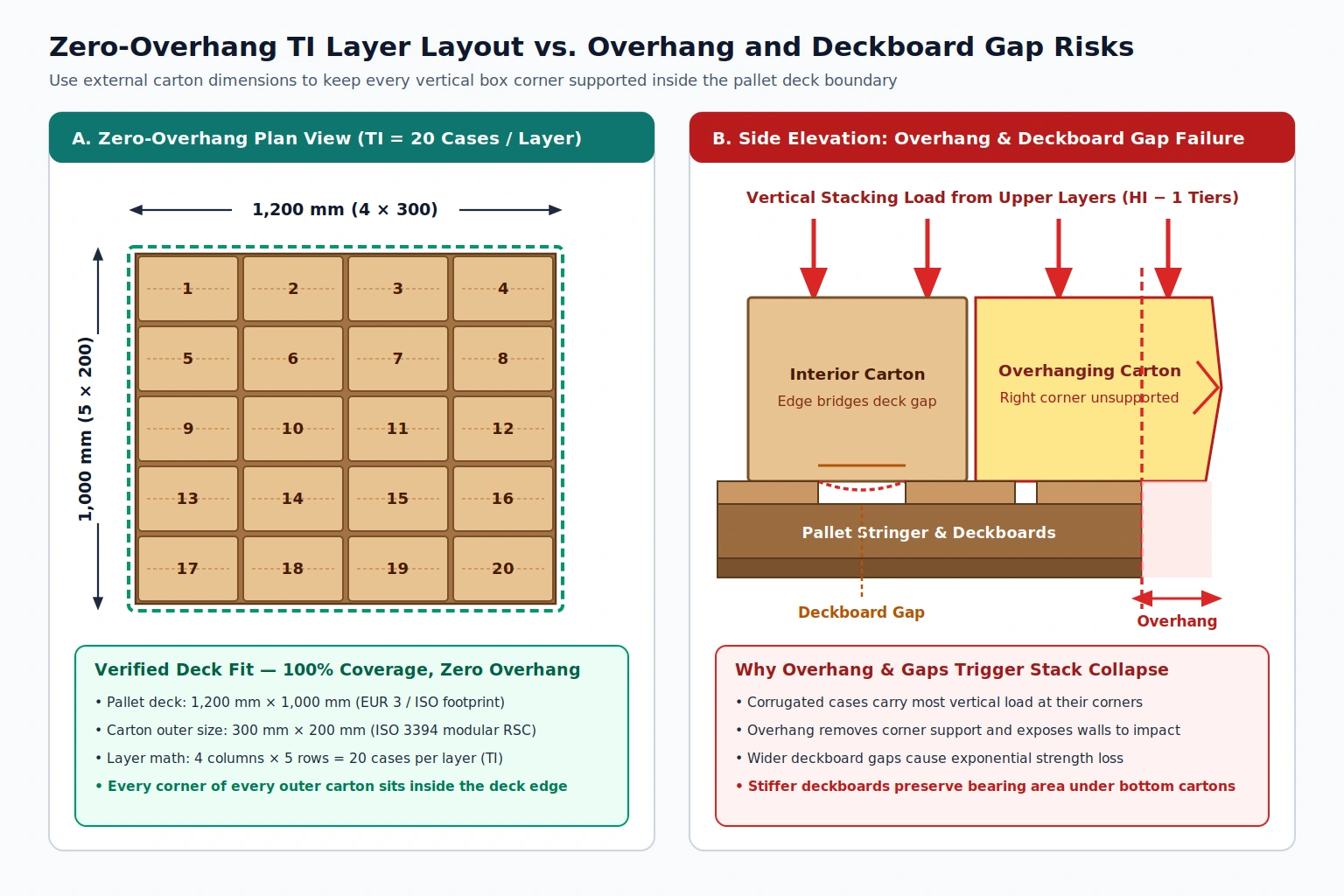
Because corrugated board wall thickness and flap folds add measurable millimeters to every face, calculating TI from internal ordering dimensions routinely pushes outer cartons past the pallet perimeter. Always verify the measured external length, width, and height of a filled, sealed case before finalizing a layer layout or entering case dimensions into a palletizer controller.
How do you calculate TI-HI and total cases per pallet?
Calculate total cases per pallet by multiplying cartons per layer (TI) by layers stacked high (HI) once TI fits inside the pallet deck with zero overhang. Cap HI at the lowest ceiling set by bottom-tier box compression capacity, vertical door or rack clearance minus pallet height, and the pallet’s maximum working load.
Solving a single-SKU load—known in unit-load engineering as the manufacturer’s pallet loading problem, where every carton shares identical outer dimensions—follows a four-step calculation sequence:
- Determine zero-overhang TI. Fit external carton length and width onto the target pallet deck in aligned, rotated, or mixed-orientation rows so zero box corners extend past the deck edge.
- Compute the vertical clearance ceiling for HI. Subtract the pallet’s own height and fork-entry lifting clearance from the tightest vertical aperture along the route (trailer door opening, shipping container door opening, or warehouse rack beam height), then divide by external carton height and round down to a whole integer.
- Compute the bottom-tier compression ceiling for HI. Divide the carton’s laboratory peak box compression strength by the required safety factor and field derating factors, divide by individual filled carton weight, and add one (because the bottom tier supports the weight of all layers above it).
- Check gross weight against pallet working load. Multiply TI by HI by single-carton mass, add pallet tare mass, and confirm the total stays within the pallet’s rated working load for racking, forklift handling, and floor stacking.
Worked TI-HI calculation on a 1,200 by 1,000 mm pallet
Experimental unit-load research at Virginia Tech by Eduardo Molina Montoya (Investigation of Pallet Stacking Pattern on Unit Load Bridging) provides a complete, measured benchmark showing how modular carton sizing aligns TI, HI, trailer cube, and retail racking simultaneously:
- Pallet deck: A 1,200 mm by 1,000 mm wooden two-way stringer pallet (matching the European EUR 3 / ISO modular footprint).
- External carton dimensions and mass: Single-wall C-flute Regular Slotted Container (RSC) boxes sized to ISO 3394:2012 modular dimensions at 300 mm long by 200 mm wide by 290 mm high, filled to 8.5 kg per box.
- Layer count (TI): Fitting 300 mm by 200 mm cartons across the 1,200 mm by 1,000 mm deck yields TI = 20 cartons per layer with 100% pallet deck coverage and zero underhang or overhang.
- Layer height (HI) and total cases: Stacking HI = 4 layers high yields 20 multiplied by 4 = 80 boxes total, an overall carton stack height of 1,160 mm (4 multiplied by 290 mm), and a total product load of 680 kg (1,500 lb).
- Transport and retail clearance fit: That 1,160 mm load height allows double stacking inside a 53-foot trailer with a 2.67 m interior height and fits cleanly inside 1,400 mm vertical club-store rack space without restacking at delivery.
Three engineering ceilings that cap maximum HI
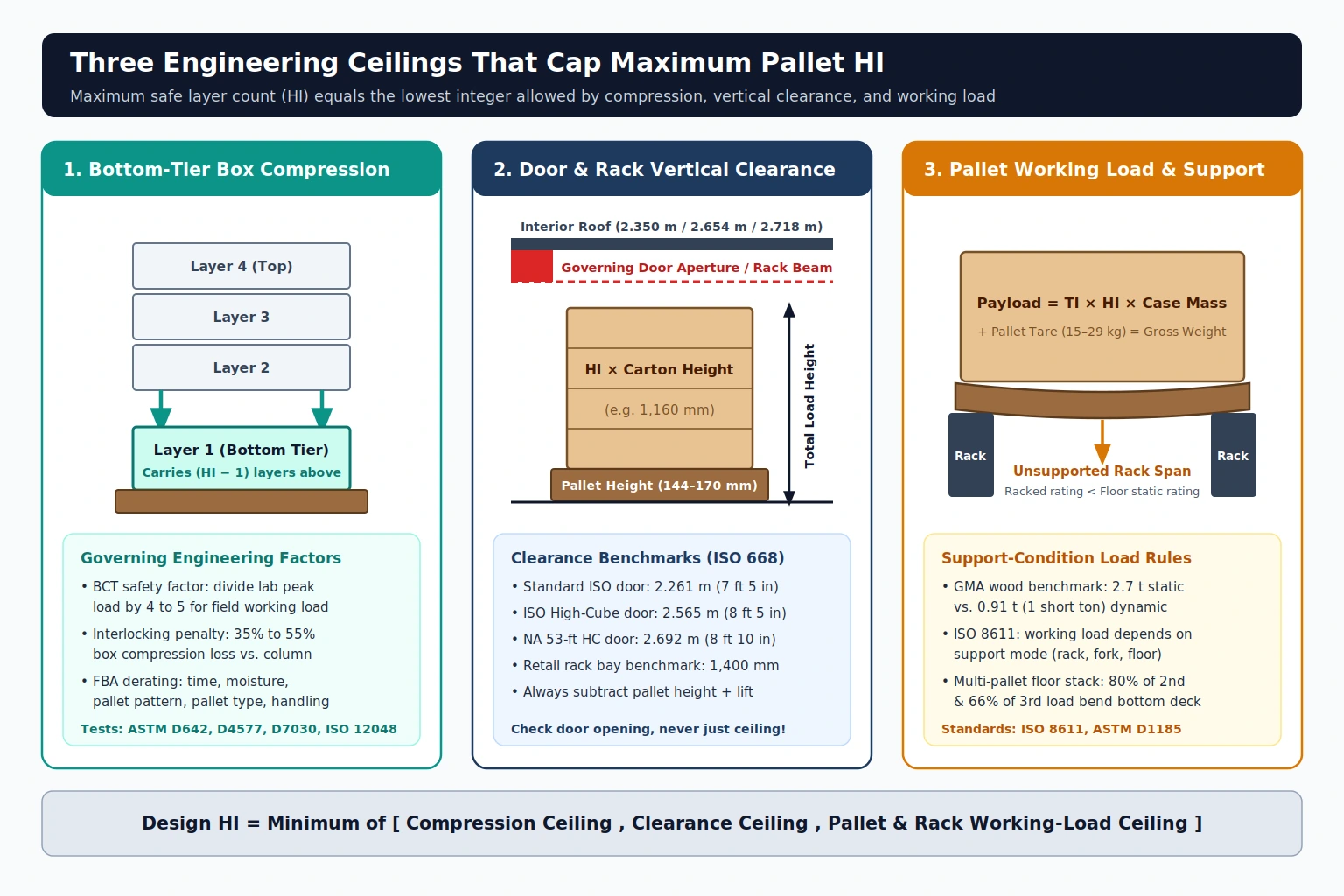
Never stop at geometric cube when choosing HI. Three separate physical ceilings govern how high a pallet can stack safely, and the lowest integer among them sets the maximum allowable HI.
Ceiling 1: Bottom-tier corrugated box compression. Standard container compression testing (such as ASTM D642, DIN 55440-1, and ISO 12048) crushes a temperature- and humidity-conditioned box between two rigid platens at a constant rate of 13 mm/min (half an inch per minute), while ASTM D4577 and ASTM D7030 evaluate constant-load creep resistance. Packaging engineers commonly apply safety factors of 4 or 5 to dynamic laboratory peak compression values to estimate allowable field working loads. While McKee’s 1963 empirical formula estimates empty single-wall RSC peak strength from board Edge Crush Test (ECT), flexural stiffness or board thickness, and box perimeter, physical compression testing of filled, closed boxes remains necessary. The Fiber Box Association compression-loss framework explicitly accounts for six field derating variables: storage time, moisture, palletizing type, pallet patterns, pallet type, and handling.
Ceiling 2: Container door aperture and rack vertical clearance. Teams frequently check the interior roof height of a shipping container or trailer and overlook the lower door lintel opening. Under ISO 668 intermodal container dimensions, standard and high-cube doors sit noticeably below the interior ceiling, and the pallet itself consumes 144 mm to 170 mm of vertical space before the first carton rests on the deck.
| Freight container class (ISO 668 / North America) | Maximum interior width | Typical door width | Maximum interior height | Typical door aperture height | Vertical planning implication for HI |
|---|---|---|---|---|---|
| 20-ft and 40-ft ISO standard height | 2.330 m | 2.286 m (7 ft 6 in) | 2.350 m | 2.261 m (7 ft 5 in) | Door height sits below interior ceiling and governs pallet entry clearance |
| 40-ft and 45-ft ISO high-cube | 2.330 m | 2.286 m (7 ft 6 in) | 2.654 m | 2.565 m (8 ft 5 in) | Adds extra door clearance over standard ISO container height |
| 48-ft and 53-ft North American high-cube | 2.489 m (8 ft 2 in) | 2.489 m (8 ft 2 in) | 2.718 m (8 ft 11 in) | 2.692 m (8 ft 10 in) | Wider 2.489 m door and 2.692 m opening support double-stacked 1,160 mm loads |
Ceiling 3: Pallet working load and multi-pallet floor stacking. Many general-purpose pallets handle loads around 1,000 kg (2,200 lb), and a standard 48 in by 40 in by 6 in wooden pallet carries roughly 3 short tons (2.7 t) static load versus 1 short ton (0.91 t) dynamic load. However, ISO 8611 (2011) distinguishes a pallet’s comparative nominal load from its maximum working load, defined as the greatest payload permitted in a specific loading and support condition—meaning an unsupported warehouse rack span can permit far less weight than flat floor storage. Where loaded pallets are stacked directly on top of one another on a warehouse floor, Virginia Tech’s review of Collie’s floor-stacking research notes that 80% of the second unit load’s weight and 66% of the third unit load’s weight contribute to bending the top deckboards of the bottom pallet.
How should you write TI-HI notation on shipping and warehouse spec sheets?
Write TI first and HI second—for example, 20 × 4 = 80 cases, or TI 20 / HI 4—immediately alongside master carton cube, external carton dimensions, pallet footprint, total load height including the pallet, and gross pallet weight so warehouse management systems and palletizer recipes stay unambiguous.
Standard TI-HI notation works seamlessly whenever every horizontal layer on the pallet carries the exact same number of cartons. Problems arise when a shipper attempts to squeeze extra cases into an irregular space by placing cartons on their side on the top layer or varying carton counts between odd and even tiers. As noted in Wikipedia’s TI-HI reference, non-standard Ti-Hi configurations do not compute logically in standard TI-HI software applications and are treated as unconventional.
Handling non-standard, asymmetric, and mixed-SKU layers
In warehouse and distribution operations, mixed-size loads belong to the distributor’s pallet loading problem rather than the single-SKU manufacturer’s problem. When a customer order or promotional display requires a partial top layer, a turned top cap, or mixed box sizes:
- Do not average TI into a decimal. Entering a fractional tier count breaks automated WMS slot allocation and robotic palletizer layer counters.
- Document uniform base tiers separately from the exception tier. State the repeating base layer count, the explicit exception layer count, and the verified total case count on the shipping specification.
- Attach a layer-by-layer coordinate drawing. Specify box orientation, zero-overhang bounds, and center-of-gravity symmetry so neither operators nor robots invert load-bearing corrugated flutes.
Use the engineering verification table below as a standardized TI-HI check sheet before releasing any new SKU recipe to the palletizer or warehouse receiving dock:
| Specification field | Required units or format | Benchmark example (ISO 3394 / Molina 2017) | Verification check before release |
|---|---|---|---|
| Pallet footprint and height | Length × width × height (mm or in) | 1,200 mm × 1,000 mm wooden stringer pallet | Confirm stringer-first orientation and tare weight |
| External carton dimensions | Outer L × W × H (mm or in) | 300 mm × 200 mm × 290 mm (C-flute RSC) | Measure filled, sealed case rather than internal order size |
| TI-HI and total cases | TI × HI = Total cases | 20 × 4 = 80 cartons (uniform layers) | Flag non-standard layers separately with layer maps |
| Deck coverage and overhang | Percent coverage; overhang status | 100% coverage; zero underhang or overhang | Verify zero protruding corners and acceptable deckboard gaps |
| Stack and total load height | Carton stack height + pallet height | 1,160 mm carton stack (+ pallet height) | Check lowest door aperture (e.g., 2.261 m to 2.692 m) and rack bay |
| Payload and gross weight | Case mass × cases + pallet tare | 680 kg (1,500 lb) product payload + pallet tare | Confirm below ISO 8611 working load for rack and forklift modes |
| Compression and stability basis | Stacking pattern and test standard | Column vs. split-row / pinwheel; ASTM D4169 or ISTA 3E | Apply field compression safety factors of 4 or 5. Account for 35% to 55% interlocking strength loss. |
What is the standard pallet size in the USA and how do global footprints cap TI?
The standard U.S. pallet is the 48 in by 40 in (1,219 mm by 1,016 mm) Grocery Manufacturers Association (GMA) pallet, representing 30% of new U.S. wood pallets. Because stringer length comes first and deckboard length second, switching between GMA and international ISO 6780 footprints directly alters zero-overhang TI counts.
GMA wooden pallets typically weigh 37 lb (17 kg) and stand 170 mm (six and a half inches) tall, while general 48 in by 40 in by 6 in wooden pallets weigh 33 to 48 lb (15 to 22 kg) with typical capacities around 3 short tons (2.7 t) static and 1 short ton (0.91 t) dynamic. Square or nearly square pallets also resist tipping better than narrow footprints. Beyond the GMA deck, the second and third most produced North American wood pallet sizes are 42 in by 42 in (1,067 mm by 1,067 mm, common in telecommunications and paint) and 48 in by 48 in (1,219 mm by 1,219 mm, common for drums). For specialized military logistics, U.S. Department of Defense unit loads generally use 40 in by 48 in (1,016 mm by 1,219 mm) pallets weighing under 4,000 lb (1,814 kg) and stacking up to 16 ft (4.88 m) high.
Internationally, ISO 6780:2003 (confirmed in 2014) sanctions six flat pallet dimensions for intercontinental materials handling. Exporting cartons sized for a 48 in by 40 in GMA deck onto a narrower European EUR 1 (800 mm by 1,200 mm) pallet requires recalculating TI to prevent overhang:
| ISO 6780 / regional pallet | Footprint (mm) | Footprint (in) | Typical height and tare weight | Wasted ISO container floor | Primary regions and notes |
|---|---|---|---|---|---|
| GMA / North American ISO | 1,016 × 1,219 | 40.00 × 48.00 | 152 mm to 170 mm; 15 kg to 22 kg (37 lb GMA typical) | 3.7% (20 pallets in 40-ft ISO) | Leading North American standard (30% of new U.S. wood pallets) |
| EUR 3 / ISO | 1,000 × 1,200 | 39.37 × 47.24 | 144 mm (5.67 in); 29 kg tare; 1,920 kg load | 6.7% | Europe and Asia; close to 40 × 48 in modular deck |
| EUR 1 / ISO1 Europallet | 800 × 1,200 | 31.50 × 47.24 | 144 mm (5.67 in); 20 kg to 25 kg tare; 2,490 kg load | 15.2% | Europe; passes standard building doorways |
| Australian standard | 1,165 × 1,165 | 45.9 × 45.9 | Varies by hardwood or light-timber build | 8.1% | Australia; square footprint suited to racking |
| Square industrial ISO | 1,067 × 1,067 | 42.00 × 42.00 | Varies by stringer or block build | 11.5% | North America (#2 U.S. production rank), Europe, Asia |
| Asian square ISO | 1,100 × 1,100 | 43.30 × 43.30 | Varies by wood or plastic build | 14% | Asia; square geometry resists tipping |
How does a TI-HI pallet configuration interact with column versus interlocking stacking?
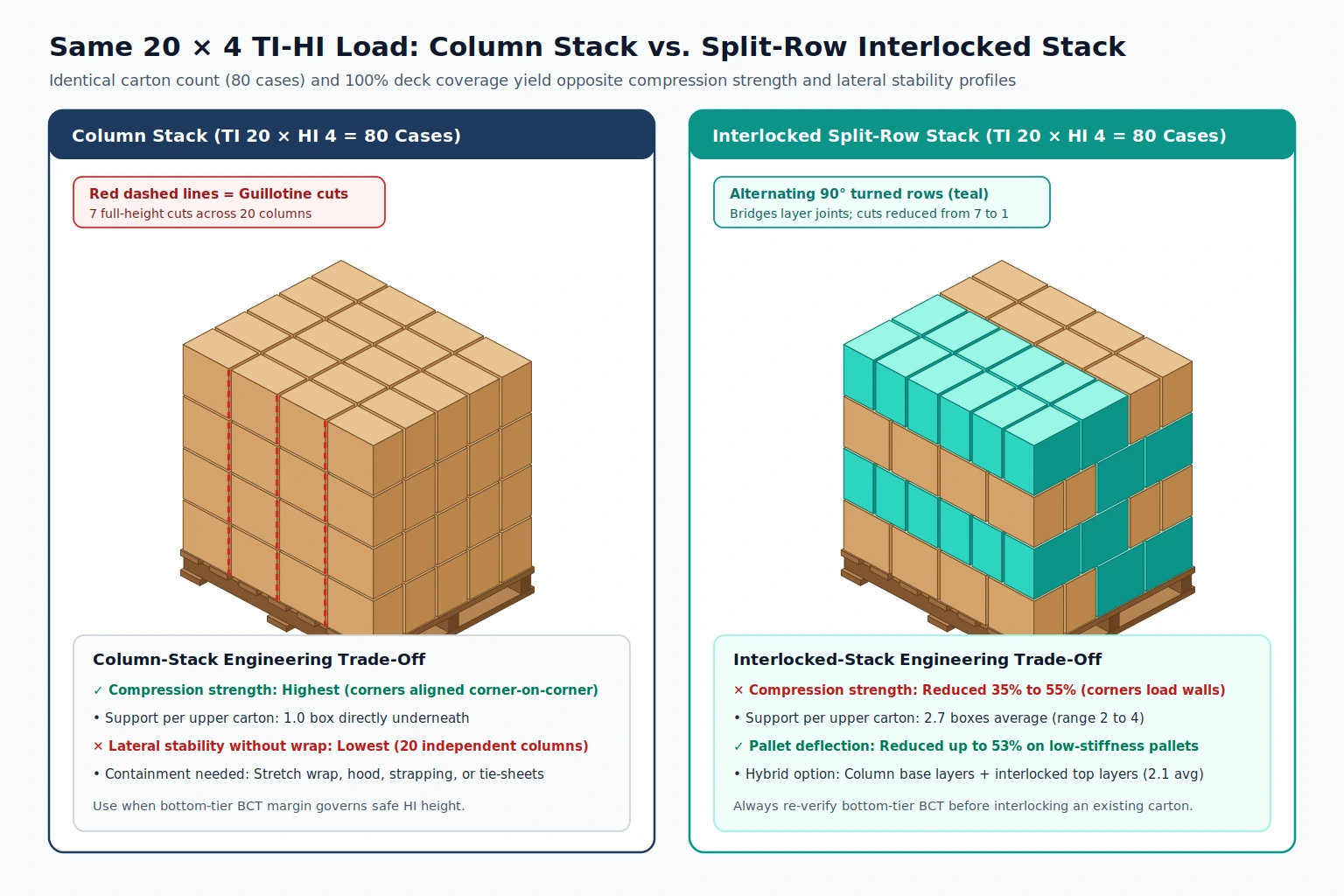
Identical TI-HI counts perform very differently under column versus interlocked stacking: column stacks preserve corrugated corner strength to support higher HI loads, whereas interlocking bridges layer joints for greater inherent stability while reducing box load-carrying capacity by 35% to 55%.
Corrugated shipping cases carry most of their vertical load through their four vertical corners. When an interlocked pattern rotates alternate tiers so upper corners rest over the weaker side walls of the cartons below, published research summarized in Virginia Tech’s unit-load bridging study places the resulting loss in box load-carrying capacity at 35% to 55%. If that strength reduction pushes bottom-tier boxes past their crush threshold, the bottom layer buckles and makes the entire pallet unstable—defeating the stability reason for interlocking in the first place.
Quantitative comparison on an identical 20 × 4 TI-HI unit load
To judge inherent pattern stability without stretch wrap, Carpenter and Dowsland (1985) established three geometric criteria: every upper box should rest on at least two boxes underneath, a high percentage of each box base should stay in contact with the layer below, and full-height vertical “guillotine cuts” that split the stack into independent columns should be minimized.
In Virginia Tech’s 20 × 4 (80-case) experimental evaluation on 1,200 mm by 1,000 mm pallets, all five tested patterns kept 100% deck coverage and zero overhang yet diverged sharply across stability and pallet bending:
| Pattern family (same 20 × 4 TI-HI) | Supporting boxes per upper carton | Full-height guillotine cuts | Box compression strength impact | Pallet bending and containment behavior |
|---|---|---|---|---|
| Column stack (P1) | 1 box directly underneath | 7 cuts across 20 independent columns | Highest; corners stay aligned corner-on-corner | Lowest unrestrained stability; requires stretch wrap, stretch hooding, strapping, or tie-sheets |
| Fully interlocked split-row (P2) or pinwheel (P3) | 2.7 boxes average (range 2 to 4) | 1 cut across the load | 35% to 55% lower box load capacity as corners load walls | Bridges joints and reduced pallet deflection up to 53% on low-stiffness pallets |
| Hybrid: column base + interlocked upper tiers (P4, P5) | 2.1 boxes average | 1 cut across the load | Protects bottom-tier corner alignment while tying top layers | Moderate interlock bridging; verify transition layer compression before adoption |
Column stacks rely heavily on secondary containment—such as stretch wrap, stretch hooding, strapping, or interlayer tie-sheets—to prevent independent columns from separating during acceleration or braking, while keeping wrap tension controlled because excessive containment force can crush outer carton walls. For a deeper comparison of how conventional layer-forming machines and robotic palletizers turn, grip, and form column, brick, split-row, and pinwheel patterns, see our guide to pallet stacking patterns compared.
How do you build a pallet TI-HI diagram that avoids overhang and passes verification?
Build a zero-overhang TI-HI diagram by modeling external carton dimensions in pattern software, checking pallet deckboard gaps and deck stiffness, enforcing OSHA 1910.176 tiered-storage stability and aisle clearances, and validating complete wrapped unit loads under ASTM D4169 or ISTA 3E before locking palletizer recipes.
Understanding how to palletize boxes reliably at production line speeds means treating the carton, pallet deck, stacking pattern, and wrap containment as a single interacting unit-load system rather than isolated purchasing specs.
Using a pallet pattern calculator without falling into overhang traps
Commercial pallet pattern calculator tools such as CAPE and TOPS optimize pallet utilization—the percentage of pallet volume occupied by product—far faster than manual sketches. However, software algorithms optimize whatever constraints you enter. Enforce four engineering guardrails whenever generating candidate TI-HI diagrams:
- Set maximum pallet overhang to zero. Research by Monaghan and Marcondes (1992) confirmed that pallet overhang reduces corrugated box compression strength by removing bottom support beneath load-bearing corners, while wider gaps between wooden pallet deckboards cause an exponential drop in box compression resistance.
- Audit pallet deckboard stiffness alongside pattern coverage. Increasing pallet deckboard stiffness minimizes bending under load, preserves effective bearing area beneath bottom-tier cartons, and lowers compressive stress on the packaging (White, 2015).
- Verify workplace stability and clearance rules. Under OSHA Section 1910.176(b), containers stored in tiers must be stacked, blocked, interlocked, and limited in height so that they are stable and secure against sliding or collapse, and Section 1910.176(a) mandates sufficient safe clearances for aisles, loading docks, doorways, and turns whenever mechanical handling equipment operates.
- Validate the complete load before FAT and SAT sign-off. Analytical formulas and pattern diagrams cannot fully predict transit vibration and impact behavior on their own. Run full-load performance verification using ASTM D4169 or ISTA 3E unitized-load protocols, and carry the approved TI-HI diagram, wrap recipe, and infeed orientation directly into your packaging line integration checklist and FAT vs. SAT equipment acceptance plan.
Frequently asked questions
What does TI-HI mean on a pallet?
TI-HI stands for Tier (TI) and High (HI). TI is the number of boxes or cartons arranged on one horizontal layer of a pallet, and HI is the number of layers stacked vertically on that pallet. Multiplying TI by HI gives the total carton count on a uniform pallet load.
How do you calculate total cases from TI-HI?
Multiply the tier count (TI) by the layer height count (HI). For example, in Virginia Tech’s ISO 3394 unit-load benchmark on a 1,200 mm by 1,000 mm pallet, 20 cartons per layer stacked 4 layers high yields 20 multiplied by 4 = 80 cases per pallet (680 kg product payload at 8.5 kg per carton).
Why should you avoid pallet overhang when maximizing TI?
Corrugated boxes carry most of their vertical stacking load through their four vertical corners. Allowing cartons to protrude past the pallet edge removes direct deck support under those corners, lowers box compression resistance, exposes sidewalls to handling impacts, and can cause bottom-tier collapse or clearance violations at doorways and racks.
Does interlocking a TI-HI pallet increase or decrease safe stack height (HI)?
Interlocking improves lateral stack stability and can reduce pallet deflection by up to 53% on low-stiffness pallets, but it transfers vertical load from strong box corners onto weaker sidewalls, cutting corrugated box compression strength by 35% to 55%. If bottom-tier compression governs the load, interlocking may force a lower HI or a stronger board grade.
What is the difference between interior container height and door aperture height when checking HI?
Shipping container doors sit below the interior ceiling. A standard 20-ft or 40-ft ISO container has a 2.350 m interior height but a 2.261 m (7 ft 5 in) typical door aperture, and a 40-ft high-cube has a 2.654 m interior height versus a 2.565 m (8 ft 5 in) door opening. Size HI plus pallet height (144 mm for EUR 1 and EUR 3 pallets, or 170 mm for typical GMA pallets) and forklift lift margin against the door opening.
Sources
- Virginia Tech (Eduardo Molina Montoya, 2017) — Investigation of Pallet Stacking Pattern on Unit Load Bridging (M.S. thesis: ISO 3394 20×4 worked unit load, Carpenter and Dowsland stability criteria, deckboard gap and overhang effects, ISO 8611, ASTM D4169, and ISTA 3E)
- eCFR — OSHA Section 1910.176 (Handling materials—general: secure tiered storage, interlocking, height limits, and safe mechanical clearances)
- OSHA — Warehousing Safety and Materials Handling Overview
- ASTM International — ASTM D642 Standard Test Method for Determining Compressive Resistance of Shipping Containers, Components, and Unit Loads
- ASTM International — ASTM D4169 Standard Practice for Performance Testing of Shipping Containers and Systems
- FEFCO — International Fibreboard Case Code (corrugated box styles including RSC 0201)
- Wikipedia — TI-HI (logistics definition, master carton cube context, and non-standard TI-HI patterns)
Update history
- : First published.
Next steps
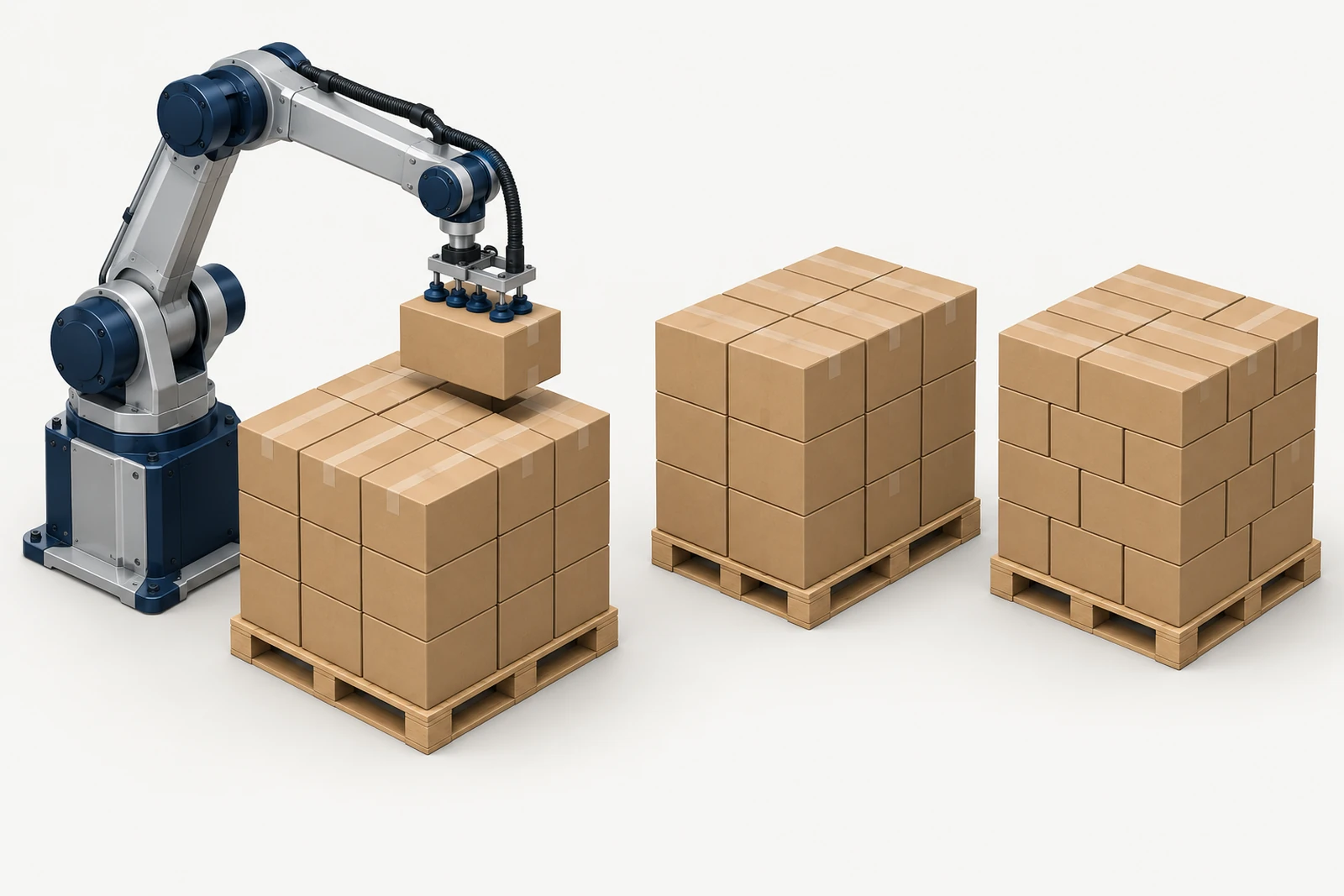
Pallet Stacking Patterns: Column, Brick, Pinwheel and Split-Row Compared
Compare column, brick, split-row and pinwheel pallet patterns by layer interlock, box compression, stability, how a palletizer forms each layer and containment.
Read guide
Packaging Line Layout: Accumulation Buffer Sizing, V-Curve Speeds and Operator Access
Plan a packaging line layout with inter-machine accumulation buffer sizing equations, V-curve station speed balancing, PackML handshakes and floor clearances.
Read guide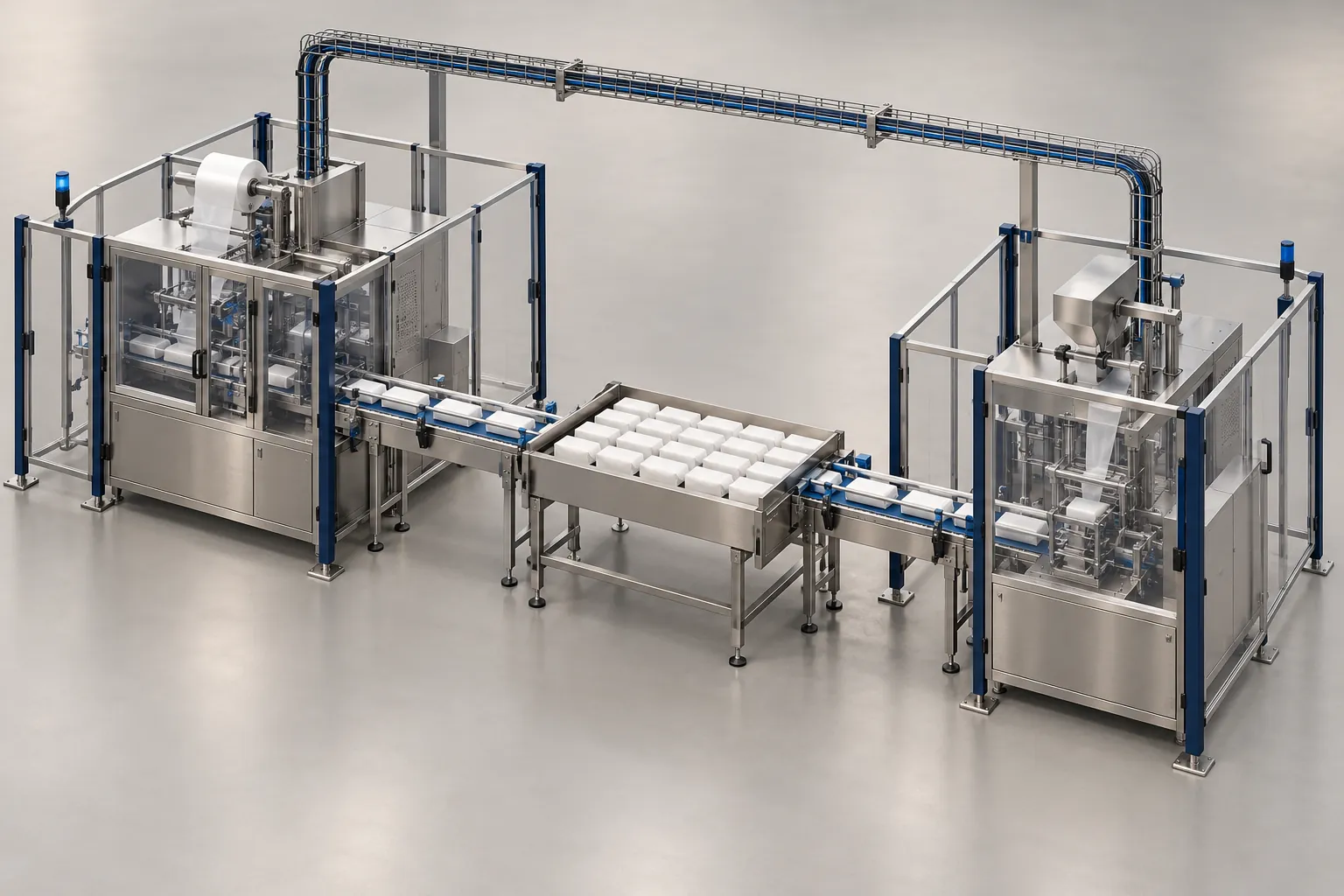
Packaging Line Integration Checklist: Interfaces to Confirm Before Ordering
Checklist of mechanical, electrical, signal, communication, safety and utility interfaces to settle before ordering a machine for a packaging line.
Read guide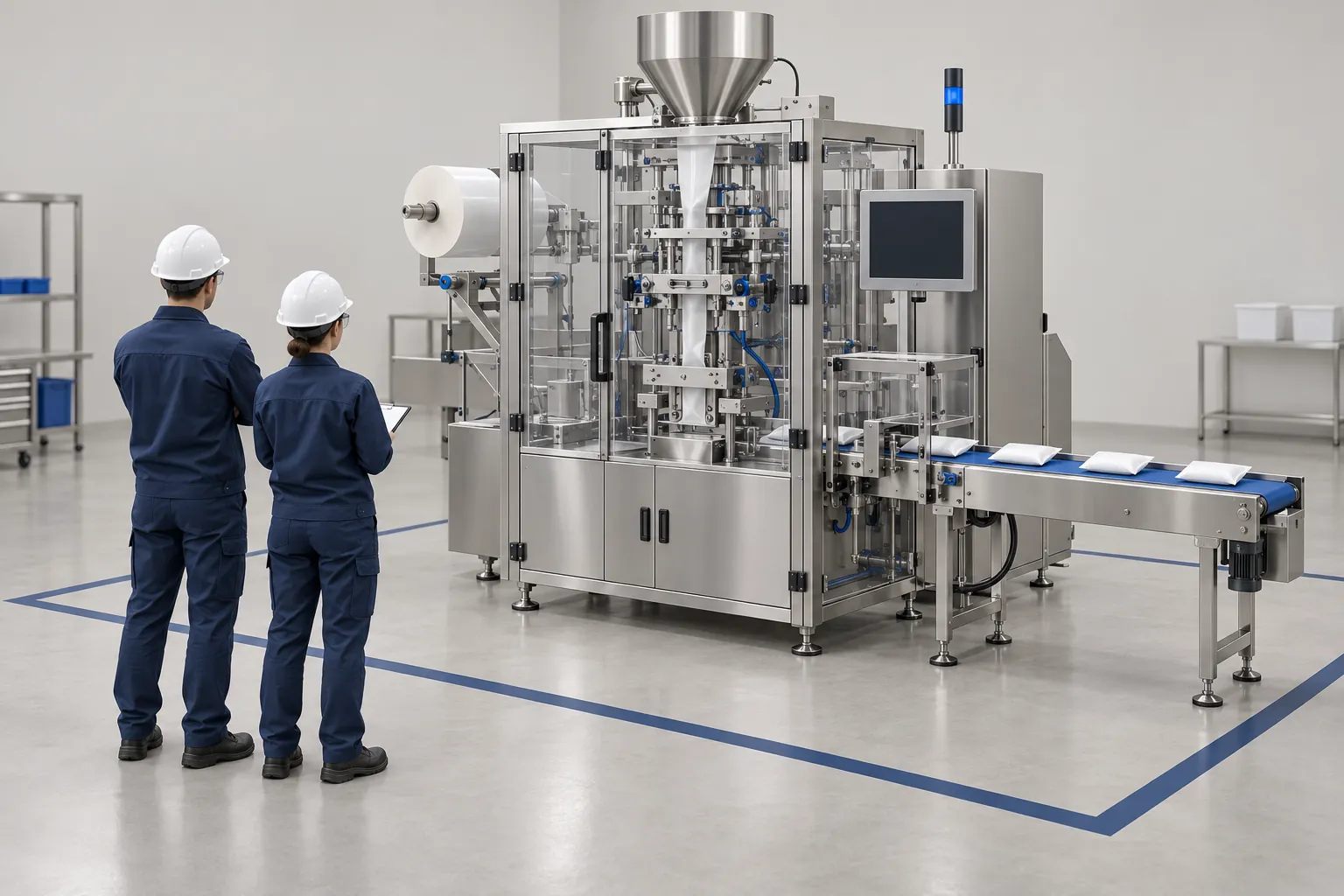
FAT vs. SAT for Packaging Equipment: Defining Acceptance Criteria
Compare factory and site acceptance tests for packaging machines, and learn how to write acceptance criteria that both buyer and supplier can verify.
Read guide